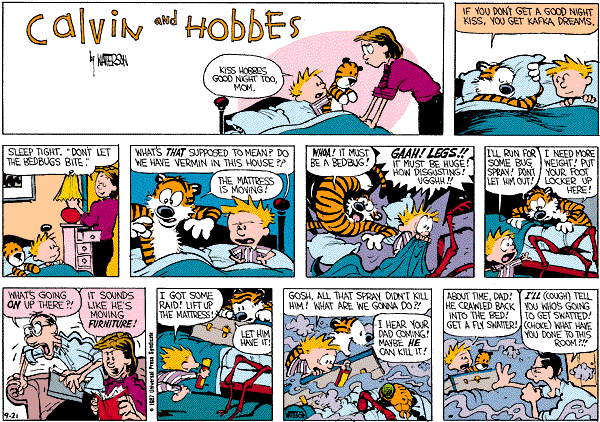
I particularly love that it looks like a giant ant. Kind of like Them with bed bugs instead of ants. How scary would that be?
P.S. Don't actually use Raid on bed bugs, imaginary or otherwise.
CHILDREN’S BOOKS ABOUT divorce—which are unanimously dedicated to bucking up those unfortunate little nippers whose families have gone belly-up—ask a lot of their authors. Their very premise, however laudable, so defies the nature of modern children’s literature (which, since the Victorian age, has centered on a sentimental portrayal of the happy, intact family) that the enterprise seems doomed from the title.It's rather small-minded to claim that books about unhappy, broken families defy "the nature of modern children's literature." More than that, it seems completely untrue. I can think of many books, going back years, that center around families that are not happy and or intact. To choose just one particularly famous example, L. M. Montgomery's books, with their orphans and motherless children, so often focus on the attempt to create such a family where one does not exist. It seems as if, for Flanagan, an awful lot of children's and young adult literature was just never written.
The salient fact of an adolescent girl’s existence is her need for a secret emotional life—one that she slips into during her sulks and silences, during her endless hours alone in her room, or even just when she’s gazing out the classroom window while all of Modern European History, or the niceties of the passé composé, sluice past her. This means that she is a creature designed for reading in a way no boy or man, or even grown woman, could ever be so exactly designed, because she is a creature whose most elemental psychological needs—to be undisturbed while she works out the big questions of her life, to be hidden from view while still in plain sight, to enter profoundly into the emotional lives of others—are met precisely by the act of reading.I loved reading as a teenager. My father used to ground me from reading because my room was a mess or I wasn't doing my math homework and I'd go and hide in my basement, or some corner of my room and read the day away. But I wasn't aware that when I was reading The Son of Tarzan or Deryni Rising I was working out the big questions in my life. I was going on adventures and imagining different lives for myself outside my suburban milieu. I wasn't entering the emotional lives of others but transporting myself. Which seems to me to be an equally valid reason to read. I like to think there's more than one reason for people--yes, even if those people are teenage girls--to read.

 hort stories--I once, somewhat embarrassingly, spent part of a flight to Savannah weeping silently over a story about Linnaeus--but am less wild about her novels. I still like the way she writes about science and history but somehow over the course of an entire book things can start to feel a bit slack. And somehow her novels seem to have less weight than her short stories. I read The Voyage of the Narwhal a few years back and decided I would stick to her short stories. But I was going visiting and needed a book that hadn't been spending time in infestation central, so I picked up The Air We Breathe at the bookstore in Port Authority.
At first I imagined a kind of low-rent, democratic version of Thomas Mann’s The Magic Mountain. As the setting was transposed to America, so the rich patients would be transposed to impoverished immigrants in a public sanatorium. As The Magic Mountain takes place just before the outbreak of World War I in Europe, so I thought this might be set in analogous time, 1916 and 1917, just before the American entry into the war. But the initial conception changed a great deal, even before I started writing.That's an interesting concept. And what Barrett ends up exploring--the ways in which feeling threatened creates a kind of xenophobic group think whether that threat is disease or war--is also something that interests me. But the problem is that she can't really get away from The Magic Mountain and that serves to highlight the fact that she doesn't delve deeply enough into the characters or the social setting. No one is any more fleshed out than they would be in one of her short stories and most of the characters actually feel less fully realized.
Romeo's farewell to Juliet in her bedroom does not occasion a grand pas de deux. Rather, Tudor emphasizes their quite determination to remain together despite what would seem their imminent destruction. In the play, Juliet's haunting thoughts predict Romeo's fate: "Methinks I see thee now, thou art so low, As one dead in the bottom of a tomb." Here we see a Juliet dancing as if drawn with every movement to Romeo's being. And then her closeness centers her. Romeo falls to the floor; Juliet goes to him.
The stage promptly fills with Montagues and Capulets jousting and battling. Tudor gives the large male corps numerous jumps and beats in curious contrapuntal rhythms, and keeps the stage alive and in motion with beating jumps to second position, often in canon. The women's dresses flow this way and that as they kick their legs from one side to the other in pointed jetes and ballottes. They wear headpieces [. . .] and swing their skirts, one arm slung weightily across the stomach; they push into the hips with gliding steps. The whole stage seems to billow like a ship. Occasionally Tudor designed pictures in which several individuals executed different movements at the same time; this activity creates a slightly syncopated atmosphere and at the same time lends definition to different groups of people. The arms and hands were never afterthoughts in Tudor's work, especially not here. He not only used them as part of every movement, but also worked them into the spatial design of the patterns. It was important to Tudor, who had studied character and period dancing, to carry across the mood of an era, in this case the Reniassance style, with its push into the hips and tilt back for the gliding women and its oppositional and erect stance for the men.
A critic in the Daily Telegraph complained that "Renewed acquaintance with 'Judgment of Paris' increases my astonishment that a theme so degraded and so sinister should be sponsored by a philanthropic and educational institution with the Archbishop of Canterbury as Chairman--but maybe this is an old-fashioned view.So it was perhaps more shocking then, although the other critics she quotes appreciated the nasty humor and it's "acrid undercurrent of tragedy" (Lionel Bradley, again quoted by Chazin-Bennahum) more.
Nobody's really done that hoop dance but me. Theres the least amount of movement in that dance! Every gesture is a satire of some other kind of bad dancing and I knew what Antony was satirizing. I became Duncan, of I became some other dance artist. With each one, there was a bad odor.
She was wandering around in a no-man's land, wasn't she an outcast? And something brought her into civilization. And guess what it was. A man? "You've got it."Particularly interesting to me though, was her discussion of the music, "Verklärte Nacht" ("Transfigured Night"). Schoenberg, Chazin-Bennahum explains, got his narrative from a poem by German poet Richard Dehmel (She states that the poem was called "Weib und die Welt" ("Woman in the World") but in fact it is "Verklärte Nacht" and Weib und Welt is the title of the collection it is from). She writes:
The poem, which was printed at the head of the score, tells of a man and a woman walking through a wood at night. She confesses she is pregnant, but her child will not be his, and she is tormented by guilt, as it is he whom she really loves. He comforts her, telling her to cast away her fears and that beccause of his love for her the child will become his. She feels redeemed by his love and forgiveness; as they walk on, the night becomes transfigured.Tudor's story is different, but for me learning the story of the music--and I know nothing about music--added another dimension to that. You can read the poem here. I don't think it's a good translation because I think it reads pretty horribly in English but so it goes. You can also listen to the music here.
 The line was moving quickly. Even better, none of the people there were in my district so while they waited on second lines for their voting booths I just waited for one of the poll workers to fill out a card for me, signed the book, and got right to voting. I'm glad we have these old, easy to use, completely non-electronic machines. My sister and I were talking yesterday about how there's something satisfying about using these machines where you have to move the lever and flip all the little tabs, much more so than there would be if we were just filling in bubbles for an optical scan or tapping a screen for one of those horrible, insecure electronic voting machines.
 A straight democratic ticket:

Tudor instinctively understood the disguises people wear in order to separate their feelings from a certain persona. The Tudor who grew up as William Cook in the East End watching the activity of the West Enders realized that behind the froth and wealth lay real feelings and conflicts.
You can't make a big gesture. It has to be small but it has to be effective, and that means you have to have tension. And that ballet is full of tensions and fluid movements all mixed up one after the other. It's quite an extraordinary ballet in which sometimes you have to show your emotions with your back to the person you're emoting about, or standing side by side without looking at them. You still have to let the audience know what you are feeling.
Tudor felt a particular affinity for the Edwardian period. Although Edwardians questioned established institutions, they knew enough not to disturb their affluent status quo. Edwardian prosperity and glitter, social stability, and spacious ease represented halcyon times before the cataclysm of World War I. Thus Caroline's forced marriage for money and social position represented a perpetuation of ritualized and convenient class choices.
Of course, anything could happen. There are three days left. McCain could still win. And, a drunk man wearing a blindfold could get a puck past Marc-André Fleury.
Yeah, unlikely. It’s a wrap. Fade to black.
After watching a performance of "Dances at a Gathering" [Robbins/Chopin], not for the first time, and being overpowered by all of its qualities, I found myself telling Mr. Robbins what a wonderful piece it was, and confessing that I also would like to bring about a ballet like that. And he simple said, "Why don't you?" The challenge rankled, hovered in the background never quite taking hold but equally never letting go. Then the music arrived--I discovered the chamber music of Dvorak. The sense of belonging was immediate...He also wrote about what I guess I would describe as the tone of the ballet:
From the first entrance of the jeunes filles en fleur with the perfumes and freshness of spring in the air, expanding their lungs and stretching their muscles and their emotional responses, we move through a series of dances until at the last exit we are left with the bittersweet memories engendered by fragrant old rose petals. Every pas de deux should have its share of exaltation and exultation, and carry the presentiments of it being "too good to last."I think it's interesting to think about "Leaves are Fading" at the same time as "Dances at a Gathering" because even though they both clearly traffic in nostalgia, "Leaves" seems to me to be the one more likely to slip into saccharine monotony. The delicate, gentle feeling of the ballet is what makes it lovely, but also, it seems to me, what puts it at risk. I love the way Julie Kent and Marcelo Gomes dance this ballet and they, along with the beautiful Veronika Part, kept me interested.


 They also had Red Delicious apples available, and while they looked very nice I think they're basically a useless apple that is only popular because it ships well to supermarkets, so I skipped out on those.
 All in all, a wonderful trip.
I have seen such portraiture in revivals of “All My Sons” from the Roundabout Theater Company (in 1997) and in particular at the National Theater in London (in 2000), productions that had much of the audience in tears. The preview performance I saw of this one left me stone cold, despite some electric moments from a very fine Mr. Lithgow and Mr. Wilson.Brantley lays this at director Simon McBurney's feet and while I liked the play better than he did, I do agree that there are problems that can be laid at the feet of the director. I've only seen one other thing McBurney directed and that was The Elephant Vanishes a few years back. Based on 3 of Murakami's short stories, it's a very different sort of text than All My Sons what with Murakami's interest in surrealism, fantasy, etc. And while it wasn't without flaws I think it seemed like a more natural fit for McBurney's aesthetic than this did. It seemed like all the flaws in the play--the too-convenient-by-half ending, the speechifying--were highlighted rather than minimized by the stylization. I think that--at least in part-- is what limits the emotional impact of the production. I didn't like the multimedia. The videos of wartime production, etc. made the play even more heavyhanded than it already is. And while for a different play I think I would have liked the actors not "on" sitting visibly to the side, I don't think it was effective for this one.
 I have bedbugs and I'm dealing with this fact with very little equanimity. I mean, I can't believe I've been sleeping with those things.
  If you enlarge that picture you'll actually be able to see that it was coming off in clumps, with the skin still attached. In only a couple of days he looked like this (what you can't see is how his bald spots went all the way down his back and were on his sides, legs, and chest as well):
 After his fur started coming off with skin attached I made a slightly panicked phone call to our lovely veterinarian and then talked to my roommate who is off at vet school. We decided that the best course would be to put him on low level systemic steroids and see if that helped. Thankfully, the hair loss stopped almost immediately and he gradually developed first peach fuzz and then actual fur. And a couple months later, he now looks like this.
 Fortunately he's a great pill taker and steroids are cheap because check out all that fur. While we still don't really know what's causing the hair loss problem, he's back to his normal, handsome self and no doubt much more comfortable. Unfortunately he also seems to have embarked on a bit of a love affair with my camera, so most of my pictures of him come out looking like this.


I don't know if I've mentioned it here before, but my younger brother, who is 18, has Down Syndrome. While I wouldn't say that a candidate's views on people with disabilities are one of my primary concerns, I do pay attention to them and they do matter to me. Talking about Palin in the debate tonight, McCain said:
I'm sure this mention is supposed to appeal to people like me while simultaneously, and more importantly, helping the Republican ticket look particularly compassionate to the general electorate. Taking care of the disabled is one of those things we're supposed to feel all virtuous about, right? But I can't help but resent the way they trot her baby out for political gain.And by the way, she also understands special-needs families. She understands that autism is on the rise, that we got to find out what's causing it and we've got to reach out to these families and help them and give them the help they need as they raise these very special needs children.
She understands that better than almost any American that I know.
I do want to just point out that autism, for example, or other special needs will require some additional funding if we're going to get serious in terms of research. That is something that every family that advocates on behalf of disabled children talks about. And if we have a across-the-board spending freeze, we're not going to be able to do it. That's an example of, I think, the kind of--the use of the scalpel that we want to make sure that we're funding some of those programs.
And he's right. Research costs money. So, too, does special education, for which Sarah Palin cut funding as a governor. I think that's probably a decision she'll come to regret as her own child through school and she sees where all that money goes. In his eighteen years of life my brother has had physical therapists, occupational therapists, and speech therapists. He's had personal aides and been a part of small classrooms. He's gone to special schools. That kind of stuff isn't cheap, and thankfully it is government funded. But parents have to fight for it. They have to know their rights and go in and advocate for their children or get someone else to do it for them. My mother worked as a volunteer parent advocate. Getting these kids into the right educational situation isn't easy.
But again, I want to come back to--you know, notice, every time, Senator Obama says, "We need to spend more. We need to spend more. That's the answer." Why do we always have to spend more? Why can't we have transparency, accountability, reform of these agencies of government?Obama was talking about funding for families with special needs and McCain comes back with the need for transparency, accountability, and reform of government agencies as good alternatives to increased funding? Does he even understand the problem? It's not a lack of transparency and accountability. The exchange didn't exactly fill me with confidence. Let me be clear. I don't think Barack Obama is going to come into office and suddenly improve the situation of people with disabilities throughout the country. I find his general embrace of science to be comforting, but I realize that special education and services for people with special needs are probably nowhere near a priority for him. I wouldn't expect them to be. But he's not the one trotting out his running mate's understanding of "special-needs families"--a phrase I detest, by the way--for political gain. And I don't think a McCain-Palin administration would be helpful either. Actually, given McCain's advocacy for a spending freeze and cuts, cuts, cuts, it could be genuinely harmful.
 A not terribly flattering photo of me
 The trail just hiked.
 Snow and ice coating the alpine grass and rocks.
 Looking toward Lake Placid from Algonquin.
 The view of a snowy Marcy (the big tall one blending into the background) and a number of the other High Peaks.
 Looking over Boundary to Algonquin
 Lake Colden and the Flowed Lands
 This picture keeps rotating 90 degrees counter-clockwise for reasons beyond me.

 The Adirondacks aren't as beautiful as the Catskills come fall because they are only partially covered by deciduous forest so you always have the green of the coniferous forest, but they're still pretty damn lovely.
 Notice the stylish gaiters. When it's not actually freezing out--which it wasn't, at least during the day--mud on the Adirondack hiking trails is as certain as death and taxes and hiking with cold, wet, muddy feet sucks, so they were definitely a good thing to have.