Last Friday I joined the P. Club at a performance of Moving Theater's Armory Show. I was particularly looking forward to this one because I'd never been to the Park Avenue Armory before and was excited to see it (and it was worth the excitement).
Several days later I'm still having trouble thinking of the show as a cohesive whole. But I was certainly interested in all the constituent parts. I particularly liked the way they addressed history and militarism in a space rife with both.
Go here for the Performance Club post and discussion.
Showing posts with label theater. Show all posts
Showing posts with label theater. Show all posts
Sunday, February 21, 2010

Friday, July 17, 2009
Mary Stuart
Sunday was my monthly dinner-and-a-show outing with my grandmother--although this time around we daringly mixed things up and made it lunch and a show. We ate at a Greek restaurant on 42nd that had delicious food. More specifically, good baklava (just so my priorities are clear here).
The acting in Mary Stuart was of that stylish, stylized British variety where the audience gets to sit and watch the actors declaim--beautifully, of course--from the stage. It's a sort of acting that I sometimes like and often dislike, but it works quite well when the focal point of the play is a conflict between two of western history's most famous queens. And it's elegantly written and crafted and feels like it should be so much more powerful than it actually is.
Mary Stuart is about any number of things--power, appearances, penance--but one thing it's not about is history. Which isn't a bad thing or a good thing, per se, but I often feel wary of work that seems intent on using history to speak to the present day. And the modern ambitions of Mary Stuart--or at least this production--seem evident in everything from the set (stark, black brick, wooden benches) to the costumes (the men are dressed in the suits of today, although the women are in Elizabethan-style dresses). Yet for all that the show attempts to drag these characters into the present day, the production isn't doing anything innovative or daring and perhaps as a result it feels stranded between the two eras.
In the end though, I'm not sure if my inability to feel anything more than a kind of detached admiration is based entirely on the play itself of if the book reading ennui I wrote about earlier is in fact a more generalized entertainment ennui. That would be too bad.
Thursday, July 02, 2009
Twelfth Night
Prior to last weekend, I'd never been to Shakespeare in the Park in New York City. I went to the one in Buffalo regularly growing up, but that's pretty different. They use the same set every year, the acting is not particularly good, and you certainly don't have to line up. You just show up kind of early with your lawn chair or blanket and some food and sit on this little slope. At intermission the actors come around collecting donations and while I don't know if it's still there, there used to be an ice cream place nearby in the park and we always made an intermission ice cream run. It's fun and summery and totally laid back.
Getting in line at central park at 6:10 in the morning--and being well back from the front of said line--is pretty much the opposite of laid back. And that's not even taking into account the fact that they have a security guy policing the line and explaining the rules. Which isn't to say that it was a drag or anything. We were right across from a big open space, which was nice.

Right across from our spot in line.
Early in the day the park is full of big dogs running around off leash, and my friend and I had fun watching them play. And there are worse ways to spend a beautiful Sunday then hanging out in Central Park snacking, reading, and playing games. Actually, I can't think of many better ways to spend a Sunday in late June.


Bananagrams
We collected our tickets--our seats were near the back but not too far from the center--and walked over to the farmers market behind the Museum of Natural History to buy lunch. A lunch which included some fantastic strawberries. Then right back to the park where we hung out until my friend's parents met us for dinner and the show.
I'd had a nice day anyway, but the fact that this production of Twelfth Night is as good as it is made it pretty perfect. It was funny and full of music and acted with great humor and clarity. I liked the entire cast. Also, this production, which is rather traditional, does a particularly nice job of balancing the comedy with the more serious aspects of the love and loss in the story. And to be honest, I tend to prefer my Shakespeare traditional, particularly when it's being performed in this kind of setting where people just want to enjoy the show after spending a day in line and out in the sun.
I was surprised at how much I enjoyed the whole day, although it can't hurt that it was such a pleasure just to have a beautiful day after the weather that plagued us for pretty much the entire spring. It's something I'll look forward to doing again (next year).
Tuesday, May 19, 2009
Desire Under the Elms
 My grandmother and I went to our monthly dinner and a show on Thursday. We ate at the sort-of expensive restaurant we sometimes go to when my grandmother can get double air miles by eating there. The food is good enough, but I'm really in it for the apple crisp with cinnamon ice cream. Priorities, right? I mean, that was totally the highlight of the night. And while, admittedly, food is often a highlight for me, the problem here was that I really didn't like the play.
Anyway, it's not that I didn't know that Desire Under the Elms is a depressing play. I knew that. But it's so goddamn stagey. The dialogue, the plot, the way the actors--Carla Gugino excepted--speak . . . it all rings so false and strips the play of whatever power it might have. And the staging and set seem calculated to make the play feel less dated, but it doesn't really work. Mostly the set looks expensive and attention grabbing. Granted, it helps create a feeling of claustrophobia and heaviness, but I'm not sure it's necessary to have a giant house hovering above the stage to create that feeling. I don't know, the play as a whole wound up feeling kind of bland and tiring to me. Tedious, even.
It was one of those nights where you sit in the theater thinking what am I doing here and why are they reviving this instead of doing something new. And that's never a good feeling. Sure, Gugino is fantastic. But I would have preferred to see her be fantastic in something else.
Tuesday, March 10, 2009
Chautauqua!
This past Friday I went to see Chautauqua! with Performance Club. I enjoyed it quite a bit. Others did not. There's a lot of discussion going on over at Claudia's discussion post on the WNYC blog. All of it far more interesting than what I could come up with on my own to post here.
I will say that I think my unfamiliarity with downtown performance--and really with performance in general--definitely causes me to miss things but probably also, at times, allows me to enjoy things that people who've seen more don't because it's still all new to me. It's been a lot of fun to discover things that are new to me.
I will say that I think my unfamiliarity with downtown performance--and really with performance in general--definitely causes me to miss things but probably also, at times, allows me to enjoy things that people who've seen more don't because it's still all new to me. It's been a lot of fun to discover things that are new to me.
Monday, February 16, 2009
The Winter's Tale
I'm not really sure what the thinking behind The Bridge Project's production of The Winter's Tale was. Let's solve this bifurcated play by making it completely schizophrenic? I can understand the desire to move Shakespeare's plays forward in time, but I'm not sure it's so effective when you have a classical setting complete with a statue that comes to life a la Galatea. And then to take the second act, different enough as is, and insert a folk-singing, anachronistic Ethan Hawke among our frolicking shepherds and nobility in disguise the former of whom perform bawdy dances with balloons? It's like Mendes looked at the play and figured, "Well screw it. It's not exactly Shakespeare's best work so why even bother trying to create a cohesive theatrical experience?"
If that's the case, I don't entirely disagree. It's definitely not one of Shakespeare's masterpieces. In fact, it's not really that good a play at all. You might as well try to do something with it. I'm just saying, maybe pick a thing instead of doing all different things and making it seem even less like one piece than it already does.
Sunday, February 01, 2009
On Books and Other Miscellany
With all the eulogizing of Updike this week I've been forced to think about the fact that I've only read half of one of his books (Rabbit, Run, assigned reading for a 20th century American lit course) and, quite frankly, decided that was more than enough. How convenient then, that there's a recent post on The Millions about glaring gaps in the reading of the contributors. The most interesting part of that post to me--and, seemingly, to a number of critical commentors--is this:
When it comes to playing readerly "I Never," there are rather a lot of burly man-authors, chiefly twentieth-century man-authors, whose work I've never read. Hemingway (other than the 4 page story "Hills Like White Elephants"), Kerouac (a bit of his poetry; enough of On the Road), Roth, Updike, Kesey, Heller, Burroughs, Cormac McCarthy, Vonnegut, Pynchon, Moody, and Foster Wallace all fall into the category of authors I haven't read. Many of them fall also into the category of authors I have no interest in reading. Perhaps it is that I intuit (or imagine - not having read them, it is hard to say) a masculinist, vaguely misogynist aura that has put me off; Or, as in the cases of Pynchon and Foster Wallace, a virtuousic formal complexity or grandiose heft, that I also associate with the masculine artistic mind. [ . . . ] Well-founded, my prejudices certainly are not, but I do not apologize for them or intend to renounce them.
Well, I've read at least a bit of a bunch of those writers over the years--Roth (The Plot Against America), Vonnegut (Breakfast of Champions), Pynchon (Crying of Lot 49 aka the short one), Kesey (One Flew Over the Cuckoo's Nest), Heller (first 70 or so pages of Catch-22), Kerouac (On the Road)--and I can't say grouping them together makes a whole lot of sense to me. But despite that, I tend to think, good for her. If reading something doesn't give you pleasure on some level, why bother? If the idea of reading a book doesn't particularly interest you why pick it up when there are so many other good books that do interest you?
Personally, I tend to at least try to read everything and then just give up part way through if I'm disinterested. Which is usually pretty quickly. I never even made it to the crime in Crime and Punishment. And I recently told my cousin I would read A Confederacy of Dunces but I've stalled out a couple chapters in and really might as well return it to the library. It might actually serve me better to just skip these books I don't have much interest in reading in the first place and am only looking at because of some misguided idea that I should read them. Food for thought.
Various notes:
According to the New York Times there's going to be a new advertising campaign aimed at getting locals to go to more Broadway shows. My suggestion? Find a way to lower the ticket prices. Significantly. I don't know how they should do it--hey, it's not my job to get people to the theater--but they should find a way. Because the prices are just too high.
I broke a mirror last night. I'm not superstitious, but I was put out since it's my roommate's mirror. I've never liked it much at all, but I still feel guilty. I've been such a klutz lately. In the last month I've broken two glasses and now this.
Somehow I ended up with plans to go to my grandparents house this evening to watch the Super Bowl with family. I've watched approximately 0 minutes of football this year, but I read Margee's Girls Guide to Choosing Your Super Bowl Team (Part I, Part II) over at SportSquee, so I figure I'm set. Right?
Wednesday, January 21, 2009
The Cherry Orchard
I think BAM's Bridge Project is an interesting one. Not so much because I care about the differing performing styles of British and American actors or anything like that--frankly I don't know enough about acting styles to know what difference it makes--but because it's an opportunity to see good (or in the case of some, like Simon Russell Beale, great) actors in new productions of classic plays. And hopefully some of those productions will be fantastic.
The Cherry Orchard was more good than fantastic. The performances ranged from good to excellent, but the direction was heavy-handed at times, which really wasn't necessary. The play is from 1904. You don't really have to be particularly knowledgeable about history to realize that the changes that occur in the play are related to much bigger changes down the road. So the overdone foreshadowing seems entirely unnecessary. I also wasn't in love with the set, which didn't really provide a sense of place for the most part. It seemed like it could be anywhere.
What you end up with is a nice looking production (the costumes, in particular, are gorgeous, although I'll cop to a general fondness for clothes from that era) that's well acted and funny where it's supposed to be funny and tragic in its characters inability to cope with the world as it is. All the boxes have been checked, I guess you could say. And yet in the end it doesn't become transcendent in the way that great theater can.
Monday, January 19, 2009
The Shipment
This was one of the January shows for Claudia LaRocca's Performance Club. It was something I never would have wound up going to on my own. I would have (possibly) read the review in the times, thought oh, that sounds interesting, and then gone back to reorganizing my kitchen cabinets or whatever and never gotten around to actually getting a ticket. I have motivation issues. But knowing that I'll have the opportunity to talk about what I've just seen with other people is exciting and makes attending things so much more fun.
Last month I was a bit nervous because so many of the people are involved with performance as as more than just a sometime audience member and so very much more knowledgeable than me. But everyone's been so nice and easy to talk with that it was soon clear my worries were misplaced. Instead, I feel like I'm expanding my performance-viewing horizons while learning from other people and having a really good time. So it's basically a win-win-win situation. And on top of that, I've genuinely enjoyed both things I've gone to so far, which certainly isn't necessary, but it a plus.
But about The Shipment. I've been trying to think about what exactly I have to say about it. Or rather, how I can organize my thoughts about it well enough to write about it in a cohesive, worthwhile way. As much as I enjoyed it, I'm still turning it over in my head (a good thing, no?). The cast was wonderful and the show itself definitely made me think about my own preconceived notions of race but also about my own discomfort with talking about race in anything other than a politically correct way. I didn't think everything worked equally well, and I'm not sure how to interpret some things, but other things really intrigued me, particularly in the way Lee raised questions about how our expectations and preconceptions influence media representations of African Americans and vice versa?
Monday, January 12, 2009
August: Osage County
Damn what a long and overstuffed play. And you know, I get that functional families are, generically speaking, less interesting than dysfunctional ones. Still, it seems a bit much. Watching the play is kind of like being bludgeoned while someone stands around telling you jokes. It seems appropriate that there t-shirts on sale in the lobby with lines from the play like, "You have to be smart to be complicated." After all, it's the quips that count in this one.
And hey, if you go to the Web site you can totally play a find-Mom's-pills game!
Tuesday, October 21, 2008
All My Sons
I actually saw this a couple weeks ago and just haven't had a chance to write about it. I'm sitting and waiting for the exterminator to show up now though. I probably should be mopping my floors, but couldn't bring myself to do it in addition to everything else I've done today, apartment-wise. I hope they come soon though, because after they do their thing I have to stay out of the apartment for four hours and I'd really like to get back in fairly early so I can start the ice cream making process.
But anyway, the play: I thought it was OK but nothing more. Katie Holmes managed not to embarrass herself, I suppose, although she lacks the ability and theatrical presence of her costars like John Lithgow and Patrick Wilson. She doesn't really project. But she wasn't laughably bad, so there you have it.
In the New York Times review Ben Brantley writes:
Give McBurney this though, it's not boring. And Lithgow and Wilson were marvelous--the scenes between them worked. So that was enjoyable.
But anyway, the play: I thought it was OK but nothing more. Katie Holmes managed not to embarrass herself, I suppose, although she lacks the ability and theatrical presence of her costars like John Lithgow and Patrick Wilson. She doesn't really project. But she wasn't laughably bad, so there you have it.
In the New York Times review Ben Brantley writes:
I have seen such portraiture in revivals of “All My Sons” from the Roundabout Theater Company (in 1997) and in particular at the National Theater in London (in 2000), productions that had much of the audience in tears. The preview performance I saw of this one left me stone cold, despite some electric moments from a very fine Mr. Lithgow and Mr. Wilson.Brantley lays this at director Simon McBurney's feet and while I liked the play better than he did, I do agree that there are problems that can be laid at the feet of the director. I've only seen one other thing McBurney directed and that was The Elephant Vanishes a few years back. Based on 3 of Murakami's short stories, it's a very different sort of text than All My Sons what with Murakami's interest in surrealism, fantasy, etc. And while it wasn't without flaws I think it seemed like a more natural fit for McBurney's aesthetic than this did. It seemed like all the flaws in the play--the too-convenient-by-half ending, the speechifying--were highlighted rather than minimized by the stylization. I think that--at least in part-- is what limits the emotional impact of the production. I didn't like the multimedia. The videos of wartime production, etc. made the play even more heavyhanded than it already is. And while for a different play I think I would have liked the actors not "on" sitting visibly to the side, I don't think it was effective for this one.
Give McBurney this though, it's not boring. And Lithgow and Wilson were marvelous--the scenes between them worked. So that was enjoyable.
Monday, June 16, 2008
Top Girls
 I really ought to have read this one before going to see it. And what's more, I'm familiar enough with Caryl Churchill's work that I should have known I should have read the damn thing first. Oops.
The themes of the opening act emerge only gradually, through the hubbub of non-sequiturs, characters talking over one another, and Marisa Tomei's accent. Why are these accomplished women all so unhappy? Again and again, they come back to their lost children, their need to leave home, to be different or leave the strictures of womanhood behind. Everyone but Patient Griselda wants something more, something different from that which most women of their time have. And in seeking it--in desiring it in the first place--they're unhappy.
In the later acts we're not in this surreal world with famous figures in the past but instead looking at the work and family life of a modern career woman--or what was a modern career woman when the play was written in the 80s. It's a critique of a certain kind of feminism--one that's more self-oriented as opposed to community-oriented. It feels a bit dated to me, and also distinctly British in the way it dwells on class issues and how they relate to feminism. It could just be, though, that Churchill's politics are not my own.
Still, it's a smart play and an interesting one, not to mention fantastically acted.
Wednesday, May 21, 2008
Cat on a Hot Tin Roof
 I went to see this with my grandmother last week and am only now getting around to writing about it. It was a production I liked, but didn't love. And given that they're charging an arm and a leg for it one wants it to be fabulous. Instead, at times it feels flat, or at the very least as if the characters are not fully embodying their roles.
Terrance Howard, who plays Brick in this production was out in the show I saw and his understudy, while inoffensive and nice to look at, also wasn't terribly convincing. Anika Noni Rose is convincing as Maggie--although she was hard to hear/understand at times--and it lent the first act a bit of an unbalanced feeling. That wasn't too troubling though because Rose's Maggie is so captivating and intense a character that I didn't really think too much about Brick. The problems occur when Rose is offstage. She's pretty much providing all the fire in this production and no one else is nearly as galvanizing.
The moment Phylicia Rashad walked onto the stage the audience burst into applause, which I hate. No one's applauding her for the performance--it hasn't happened yet--and no one's applauding the character. They're just applauding Rashad for existing and stepping onto the stage. And there's a certain smugness to it all: we recognized this actor, we're in the know, we're going to applaud. I think it takes away from the actual work being done before us. That's a side note though. Far more problematic is the fact that I hated her portrayal of Big Mama. I'm not the biggest Phylicia Rashad fan; I've seen her in plays before and found her less then enjoyable. Nevertheless I was disappointed in the fact that Big Mama, as she plays her, is basically a caricature. It doesn't do justice to Tennessee Williams' writing.
 James Earl Jones--subject to his own hearty applause upon entrance, of course--is not a caricature, but he's also not terribly interesting. The New York Times writes:
Mr. Jones is forced to play his character as a blustery but affectionate fellow whose vulgarity masks a good heart, not so different from the lovable codger he recently portrayed in “On Golden Pond.”It's very true that the character is very like the one he played in On Golden Pond. There's not much sharpness to him and it takes a lot of the bite out of the play.
The audience was so loud that I actually missed bits in the beginning of the second act. We were sitting near a large group that had traveled to the city to see the show and the women behind us were basically holding a conversation a couple minutes into the act. Given that one of them had spent the end of intermission obliviously whacking both my grandmother and me in the face with her scarf I was fairly irritated. People were also eating some kind of chips or snack mix our of those loud crinkly bags. I'm really not the fussiest theatergoer but I do think it would be nice if people followed basic theater etiquette.
I've made this sound like a miserable experience though and that wasn't the case. It's a brilliantly written play and the production wasn't terrible, just tending toward the dull when Rose wasn't there enlivening it.
Saturday, February 23, 2008
Grace
 At least the actors were good. Grace is about an atheist--named Grace, of course--and her struggle to deal with her son's desire to become an Episcopalian priest. Dealing with it apparently means constantly haranguing him about the evils and illogic of religion in a thoroughly shrill and unpleasant way.
I'm not a religious person; I don't believe in God or have a whole lot of patience for organized religion. I think it does more harm than good and is, well, illogical. So in theory I should have had quite a bit of sympathy for Grace. In reality, whenever she went on one of her tirades and/or argued with her son I wanted to stab myself in the ears with my knitting needles.
It's not only that Grace is such an unpleasant character though. It's that she doesn't have anything particularly interesting or insightful to say. Nor does her son, for that matter. One family member wants to live her life by the rules of logic and the other is following a path which even he can't explain logically. There's an good play to be made of that. Unfortunately this wasn't it, and that's mostly due to the laziness of the writing.
There's an overly fussy structure to the play where important things happen off stage, as if it's too much effort to actually show us the interesting bits. What's more, the characters don't seem to have any thoughts that haven't been expressed more eloquently time and time again. At one point the son uses the Matrix as a metaphor. At another point his fiance, Ruth, listens to Ani Difranco's "Untouchable Face" and then explains to Grace that sometimes it's easier for her to use other people's words. Easier for the playwright as well, I imagine, but it sure as hell isn't interesting or illuminating for the audience. I mean, when I was about 15 I loved that song and Ani Difranco--after all, she's pretty much the patron saint of angry teenage girls--but it's not exactly an effective use of her music.
In the end the play takes an interesting topic and doesn't do much of anything with it. The whole thing feels rather thin and convenient. The characters aren't fully realized and so the moments of emotional catharsis leave you cold and the closure they achieve at the end doesn't feel earned. That could be partially excused if the ideas presented in the play were enough to hold it together. Instead though, we're left with regurgitated cliches presented in an uninteresting manner. So really, what's the point.
Sunday, January 20, 2008
Happy Days
 I read a couple good reviews of the production of Happy Days and I loved the production of Medea with Fiona Shaw and directed by Deborah Warner that was in New York a few years ago, so I figured I'd brave Beckett to see it (I'm totally intimidated by Beckett plays, you see).
I'm glad I decided to go, because it was wonderfully done. Much has been made of the set, which looks like the rubble of a bombed out city. It's a landscape in which it doesn't seem possible for life to survive. And you have to wonder, while watching, if the life there really is worth living. That question doesn't seem to be at the forefront for the determinedly cheerful Winnie. There's not much to do and her husband is barely a presence, yet she has developed a routine to stave off the tedium of her situation and maintains an absurd cheerfulness. There are moments when the difficulty of the situation becomes overwhelming, but these moments are quickly brushed aside.
Ah well, natural laws, natural laws, I suppose it's like everything else, it all depends on the creature you happen to be. All I can say is for my part is that for me they are not what they were when I was young and . . . foolish and . . . (faltering, head down) . . . beautiful . . . possibly . . . lovely . . . in a way . . . to look at. (Pause. Head up) Forgive me, Willie, sorrow keeps breaking in. (Normal voice.) Ah well what a joy in any case to know you are there, as usual, and perhaps awake, and perhaps taking all this in, some of all this, what a happy day for me . . . it will have been. (Pause.) So far.Winnie's talking is a way to fill emptiness, to ward off the sorrow. It's only effective up to a point. The illusion can be maintained when Willie is present and visible to Winnie. But when deprived of human contact it collapses.
Shaw is a fantastic, at times manic, presence and carries a play that I imagine must depend almost entirely on its actress for success beautifully. For that alone, the play is worth seeing. But there are also brilliant lines and poignant moments and on the whole, I found it rather fascinating. I still find Beckett . . . forbidding, I guess. I'm not quite sure how to think of him. But I'd go to see more.
Saturday, September 15, 2007
The Seagull
I've been quiet here this week, I know. It hasn't been intentional. Just busy, shockingly enough. And not, for the most part, with stuff that makes for interesting posts. Unless you really want to read about my doing dishes and going to the bank? No? Didn't think so. Which is fine by me, because I sure as hell don't want to write about it.
 I went out to Brooklyn to see the Royal Shakespeare Company perform The Seagull at the BAM Harvey Theater. I'd been there once before, to see Play Without Words, and I like the theater for it's peeling paint and feeling of semi-genteel disrepair. It feels very typically Brooklyn to me. Less enjoyable are the stools one sits on in the balcony. They do have footrests, and they're fine generally, but when you're watching a long play like The Seagull they quickly grow uncomfortable.
I almost never get out to Brooklyn so I really don't know my way around. I was feeling pretty good though, because the BAM website gives very specific directions (bless them) and I'd written those directions down. Then I miscalculated the number of stops it was to the Atlantic station, became absorbed in my book, and missed my stop. And in that part of Brooklyn there's a whole lot of space between stops on the D line. So it took me forever to get there, when it really shouldn't have taken long at all. Oh well.
 The only version of The Seagull I'd seen before was "inspired by" the Chekhov play and retitled Drowning Crow. As I recall, it followed the plot pretty precisely, but was set in South Carolina's Gullah Islands and explored the African-American experience. Stripped of the humor and pathos, complexity and nuance, beauty and poetry, that Chekhov imbued the play with, as it was, the story itself isn't necessarily something anyone would want to watch. In short, it was awful.
So I was excited to see the RSC do it. I know they're not slavish followers of the text, afraid to put their own interpretation on things--the only previous time I saw them, they were doing a very interesting version of Hamlet--but I figured they also wouldn't be trying to reinvent the wheel. And, while this production of The Seagull is played for laughs a little too often to match the platonic ideal of the play that I have in my head, it was certainly a great deal closer.
The acting was excellent, as could be expected. I also kept getting distracted by the costumes. Not that they were anything special, just that I really like the clothing from that era. It was also interesting to see the different audience reactions to the play. On one side of me I had a guy who was so engrossed that he was watching with his mouth hanging open, and spent the intermission talking animatedly about the play to the woman who was there with him. On the other side I had three people who left during the intermission. I was tired and uncomfortable which made me less attentive than I might otherwise have been, but over all I'm glad I went.
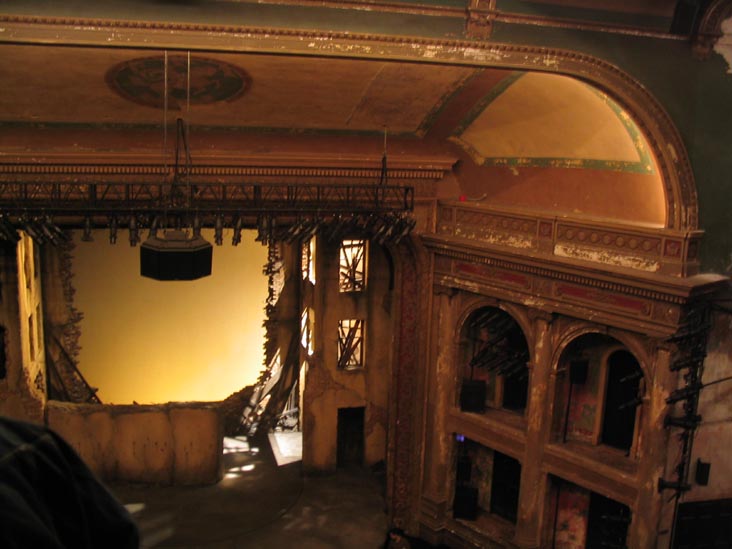 I went out to Brooklyn to see the Royal Shakespeare Company perform The Seagull at the BAM Harvey Theater. I'd been there once before, to see Play Without Words, and I like the theater for it's peeling paint and feeling of semi-genteel disrepair. It feels very typically Brooklyn to me. Less enjoyable are the stools one sits on in the balcony. They do have footrests, and they're fine generally, but when you're watching a long play like The Seagull they quickly grow uncomfortable.
I almost never get out to Brooklyn so I really don't know my way around. I was feeling pretty good though, because the BAM website gives very specific directions (bless them) and I'd written those directions down. Then I miscalculated the number of stops it was to the Atlantic station, became absorbed in my book, and missed my stop. And in that part of Brooklyn there's a whole lot of space between stops on the D line. So it took me forever to get there, when it really shouldn't have taken long at all. Oh well.
 The only version of The Seagull I'd seen before was "inspired by" the Chekhov play and retitled Drowning Crow. As I recall, it followed the plot pretty precisely, but was set in South Carolina's Gullah Islands and explored the African-American experience. Stripped of the humor and pathos, complexity and nuance, beauty and poetry, that Chekhov imbued the play with, as it was, the story itself isn't necessarily something anyone would want to watch. In short, it was awful.
So I was excited to see the RSC do it. I know they're not slavish followers of the text, afraid to put their own interpretation on things--the only previous time I saw them, they were doing a very interesting version of Hamlet--but I figured they also wouldn't be trying to reinvent the wheel. And, while this production of The Seagull is played for laughs a little too often to match the platonic ideal of the play that I have in my head, it was certainly a great deal closer.
The acting was excellent, as could be expected. I also kept getting distracted by the costumes. Not that they were anything special, just that I really like the clothing from that era. It was also interesting to see the different audience reactions to the play. On one side of me I had a guy who was so engrossed that he was watching with his mouth hanging open, and spent the intermission talking animatedly about the play to the woman who was there with him. On the other side I had three people who left during the intermission. I was tired and uncomfortable which made me less attentive than I might otherwise have been, but over all I'm glad I went.
Thursday, August 30, 2007
I love dysfunctional alcoholics! Really.
 Went with my grandmother last night to see 33 to Nothing, which is at a theater near my apartment called the Wild Project, which is an "eco-conscious" theater. Taking place in real time, the play shows us the rehearsal of a band falling apart.
I certainly wasn't expecting the play to be what it was. Thank you for that, TONY. When you describe a play as "adorable," I somehow don't expect it to center on a narcissistic alcoholic. At no point during this did I think, oh, how cute! Adorable is puppies, and children who are seen but not heard, not drunkards.
Anyway, I thought the music was a bit two Coldplay for my tastes, the acting was uneven, and the play was a bit too centered on the lead singer/alcoholic/least functional member of the band, leading to the other characters not being well fleshed out. That said, while the conflict between the band members is hardly original it is believable, and the dialogue is clever and entertaining.
Friday, August 17, 2007
Schiele
 Egon Schiele was an Austrian artist and protege of Gustav Klimt. Controversial due to his paintings of young girls--and alleged relations with them--he was jailed for seducing a girl under the age of consent in 1912. The charge was eventually dropped, but he was found guilty of exhibiting erotic art in a place where children could see it. He was known for his twisted, expressionist figures. Schiele died in 1918 at the age of twenty-eight in the influenza epidemic.
His paintings are sexual in an at-times-discomfiting manner. The bodies are distorted, the gaze sometimes voyeuristic. In the brochure for their 1997 exhibition of his work the MoMA wrote:
The very aspects of Schiele's art that precluded its popularity during much of his lifetime--ugly distortion in place of accepted notions of beauty, unveiled eroticism, and personal angst--are those for which it is considered most compelling today.
 His work is simultaneously a product of its time and modern feeling. Although he enrolled in the Vienna Academy of the Fine Arts, he eventually dropped out, disillusioned by their traditionalism. He was mentored then by Klimt, who was an established artist in Vienna at the time, although his art is of a different school than Klimt's. ArtAndCulture.com writes:

Klimt and Schiele's friendship created a bridge between nineteenth-century Symbolism and twentieth-century Expressionism. Symbolism, in its search for a subject matter based in the emotions, dreams, and the subconscious, had discovered a new set of icons. Chief among them was the femme fatale, an archetype of eroticism and mysticism. She appears frequently in the work of Klimt and Edvard Munch, where her figure is a combination of erotic allure and morbid repulsion. Schiele and other Expressionists picked up on this theme but made it more personal, exploring the psychological conflicts inherent in desire, and using more violent pictorial means to convey the body’s painful wrenching at the hands of both Eros and Thanatos.
 Not then, an easy sort of art but the type that is challenging and exposing. A tangled set of emotions exposed through painting and drawing.
I'd never heard of him before today, but I went to a play about him this evening with a couple of my uncles and aunts plus a cousin that was part of The American Living Room 2007 at Here. They're showing super brief runs of plays (2 days) and this one was put on by the Human Company. The air conditioner in the theater was broken and it was very hot and hard to breathe. I can't imagine what it must have been like for the poor actors who were under the lights. Despite the discomfort though, it was a very interesting play.
Schiele interweaves dance and music. This is most effective at times when the actors go through a series of repetitive motions, grasping the edges of their chairs as if in fear, reaching forward with both arms and to the side with one as though imploring someone who is present only in spirit, and so on and so forth.
 The play focuses largely on his relationships with three women: his mistress, his sister, and the girl who caused him to go to jail. I series of vignettes, the goal is certainly not realism. There is a master of ceremonies, but at points the actors also break the fourth wall, handing out chocolates to the audience and addressing them directly when speaking of things they are guilty of. While not traditional in its approach, it avoids the use of technology--which I think more often than not has a distancing effect, although it sometimes works--and succeeds in creating a consistently interesting play that discusses big concepts while also remaining completely human and grounded.
Thursday, March 29, 2007
Prelude to a Kiss
My cousin and her fiancée were in town briefly so I went out last night with them and my grandmother, who is very excited at the prospect of adding a new granddaughter to the family. Narrowly avoiding eating at Applebees (because there's seriously no reason to eat there when you live in New York) we had a very nice dinner. She wanted me to choose the restaurant which I wasn't really prepared to do. I don't really know the Bway/Times Square area that well so I can't pick restaurants off the top of my head. The only place I could think of was Saigon 48--which is very good, and very cheap should you be in the area--but I couldn't remember its location. I'd forgotten the 48 bit of the name. We ended up eating at West Bank Cafe which was just expensive enough that I wouldn't have suggested it myself for fear of imposing. My grandmother would never say no, so I try not to put her in a position where she might. It was great though--particularly the desserts--so I'm very glad we went there instead of Applebees.
 I knew nothing about Prelude to a Kiss and hadn't really had a particular interest in seeing it, although I also wasn't disinterested. It's kind of Freaky Friday except the body switchers aren't related and one of them doesn't immediately want to switch back. Anyway, it's decidedly mediocre and I imagine that there are two reasons it's been popular: a) It stars the guy who played Frasier Crane's father b) it's got a happy ending which the old ladies around us seemed to appreciate quite a bit.
Less appreciative, was the forty-something year old man sitting behind us. At one point the young and fairly freaked-out groom kisses Frasier's Daddy who is really his wife in another body. He loves his wife and it makes total sense for him to do this in the context of the play. Furthermore, it's not exactly the kind of kiss that leads to people jumping into bed sans clothing and getting down to business. But clearly these things didn't matter much to forty-something who said, "Ewww," so loudly that half the theater must have heard him. Seriously? What are you, seven? Grow up. Probably some tourist from Omaha. I certainly hope so anyway.
Saturday, March 24, 2007
Journey's End
It seems to be grandparents week here, as yesterday was my monthly dinner and a show date with my grandmother (different grandmother than I saw earlier in the week). We ate at a rather expensive Indian restaurant we've been to before. The service is better than the places on 6th street and the food is served on nicer dishes, but frankly it's not worth paying 4 times more. Particularly when my grandmother insists on getting appetizers and desert and whatnot.
Journey's End has gotten great reviews but apparently those haven't translated into great ticket sales because the theater was far from full. That was good for us though because it meant our seats got upgraded quite a bit. We always go for the cheap seats--although granted it's all relative on Broadway--so it's a nice surprise to be moved up to the somewhat less cheap seats. Between that and the fact that it was a very good play, it was obviously an evening meant to go our way. My grandmother got to make her, "Bush should be forced to watch this again and again until he learns something," comments and I think that only added to her day. It seems to make her happy any time she can insult the louse. At the same time though, I always have to suppress a laugh at the idea she seems to have that reading something or seeing a play could possibly change him. Thinking about it more closely though, I think it's a sad thing if such works can't change people.
I was particularly interested in seeing this one because I have a bit of a thing for World War I. I don't mean that I know a lot about the history or anything. But I love poetry and novels about the war. I wouldn't say that I'm an outright pacifist, but quite close, and it's partially because of reading this stuff. I remember reading All Quiet on the Western Front when I was quite young and certainly that played a role, but mostly I think it was the War Poets first: writers like Wilfred Owen, Siegfried Sassoon, Isaac Rosenberg. (Their poetry is available here.) Sassoon's "A Soldier's Declaration" was also an influence because it forced me to look at what I'd always thought of as--and been told was--a "good war" in another light.
I think it was Pat Barker's Regeneration that did me in, though. This scene in particular, although it may not seem significant out of context. I don't know. Rivers is a doctor treating shell-shocked soldiers in a military hospital, and David Burns is a former patient whom he goes to visit. He finds Burns to remain quite unwell. While he's visiting, there's a storm.
Rivers goes out into the storm to look for Burns, and is unable to find him in the town. Directed by a woman also out in the rain, he walks along the edge of a tidal river, surrounded by marshy land, toward a tower he'd been to earlier in his visit.
Now, I wasn't so naive that I didn't know about Post-Traumatic Stress Disorder, or that war had mental and emotional consequences for the soldier. But it's one thing to hear about it or read about it, and another entirely for a piece of writing to allow you to truly form a picture of such a thing in your mind. And it was from reading things like this that I came to feel that war was beyond the realm of what should be acceptable in our lives.
So I suppose that literature had the effect on me that my grandmother wishes it could have on someone like Bush. The power of fiction, whether Regeneration or Journey's End is that it allows us to expand the boundaries of our understanding--to a certain extent--past that which we actually know. And while I've always rolled my eyes and thought it fairly ridiculous when someone says a song or a book, "changed [their] life," I do think such things can have a cumulative effect on a person's outlook, if they're willing to let it happen.
Journey's End
 has gotten great reviews but apparently those haven't translated into great ticket sales because the theater was far from full. That was good for us though because it meant our seats got upgraded quite a bit. We always go for the cheap seats--although granted it's all relative on Broadway--so it's a nice surprise to be moved up to the somewhat less cheap seats. Between that and the fact that it was a very good play, it was obviously an evening meant to go our way. My grandmother got to make her, "Bush should be forced to watch this again and again until he learns something," comments and I think that only added to her day. It seems to make her happy any time she can insult the louse. At the same time though, I always have to suppress a laugh at the idea she seems to have that reading something or seeing a play could possibly change him. Thinking about it more closely though, I think it's a sad thing if such works can't change people.
I was particularly interested in seeing this one because I have a bit of a thing for World War I. I don't mean that I know a lot about the history or anything. But I love poetry and novels about the war. I wouldn't say that I'm an outright pacifist, but quite close, and it's partially because of reading this stuff. I remember reading All Quiet on the Western Front when I was quite young and certainly that played a role, but mostly I think it was the War Poets first: writers like Wilfred Owen, Siegfried Sassoon, Isaac Rosenberg. (Their poetry is available here.) Sassoon's "A Soldier's Declaration" was also an influence because it forced me to look at what I'd always thought of as--and been told was--a "good war" in another light.
I think it was Pat Barker's Regeneration that did me in, though. This scene in particular, although it may not seem significant out of context. I don't know. Rivers is a doctor treating shell-shocked soldiers in a military hospital, and David Burns is a former patient whom he goes to visit. He finds Burns to remain quite unwell. While he's visiting, there's a storm.
The more Rivers thought about Burns sitting alone in the kitchen, the more he thought he ought to get up. The sounds of the storm had now been joined by running footsteps. He wouldn't find it easy to sleep again anyway.
.......The kitchen was empty and didn't seem to have been disturbed since last night. He told himself that he'd been mistaken and Burns was still in bed. By now rather anxious, perhaps unreasonably so, he went upstairs and peered into Burns's room. The bedclothes had been pushed back and the bed was empty.
.......He had no idea what he should do. For all he knew midnight walks--or rather three am walks--were a habit of Burns's when the nights were particularly bad. Surely he wouldn't go out in this. Rivers heard shouts, followed by more running footsteps. Obviously other people were out in it.
Rivers goes out into the storm to look for Burns, and is unable to find him in the town. Directed by a woman also out in the rain, he walks along the edge of a tidal river, surrounded by marshy land, toward a tower he'd been to earlier in his visit.
Looking at the tower, Rivers thought again how squat and unimpressive it was, and yet how menacing. A resemblance that had merely nagged him before returned to his mind with greater force. This waste of mud, these sump holes reflecting a dim light at the sky, even that tower. It was like France. Like the battlefields. A resemblance greater by night than by day, perhaps, because here, by day, you could see things grow, and there nothing grew.
.......[...]
.......He groped his way into the moat, steadying himself against the wall. It was so wet, so cold, so evil-smelling, that he thought perhaps the tide had already reached it's height and was now falling. At first he could see nothing, but then the moon came out from behind a bank of cloud, and he saw Burns huddled against the moat wall. Rivers called 'David' and realized he was shouting when there was no need. Even the howl of the storm sounded subdued in the shelter of the moat. He touched Burns's arm. He neither moved nor blinked. He was staring up at the tower, which gleamed white, like the bones of a skull.
.......'Come on, David.'
.......His body felt like a stone. Rivers got hold of him and held him, coaxing, rocking. He looked up at the tower that loomed squat and menacing above them and thought, Nothing justifies this. Nothing nothing nothing. Burns's body remained rigid in his arms. Rivers was aware that if it came to a fight he might not win. Burns was terribly emaciated, but he was also thirty years younger. His surrender, when it came, was almost shocking. Suddenly his body had the rag-doll floppiness of the newborn. He collapsed against Rivers and started to shake, and from there it was possible to half lead, half push him out of the moat and up on to the relative safety of the path.
Now, I wasn't so naive that I didn't know about Post-Traumatic Stress Disorder, or that war had mental and emotional consequences for the soldier. But it's one thing to hear about it or read about it, and another entirely for a piece of writing to allow you to truly form a picture of such a thing in your mind. And it was from reading things like this that I came to feel that war was beyond the realm of what should be acceptable in our lives.
So I suppose that literature had the effect on me that my grandmother wishes it could have on someone like Bush. The power of fiction, whether Regeneration or Journey's End is that it allows us to expand the boundaries of our understanding--to a certain extent--past that which we actually know. And while I've always rolled my eyes and thought it fairly ridiculous when someone says a song or a book, "changed [their] life," I do think such things can have a cumulative effect on a person's outlook, if they're willing to let it happen.
Subscribe to:
Posts (Atom)