Today was not a good day for Sabres fans (make sure the sound is on when you follow that link). I hate days like the trade deadline and the beginning of free agency because the Sabres never do anything exciting (unless one counts losing players as exciting). Which would only be partially bad except certain Sabres fans (not linked to here) then proceed to flip out about the lack of activity even though said dullness has been the GM's m.o. for years and is therefore entirely predictable. It makes me cranky.
On the other hand--and be prepared to admire this incredibly smooth transition--I did have a lovely evening at the ballet last night. I went to see American Ballet Theatre's beautiful All-Ashton program. Having never seen any of Ashton's work I was excited to go and was even more excited when the box office sold me a student ticket for a seat toward the front of the orchestra. So different from sitting in the Family Circle and watching the tiny dancers.
The first ballet--Birthday Offering--featured roles for seven female soloists and costumes gaudy enough that they might have been improved by watching from the Family Circle. But I loved how distinct each of the seven variations were and particularly liked Misty Copeland's, in which she repeatedly flicked her feet rapidly in front of and behind the knee as if knitting with her legs. And Stella Abrera and Eric Tamm looked wonderful both separately and together. They're two dancers I'd so like the opportunity to see more often.
I was much less sure of the partnership of Sascha Radetsky and Hee Seo in Thais Pas de Deux. The pas de deux achieves a delicate exoticism without veering as sharply into orientalism as other ballets do although the orange costumes don't help. Seo looked graceful and soft and otherwordly but her beautiful lines made Radetsky's look short in comparison and he couldn't match her air of mystery. I usually like him very much--I just think this role might not serve him well.
The second pas de deux of the evening was the Awakening from Ashton's Sleeping Beauty which I don't think works particularly well as a stand-alone piece. Although maybe it would with a more charismatic pair of dancers. Particularly problematic for me was that Paloma Herrera seemed so much the stronger of the two. Cory Stearns seemed almost superfluous when partnering her; it felt as though she could do all the same things with no help at all. Maybe if he had been more authoritative it would have helped. I feel as though my lack of knowledge when it comes to dance really hurts me at times like this. I don't know if my problem is the choreographers or the dancers and I don't know if my problem is something technical or if it's just that I'm watching dancers that don't quite do it for me for whatever reason. Well, it's something that I imagine I'll understand better the more I see.
Even if I hadn't enjoyed the first three ballets of the evening though, it would have been more than worth it to see The Dream. I particularly appreciated the clarity of the storytelling and the way that the dancing constantly moved the story forward. Maybe it's the result of having no background in dance but the utter frivolity of so many story ballets can drive me crazy. I sit there wondering why I'm watching a variation in a particular place or what purpose some bit serves other than obstructing the story or if it was really quite necessary for the dancers to do that move again. Then again, maybe it's just that a lot of these ballets are very silly indeed. But with Ashton's take on The Midsummer Night's Dream there was none of that. The dancing--coupled with the lovely set and costumes--served to create characters and atmosphere with very little that felt like excess. And such dancing from all involved (I saw the cast with Herman Cornejo as Puck and David Hallberg and Gillian Murphy as Oberon and Titania respectively)! I felt fortunate to be sitting in the theater, watching people who are capable of creating something so beautiful and funny and charming.
Showing posts with label American Ballet Theater. Show all posts
Showing posts with label American Ballet Theater. Show all posts
Thursday, July 01, 2010

Monday, October 12, 2009
American Ballet Theatre at Avery Fisher
I found the choice of Avery Fisher Hall as a performance space frustrating. The cheapest unobstructed seats were $40 and while normally I'd just suck it up and deal with the obstructed seats I couldn't do that this time around because I was bringing my elderly grandmother. So that was a blow to the budget. While none of the Lincoln Center buildings I've been in are particularly beautiful, Avery Fisher, with its odd glass enclosure around the auditorium and its mustard-colored seats, is particularly unappelaing. Also, I had an allergy attack while there so that was nice. Still, the hall wasn't entirely without its advantages as we could see well from our seats at the back of the third tier and it was fun to see the dancers warming up during each intermission. Whether they enjoy having an audience for that I don't know—I imagine they're entirely indifferent—but it was an interesting peek behind the scenes for us.
Ratmansky, more than any other choreographer whose work I'm familiar with, is one whose new work I'm always excited to see. Even when he fails ("Pierrot Lunaire," which I found miserable) or gives us a flawed work ("On the Dnieper" which I adore despite its flaws) there's a sense that he's at least trying to do something interesting within the context of the ballet tradition. His dancers seem to relate to one another as people first and dancers second. He puts characters on the stage and then has them interact with one another in ways that seem quite natural. In doing this he clearly gives genuine consideration to who his dancers are and where their strengths and weaknesses lie. They're neither interchangeable nor faceless and so it's easy to care about the people in a Ratmansky ballet. But in presenting these characters he doesn't neglect the need for interesting, varied movement and into his streams of steps he inserts small, happy surprises and motifs to which you're delighted to return. There's a balance to his successful choreography that makes it comfortable to watch without being easy.
"Seven Sonatas" is probably the least ambitious of the Ratmansky ballets that I've seen. He's certainly not reinventing the wheel here. And yet its beautifully crafted. Could it have been a tad shorter--say "Six Sonatas"? I think so. But that could very well be my own personal lack of patience. Although reminiscent of Robbins ballets like the larger "Dances at a Gathering," I think “Seven Sonatas” lacks the (occasionally bitter)sweetness and nostalgia that give that ballet its power. Rather, this ballet feels like it takes place very much in the present with three distinct couples living out their own personal dramas. And yet, because no one exists in isolation in a Ratmansky ballet, these pairs occasionally overlap in the Venn diagrams of community life. Herman Cornejo and Sarah Lane were the flirty fun couple (of course, they're short and in ballet that means they're the fun ones), while Stella Abrera and Gennadi Saveliev seemed weighted down by some undefined sorrow. David Hallberg, meanwhile, was often left searching for an elusive Julie Kent. But over the course of the ballet all three couple step outside themselves to interact as a community. It's an entire small world on stage and you feel richer for having experienced it.
Coming after "Seven Sonatas" Aszure Barton's "One of Three" felt impoverished both in feeling and in movement. It seemed like she didn't quite know what to do with her talented dancers. Why bother using Gillian Murphy if all you're going to have her do is look lovely in a long white dress and lift her leg in the air? Why did all the men seem so interchangeable? Surely it wasn't just the suits. I feel like it's not fair to say only that something isn't interesting, because that's a conversation killer. If you're simply bored by something then what more is there to discuss?But the truth is, I just wasn't interested in this ballet.
The most ambitious ballet of the evening—which followed Clark Tippet's enjoyable, but in my opinion too long, “Some Assembly Required”--was Millipied's “Everything Doesn't Happen at Once.” Although I didn't love it, I also didn't think it was as much of a mess as many of the critics did. Certainly it was the crowd pleaser of the evening and that's not inherently a bad thing. It sent the audience out happy while at least attempting to do something of artistic value and that in itself seems like a plus for an art form that struggles to find an audience and often resorts to impressive levels of tackiness in its attempts to draw people into the theater.
My grandmother and I speculated that maybe the view of this ballet was actually better—clearer, less confused--from our seats than it was from those closer and lower seats that the critics occupy. We thought that from lower down the stage might seem muddled and confused to a greater extent than it did from the third tier. (If this wasn't the case, please don't disillusion me, I'm enjoying that fantasy that I had particularly desirable seats for a change.)
To my untutored eye the ballet had three major problems. The first is that the space was just a bit too small. I don't think that it needs a large stage, but it needs a stage that's a touch larger. The second is that the transitions from section to section seem somewhat slapdash. And the third (which I actually think is the root of the second) is that the central duet is just not strong. All that seems to matter here is the mechanics of the dancing. Marcelo Gomes is a delightfully charismatic dancer with a strong stage presence and yet the only thing the audience gets to see is what he's physically capable of doing. Which is impressive, but he brings so much more to the table. I'm less familiar with Isabella Boylston but she seems like a lovely dancer. Surely she too is capable of projecting more personality if only she's given the material to work with. These problems undermine any coherence and leave the viewer with a ballet that has a lot of excitement but lacks clarity.
That's a shame, because I actually thought there was a lot to enjoy here. Of all the choreographers, Millipied seems to have thought most about how he could use the unusual dance space in an interesting way. I liked that he used white flooring to lend a degree of definition to the performance space and I also liked that he allowed the borders of that space to remain permeable. The regimented way in which he mobilized groups of dancers was intriguing and I loved the way he employed applause-machine Daniil Simkin to add and element of chaos and bringing light to what was otherwise a dark piece.
I thought you could feel Millipied working through problems throughout the ballet. I just wish it were a work in progress as opposed to a finished ballet because I think that what it needs is not a trip to the scrap heap but a little editing and rethinking. Unfortunately, I'm not under the impression that ballet choreographers have much opportunity to revise their work. It's a shame because I think that what we saw should be, "Everything Doesn't Happen at Once: First Draft," and I'd be eager to see the second version.
Saturday, June 20, 2009
Two Ballets
La Sylphide had been on my (unwritten, highly informal) list of ballets I most wanted to see for awhile now. Alexandra Tomalonis wrote about it extensively in her biography of Henning Kronstam and I've wanted to watch it ever since because I have a weakness for magical creatures and Scottish reels and all that sort of thing.
At its heart it's the story of a man who falls in love with a being that is not quite of this world, and of the tragedy that ensues when he follows her instead of staying home where he belongs. In fairy tales--and La Sylphide, which comes complete with a witch stirring a cauldron and mimed triumphal laughter, feels more like a fairy tale than most such ballets--it's never a good idea to go chasing supernatural beings into the forest.
Herman Cornejo is a dancer I've often felt like I admire more than enjoy. It's utterly unfair of me, but I often find myself distracted from just how good he is by just how small he is. In this case I wasn't bothered by that, and his dancing was fantastic--as it always is, as far as I can tell--but I didn't believe the character. In her book, Tomalonis quote Kronstam talking about the role of James:
James can be a man who is so infatuated with the Sylph that he abandons everything to follow her. Or he can be a Romantic soul who is looking for the beauty of life and he sees that more in the Sylphide than in a household. Or he can be very impulsive [. . .] James has his doubts, and he has his fears of what he is going to do, but he cannot help himself. Or, if you do it differently, its that he wants to get away. It's not that he is unhappy; it's because he wants to get out.
What's clear is that there's any number of variations when it comes to the characterization of James. But in all those variations his character is such that the events of the ballet become inevitable. This is who he is and so this is how it ends. The problem is, in Cornejo's interpretation the character of James isn't fully embodied; he's merely a sketch and you never quite know who he is. And that lack of clarity undermines the story as a whole.
Natalia Osipova was more convincing as the sylph. She's a less complex character--a creature really. And because she's a magical being associated with weightlessness and flight, Osipova's particular talents serve her well. She jumps so high: One second she's on the ground and the next second there she is, hanging in the air, without having seemed to put any effort into getting there. And then she comes down quietly and feather light. It's as though being in the air is the easiest, most natural thing in the world for her.
So there's a lot to enjoy. In the end though, for all the wonderful dancing--there were also lovely performances from Gemma Bond as James's fiancee, jilted at the altar, and Jared Matthews as Gurn, who loves her (and seems rather more deserving of her love than James--the ballet didn't entirely hold together as theater on Wednesday night.
The evening had opened with Paul Taylor's Airs which I enjoyed in the sort of abstracted way that I've enjoyed the few other Taylor dances I've seen. His dances have such a sense of fun and play, which I love because being able to depict such things without seeming saccharine is a particular strength of dance as an art form. It also seemed to be a good pairing with La Sylphide in terms of tone. I do prefer the weightier quality his own dancers give his choreography though.
Tuesday, June 02, 2009
On the Dnieper, etc.
I was at BEA Saturday and am very grateful that my job doesn't actually require me to spend time there, because I find it pretty overwhelming. Also, someone tried to hard-sell me these weird insoles for my shoes. What's with that? Are people at BEA really all about the gel-filled insoles? Somehow I doubt it. Then on Sunday I got all hardcore with my backpacking training and walked about 8 miles. Shock of shocks, I gave myself blisters. So by the time I found myself at the Metropolitan Opera house on Monday night I was very ready to spend an evening off my feet in a darkened theater.


The real draw of the evening was the premier of Alexei Ratmansky's first ballet for ABT, On the Dnieper, which was also the last ballet. I so enjoyed this ballet and, while it wasn't perfect, thought it was very good. The plot is neither awful nor inspiring: A soldier (Marcelo Gomes) returns home from World War I and finds that he no longer loves his fiancee (Veronika Part), but instead wants another girl (Paloma Herrera) who is herself engaged to someone else (David Hallberg). Tragic and not terribly subtle, it's exactly the sort of material from which you expect ballets to be made. But what Ratmansky does with it is often fantastic.
Apollinaire Scherr has a review up on her blog, and I basically agree with her criticisms--the score was too short for the female characters and situations to be fully developed. At times the plot itself seems to rush forward, which goes hand with the previous. "Wait," I wanted to say, "how can they be in love already? They should fall in love longer. This tension should build more."
But the score is what it is, and the work has so much to recommend it that I can easily overlook those flaws. Both major male characters are fully developed and both have wonderful solos. Alice Munro writes short stories in which she creates an entire world and characters that feel so real you think they must exist, just as they are in the story, somewhere in the world, in just a few pages. They're small miracles of writing; it seems like it should be impossible to get things so exactly right, and yet there the story is in front of you. The solo for Gomes that opens the ballet, and the solo for Hallberg in the second part of the ballet are like that. These characters are real individuals and watching them dance you feel that you understand them; you know who they are. And the community of which they are a part feels genuine in the same way. Ratmansky's characters don't exist in a void: they're interconnected parts of a community.
The great gift of the ballet though is the fact that unlike so many things that ABT dances, particularly the new ballets that are made for them, in On the Dnieper Ratmansky gives the dancers choreography that genuinely utilizes their prodigious abilities. Gomes and Hallberg, who are so frequently fantastic, were as wonderful in this as I've ever seen them (Gomes throughout, Hallberg in that great solo). Ratmansky told Robert Hilferty of Bloomberg that Gomes was, "very inspiring," and it's not hard to understand why. And although their characters were less clearly sketched Herrera was lovely and Part does despair as beautifully as anyone.
I also thought that, though the lighting could stand to be brighter, the sets were beautiful. I like the cherry trees and loved the fences that were moved around to redefine the space.
In addition to Apollinaire Scherr's review, Alastair Macaulay reviewed it for the New York Times, Tonya Plank has a post up, and Robert Johnson reviewed it for the Newark Star-Ledger (and hated it to a degree I find utterly baffling, but he also thinks that Ratmansky isn't a "genuine choreographic talent" so we're clearly on very different wavelengths).
And one more note before I move on: I don't know who writes the synopses for ABT's program, but "the villagers enjoy lively dancing and boisterous cheer"? Really? I have every confidence that it's possible to do better.
The evening had started with Balanchine's Prodigal Son, which I was excited to see but found that I didn't love. In retrospect it's not so surprising. When it comes to art movements, I've really never liked Primitivism and I can't say Constructivism drives me wild either and there's an abundance of both in the ballet. And then there was the fact that I forgot my opera glasses and we were sitting so far away (Family Circle). Being closer and able to see more detail would surely have helped, particularly for a ballet like this.
Michelle Wiles--who I really wish I enjoyed more than I do--just didn't work for me in this role. She's certainly commanding. Particularly so when towering over Herman Cornejo (the size difference there is something else). But I felt like she should also seem alluring and predatory and that really didn't come across. The connection between Wiles and Cornejo seemed awkward but I imagine that will get better in subsequent performances. Cornejo was dancing in place of an injured Ethan Stiefel, and I expect that he and Wiles will polish their performance as the week goes on.
One thing that did help me to appreciate the ballet more than I otherwise would have, was Nancy Goldner's essay on Prodigal in her Balanchine Variations. She writes:
The desire to bring industry and art, the functional and the decorative, under one tent extended to making an amalgam of beautiful and ugly movement, and high and low art--that is, dance and circus.Thinking about the pas de deux between the Siren and the Son as a circus-like performance, and the drinking companions as grotesques helps me to understand this decidedly unclassical ballet.
About the second ballet of the evening I really have very little to say. Desir was one of those ballets where you can see why it was made but it's awfully hard to figure out why it's being revived or picked up by other companies than the one it was made for. The costumes are pretty, the music is pretty, a good bit of the dancing is pretty (and also pretty repetitive). And that's just about all there is to it. It's theoretically about relationships and desire, but it doesn't feel particularly human or individual. Ultimately it was kind of inoffensively boring.
The photo for On the Dnieper was stolen from this Wall Street Journal article and the the photo from Prodigal Son from the New York Times review.
Wednesday, May 27, 2009
Balanchine-Tchaikovsky Spectacular
I meant to write about this last week but I was wrapped up in packing for a camping/hiking trip and then I was actually on the trip and time just got away from me. Of course now I'm trying to get in shape for four days of backpacking with my sister the hiking machine next month. I actually went for a run today, which I can tell you is nowhere near a regular occurrence. But anyway, on to talking about people who are far more fit than I'll ever be . . .
This seemed to me like a program put together with marketing in mind as opposed to audience enjoyment. Which isn't to say that each of the ballets isn't a pleasure in and of themselves, but that there was a certain sameness to them and I was longing for a bit more variety. There were two ballets I'd seen before ("Tchaikovsky Pas de Deux" and "Theme and Variations") and two I hadn't ("Allegro Brillante" and "Mozartiana") and perhaps my preference for the two I'd seen previously had something to do with a greater level of familiarity. But I think it also had to do with the performances.

I normally like Gillian Murphy a great deal but in "Allegro Brillante" she and Ethan Stiefel left me a bit cold. It's so fast and the architecture of the dance is interesting, but it didn't seem like much fun somehow. There they were, doing the steps with their usual proficiency and looking a little bit like they were ticking off boxes on a form. It was refreshing then, to see Paloma Herrera and Marcelo Gomes look like they were genuinely enjoying themselves. They brought a spontaneity and sense of fun to "Tchaikovsky Pas de Deux" that fit well with its flash and showoff-y quality. Also the first time I saw this ballet I whined about the costume for the man, so I guess I should say that I dislike ABT's costume far less. (Granted, they make up for that with "Theme and Variations," but more on that later.)
I'm conflicted about "Mozartiana" though. I think Veronika Part is an absolutely gorgeous dancer: She has beautiful lines and is so musical. And it's nice to see such a womanly looking ballerina. But I think I need to see the ballet again because the first time around it didn't make much of an impression but at the same time I think it's a ballet I could work my way into as a viewer.
My favorite ballet of the night though, was "Theme and Variations." I'd never particularly enjoyed Michelle Wiles's dancing, so I'm very glad that I did this time around (although I do feel like she'd benefit from dancing with someone who doesn't look like he could be her twin--a little contrast would be nice). And David Hallberg was wonderful, but that won't be news to anyone who has seen him dance. This looked so much nicer and more expansive and impressive on the big Met stage than it did at City Center.
What I don't understand though is why the ballet world feels the need to dress men up so they look like like, for example, a watermelon that's been attacked by a bedazzler. As in the pictures below.

Now, I'm not saying there's something wrong with a man being dressed up in a tacky, glittery outfit per se. But when the role is that of a noble cavalier I don't think it particularly works; at the very least it isn't in keeping with modern sensibilities. And as such it only serves to emphasize the museum piece quality that so much ballet has. Isn't this a problem? Is it really so hard to manage costumes that aren't silly?
Oh well. The next ABT performance I'm going to is the All-Prokofiev evening, which I'm very much looking forward to.
Sunday, November 02, 2008
American Ballet Theatre, Sun Oct. 31st (Part I)
I was decidedly unhappy about ABT scheduling their all-Tudor evening on Halloween. Even after I'd bought my ticket I was wishy-washy about going, but I'm glad I did because it was my favorite evening of the three I attended. I liked everything but particularly loved "Jardin aux Lilas" and "Pillar of Fire," with the latter being my favorite in large part because of Gillian Murphy's fantastic performance.
I've been reading Judith Chazin-Bennahum's The Ballets of Antony Tudor: Studies in Psyche and Satire and have particularly enjoyed seeing the ballets at the same time as learning more about them. Anyway, rather than witter on endlessly about the ballets, I thought I'd share some of the most interesting excerpts from the book in reference to the ballets ABT danced a couple days ago.
The evening began with "Continuo," which Tudor choreographed in the early '70s. Chazin-Bennahum doesn't have much to say about it but she does quote Tudor's notes for the labanotation score. He writes, "It is one long lyrical out-pouring. The movement flow never stops. The 'steps' should be linked with freedom and abandon." Bennahum notes that, "this quality of linkage characterized Tudor's movement style and is often the most prominent feature noted by critics." I was glad to see this slight ballet and enjoyed watching the all-corps cast. It was a light start to an evening that otherwise featured more substantial work.
"Jardin aux Lilas" was the second ballet performed and while I'm not sure I was quite convinced, dramatically, I wonder if it's partially that sitting so far back one doesn't necessarily see the tiny details. Well, for viewers with eyes and minds that are well-trained when it comes to watching dance I imagine it's possible to see the tiny subtleties, but for me it's not. One of the things Chazin-Bennahum emphasizes in writing about "Jardin" is the contrast between outward propriety and interior turmoil. She explains:
Tudor instinctively understood the disguises people wear in order to separate their feelings from a certain persona. The Tudor who grew up as William Cook in the East End watching the activity of the West Enders realized that behind the froth and wealth lay real feelings and conflicts.
Later, she quotes the original Caroline, Maude Lloyd, talking about this conflict and how it propels the ballet:
You can't make a big gesture. It has to be small but it has to be effective, and that means you have to have tension. And that ballet is full of tensions and fluid movements all mixed up one after the other. It's quite an extraordinary ballet in which sometimes you have to show your emotions with your back to the person you're emoting about, or standing side by side without looking at them. You still have to let the audience know what you are feeling.
Bennahum also discusses the ballet in the context of its time, noting that London was," "becoming an important artistic crossroads," with immigrants playing a vital part in the development of the arts community. She glancingly, mentions that the appeal of the Edwardian period in which the ballet is set can be seen in part as a reaction to the times, writing:
Tudor felt a particular affinity for the Edwardian period. Although Edwardians questioned established institutions, they knew enough not to disturb their affluent status quo. Edwardian prosperity and glitter, social stability, and spacious ease represented halcyon times before the cataclysm of World War I. Thus Caroline's forced marriage for money and social position represented a perpetuation of ritualized and convenient class choices.
Disappointingly, Chazin-Bennahum doesn't go further in looking at the ballet as a product of its time or in the context of what other British artists are creating. I think that would have been worthwhile. She describes the Edwardian period as halcyon, which I suppose is true if one looks back in nostalgia on what was, in some ways, the last gasp of the Victorian era. Less true if you consider the number of people living in extreme poverty. We also see in the Edwardian era the beginning of social trends that were accelerated, not created, by the first World War. So the period between the World Wars, during which Tudor created "Jardin aux Lilas," was one of massive change in Britain less because of immigrants coming into the community than because there was a change to the structure of society itself, with the deeply ingrained class system shifting and the encroachment of the middle and lower classes upon the traditional domains of the upper class. Class was moving from something defined by birth to something defined by money. That's something that many writers and other artists were addressing around the time Tudor choreographed "Jardin aux Lilas" and it seems to me rather relevant to the ballet, which for all it's inventiveness presents what was essentially a conservative world view. I wish Chazin-Bennahum had looked at that in her book. Still, it's interesting to think about.
Thursday, October 30, 2008
American Ballet Theatre, Tuesday Oct. 28th
I've been enjoying ABT's fall season so much. I wish I could afford to go more often, because both days that I have gone have just been a real pleasure.
"Ballo della Regina" was another ballet that Gillian Murphy was originally cast in. Michelle Wiles was dancing instead. I enjoyed Hallberg, with whom she was dancing, but can's say the same for Wiles. I keep hoping that one of these days I'm going to see her dance and suddenly enjoy her and it just hasn't happened. She can obviously do everything, technically, and it never looks like it's hard for her which is certainly impressive, but it just doesn't do much for me. I'm not sure why but I think part of it is that she seems a bit staid to me and part of it is just a stage presence kind of thing. The really delightful dancing, though, came from the soloists, particularly Misty Copeland and Hee Seo. And I love the ballet.
Brief Fling, on the other hand, I'd love to see again. The costumes are fun and kind of ridiculous (there are a bunch of pictures of them in the New York Times slideshow.) Although the dancers didn't seem as practiced in this as they did in the other ballets I've seen this season and I'd like to see it after they've done it a few more times, they were consistently entertaining. The quartet in green, which was the least traditionally balletic of the groups, was the one I enjoyed most, with Misty Copeland again standing out. A busy night for her, which was fortunate for the audience.
"Ballo della Regina" was another ballet that Gillian Murphy was originally cast in. Michelle Wiles was dancing instead. I enjoyed Hallberg, with whom she was dancing, but can's say the same for Wiles. I keep hoping that one of these days I'm going to see her dance and suddenly enjoy her and it just hasn't happened. She can obviously do everything, technically, and it never looks like it's hard for her which is certainly impressive, but it just doesn't do much for me. I'm not sure why but I think part of it is that she seems a bit staid to me and part of it is just a stage presence kind of thing. The really delightful dancing, though, came from the soloists, particularly Misty Copeland and Hee Seo. And I love the ballet.
Flames of Paris was also fun. Daniil Simkin looks about 12, but he was certainly exciting to watch and generated the most in-ballet excitement of the night. Also, it's a good thing Sarah Lane is so bitty--it means they look good together. Overgrown Path, which followed was . . . not so exciting. Downright dreary in fact. The tone would be fine if the choreography was interesting or surprising in some way. But it's not, so the ballet ends up feeling long, and as good as the dancers are it isn't enough to make the ballet something I would want to see again.
Brief Fling, on the other hand, I'd love to see again. The costumes are fun and kind of ridiculous (there are a bunch of pictures of them in the New York Times slideshow.) Although the dancers didn't seem as practiced in this as they did in the other ballets I've seen this season and I'd like to see it after they've done it a few more times, they were consistently entertaining. The quartet in green, which was the least traditionally balletic of the groups, was the one I enjoyed most, with Misty Copeland again standing out. A busy night for her, which was fortunate for the audience.
Monday, October 27, 2008
American Ballet Theatre, Sun Oct. 25th
I knew there would be plenty of kids at a Sunday matinee but man were the little darlings behind me rambunctious. It was good that there were lots of empty seats so they could move around instead of going stir crazy I think. Because they were not so well behaved. Hopefully they enjoyed their ballet experience though.
Anyway, I thought it was a nice program. I like "Baker's Dozen," which feels kind of like a jazz age garden party. I almost imagine that I'd like it better if the dancers were a bit looser limbed and relaxed seeming, but it's so enjoyable to watch anyway. It just gives me a pleasant feeling.
And I liked "Theme and Variations" a great deal as well. I was disappointed to see that Gillian Murphy--who is one of my favorite ABT dancers--wasn't going to be dancing, but I still enjoyed the ballet with Yuriko Kajiya dancing. And now that I've seen the ballet I understand what people mean when they say it's a gloss on "Sleeping Beauty." The chandeliers and costumes and those tiaras are kind of awful though. I mean, that pink? Not good.
Along with "Baker's Dozen" the other ballet this afternoon that I'd seen before was "Leaves are Fading." And I've been reading about Tudor lately so it was fun to see something I've read about. In her Tudor biography, "Undimmed Lustre," Muriel Topaz wrote quite a bit about the design for the ballet--the set designer was trained in Chinese landscape painting where different strokes represent different leaves. The backdrop was painted with a "five-stroke pattern" which is what gives it that abstract leafy look. I thought it was neat to know that.
Even better, Topaz quotes from Tudor's writing about the ballet. First about his inspiration:
To end on an unfortunate negative note, the one new ballet of the evening, "Citizen" by Lauri Stallings, was also the one new work I didn't like. Although I didn't hate it either. I have to admit, that even before the Stallings ballet started I was thinking black thoughts just because I'd looked at the program notes. I mean, for fuck's sake, what's so scary about capital letters? I can't think of a single reason not to use proper capitalization in ballet program notes that's not highly obnoxious. I found myself thing the description of the ballet was pretentious tripe but that might just be because I was so annoyed by the lack of capital letters.
So I'll give Citizen this: The actual ballet irritated me far less than the program notes. The costumes were quite interesting (Tonya Plank describes them in detail in her post on the ballet) and I also liked the music and the sound of falling rain at the beginning and end. Some of the effects also worked--the falling glitter--while others didn't. The lights coming up, for example, and the people coming onstage (a group that included a couple dancers in Baker's Dozen costume) just confused things.
In her review Tonya talks about how the dancers seemed to be yearning for, and struggling toward a human connection. I love that interpretation and I think that there were moments when that yearning did come through and I found them quite touching. I would need to see it again to write more accurately, I think but the one that sticks in my mind in my mind most is the point when two of the women--Devon Teuscher and Melissa Thomas in the cast I saw--dance slowly together. It reminded me of nothing so much as this old Edison video, despite the fact that the Stallings ballet is set in what seems to me to be a very modern, urban seeming world:
And because I found it to be moving at times, because I felt like there really was supposed to be a point and that the ballet was quite humanistic and concerned with people, as opposed to shapes or abstraction, I was particularly disappointed by the fact that I didn't like it. But I just don't think the parts come together to form a cohesive whole. I'm left with the frustrating feeling that it's a ballet that has genuine potential and pieces that could be developed into something that works in its entirety. But right now it doesn't.
Anyway, I thought it was a nice program. I like "Baker's Dozen," which feels kind of like a jazz age garden party. I almost imagine that I'd like it better if the dancers were a bit looser limbed and relaxed seeming, but it's so enjoyable to watch anyway. It just gives me a pleasant feeling.
And I liked "Theme and Variations" a great deal as well. I was disappointed to see that Gillian Murphy--who is one of my favorite ABT dancers--wasn't going to be dancing, but I still enjoyed the ballet with Yuriko Kajiya dancing. And now that I've seen the ballet I understand what people mean when they say it's a gloss on "Sleeping Beauty." The chandeliers and costumes and those tiaras are kind of awful though. I mean, that pink? Not good.
Along with "Baker's Dozen" the other ballet this afternoon that I'd seen before was "Leaves are Fading." And I've been reading about Tudor lately so it was fun to see something I've read about. In her Tudor biography, "Undimmed Lustre," Muriel Topaz wrote quite a bit about the design for the ballet--the set designer was trained in Chinese landscape painting where different strokes represent different leaves. The backdrop was painted with a "five-stroke pattern" which is what gives it that abstract leafy look. I thought it was neat to know that.
Even better, Topaz quotes from Tudor's writing about the ballet. First about his inspiration:
After watching a performance of "Dances at a Gathering" [Robbins/Chopin], not for the first time, and being overpowered by all of its qualities, I found myself telling Mr. Robbins what a wonderful piece it was, and confessing that I also would like to bring about a ballet like that. And he simple said, "Why don't you?" The challenge rankled, hovered in the background never quite taking hold but equally never letting go. Then the music arrived--I discovered the chamber music of Dvorak. The sense of belonging was immediate...He also wrote about what I guess I would describe as the tone of the ballet:
From the first entrance of the jeunes filles en fleur with the perfumes and freshness of spring in the air, expanding their lungs and stretching their muscles and their emotional responses, we move through a series of dances until at the last exit we are left with the bittersweet memories engendered by fragrant old rose petals. Every pas de deux should have its share of exaltation and exultation, and carry the presentiments of it being "too good to last."I think it's interesting to think about "Leaves are Fading" at the same time as "Dances at a Gathering" because even though they both clearly traffic in nostalgia, "Leaves" seems to me to be the one more likely to slip into saccharine monotony. The delicate, gentle feeling of the ballet is what makes it lovely, but also, it seems to me, what puts it at risk. I love the way Julie Kent and Marcelo Gomes dance this ballet and they, along with the beautiful Veronika Part, kept me interested.
To end on an unfortunate negative note, the one new ballet of the evening, "Citizen" by Lauri Stallings, was also the one new work I didn't like. Although I didn't hate it either. I have to admit, that even before the Stallings ballet started I was thinking black thoughts just because I'd looked at the program notes. I mean, for fuck's sake, what's so scary about capital letters? I can't think of a single reason not to use proper capitalization in ballet program notes that's not highly obnoxious. I found myself thing the description of the ballet was pretentious tripe but that might just be because I was so annoyed by the lack of capital letters.
So I'll give Citizen this: The actual ballet irritated me far less than the program notes. The costumes were quite interesting (Tonya Plank describes them in detail in her post on the ballet) and I also liked the music and the sound of falling rain at the beginning and end. Some of the effects also worked--the falling glitter--while others didn't. The lights coming up, for example, and the people coming onstage (a group that included a couple dancers in Baker's Dozen costume) just confused things.
In her review Tonya talks about how the dancers seemed to be yearning for, and struggling toward a human connection. I love that interpretation and I think that there were moments when that yearning did come through and I found them quite touching. I would need to see it again to write more accurately, I think but the one that sticks in my mind in my mind most is the point when two of the women--Devon Teuscher and Melissa Thomas in the cast I saw--dance slowly together. It reminded me of nothing so much as this old Edison video, despite the fact that the Stallings ballet is set in what seems to me to be a very modern, urban seeming world:
And because I found it to be moving at times, because I felt like there really was supposed to be a point and that the ballet was quite humanistic and concerned with people, as opposed to shapes or abstraction, I was particularly disappointed by the fact that I didn't like it. But I just don't think the parts come together to form a cohesive whole. I'm left with the frustrating feeling that it's a ballet that has genuine potential and pieces that could be developed into something that works in its entirety. But right now it doesn't.
Wednesday, July 09, 2008
Giselle
Before I actually talk about Giselle let me just point you to this article. Now I like bats. I think they're neat. But if I looked down and found one nestled up to me? I think I might be less calm than this girl. Of course I have far, far less for the bat to nestle up to. Anyway...
 I was really excited to go to see Giselle, partially because the photos I've seen of it have always been so beautiful and partially because I love Julie Kent's dancing and haven't seen her in anything at ABT this season. And the evening got off to a humorous start for me when I overheard a man near me asking his companion, "so this is like the Nutcracker?" And when she told him no, "well I mean the guys wear tights, right?" Heh.
I feel like the excitement was well deserved too, because I really enjoyed the whole ballet. The dancing in the first act was so delightful when it was meant to be happy and I thought that Kent, with her delicacy and beautiful arms really made me believe in the frail village girl she was playing. Stiefel was also believable as a noble in disguise--never really a peasant but just convincing enough. And he's such a fantastic dancer that he's just a pleasure to watch. I also liked Sascha Radetsky's angry Hilarion and Misty Copeland in the peasant pas de deux. Carlos Lopez, also in the peasant pas de deux, was exciting but there was something that felt just off about his dancing in moments and I can't put my finger on what it was. And now I have to confess that I've always kind of rolled my eyes at the idea of being moved to tears by these old ballets but when Kent died I did well up a bit (so fine, I was wrong). Her mad scene feels like a shtick of sorts but it's a beautiful and moving one. What I really got to me though was Susan Jones as Giselle's mother. Her grief came through so clearly.
I did wish that I knew what all the mime meant. I mean, things like, "I love you," and, "I don't love you," came through pretty clearly and I certainly picked up on "dance" but during the scene where Giselle's mother has the vision of daughter's death I would never have known what was going on if I hadn't read the synopsis first. Nutcracker man had not, and during the intermission I overheard him saying, upon finding it, "reading this probably would have been helpful." Yeah. I've been there.
The second act was beautiful. The only dancer I didn't particularly enjoy was Michelle Wiles as Myrta, who seemed stiff to me. I wonder if her dancing just isn't to my taste or if I would enjoy her more in more modern works or what? That's a minor quibble though. I think part of what I liked so much about Giselle was that instead of seeming like the narrative was a cobbled together excuse for dancing or silly Orientalism or merely a thin outline, Giselle is actually about the dancing and winds up instead feeling like a fairy tale. The dancing is still paramount, yes, but the story is a part of that. I think that's where the emotional connection comes from; these characters are people and their lives matter. Giselle retains enough of her humanity and so she still loves Albrecht and saves him. It's more interesting to me than something like, say, Bayadere where Nikiya and Solor are reunited after divine intervention and the destruction of the temple. Telling a human story only works though, because the dancers succeed in conveying the story and their humanity.
As we were leaving I overheard a man saying, "That was the greatest ballet I've ever been to. It's the only ballet, but it was the greatest." Funny how that works.
 I was really excited to go to see Giselle, partially because the photos I've seen of it have always been so beautiful and partially because I love Julie Kent's dancing and haven't seen her in anything at ABT this season. And the evening got off to a humorous start for me when I overheard a man near me asking his companion, "so this is like the Nutcracker?" And when she told him no, "well I mean the guys wear tights, right?" Heh.
I feel like the excitement was well deserved too, because I really enjoyed the whole ballet. The dancing in the first act was so delightful when it was meant to be happy and I thought that Kent, with her delicacy and beautiful arms really made me believe in the frail village girl she was playing. Stiefel was also believable as a noble in disguise--never really a peasant but just convincing enough. And he's such a fantastic dancer that he's just a pleasure to watch. I also liked Sascha Radetsky's angry Hilarion and Misty Copeland in the peasant pas de deux. Carlos Lopez, also in the peasant pas de deux, was exciting but there was something that felt just off about his dancing in moments and I can't put my finger on what it was. And now I have to confess that I've always kind of rolled my eyes at the idea of being moved to tears by these old ballets but when Kent died I did well up a bit (so fine, I was wrong). Her mad scene feels like a shtick of sorts but it's a beautiful and moving one. What I really got to me though was Susan Jones as Giselle's mother. Her grief came through so clearly.
I did wish that I knew what all the mime meant. I mean, things like, "I love you," and, "I don't love you," came through pretty clearly and I certainly picked up on "dance" but during the scene where Giselle's mother has the vision of daughter's death I would never have known what was going on if I hadn't read the synopsis first. Nutcracker man had not, and during the intermission I overheard him saying, upon finding it, "reading this probably would have been helpful." Yeah. I've been there.
The second act was beautiful. The only dancer I didn't particularly enjoy was Michelle Wiles as Myrta, who seemed stiff to me. I wonder if her dancing just isn't to my taste or if I would enjoy her more in more modern works or what? That's a minor quibble though. I think part of what I liked so much about Giselle was that instead of seeming like the narrative was a cobbled together excuse for dancing or silly Orientalism or merely a thin outline, Giselle is actually about the dancing and winds up instead feeling like a fairy tale. The dancing is still paramount, yes, but the story is a part of that. I think that's where the emotional connection comes from; these characters are people and their lives matter. Giselle retains enough of her humanity and so she still loves Albrecht and saves him. It's more interesting to me than something like, say, Bayadere where Nikiya and Solor are reunited after divine intervention and the destruction of the temple. Telling a human story only works though, because the dancers succeed in conveying the story and their humanity.
As we were leaving I overheard a man saying, "That was the greatest ballet I've ever been to. It's the only ballet, but it was the greatest." Funny how that works.
Picture stolen from the New York Times slideshow. Consider it a teaser and go here to see the whole thing.
Thursday, June 26, 2008
La Bayadère
As usual, I go to the ballet and find myself conflicted. I don't know much about Russian, or for that matter French, Orientalism, but the British thought that India had a glorious past but had grown corrupted and degenerate and that it was their duty to return India to its past. The East was seen as a mysterious, feminized world: weak and ruled not by logic but by emotion. British Orientalism and Russian Orientalism aren't one and the same, but this notion of a world of mystery and emotion is certainly present in the ballet. Add to that the hokey "Indian" movements and a bunch of thoroughly Western looking dancers spinning about pretending--in theory--to be from Southeast Asia and you've got something that I wasn't entirely enthusiastic about going to see. Maybe I took one too many colonial/post-colonial courses in college but that sort of stuff generally makes my skin crawl. And I'm not going to lie . . . there were moments that I cringed through. Most of it's just silliness, but the fakirs with their animalistic, bent-legged movements, creeping along the ground on hands and feet are pretty bad. Still, I was surprised by how much I enjoyed the ballet.
The first act was . . . not my favorite, although I didn't hate it. I liked Hallberg as Solor. Hhe's more princely than warrior-like but always such a beautiful dancer. It's just that even when distraught he seemed so composed. I also enjoyed watching Murphy's Nikiya. It's so different from what I've seen her in before and while I think it's a role she could more thoroughly inhabit it was interesting to watch. I didn't really enjoy Michelle Wiles's dancing; she seemed terrifically competent but inexpressive. I'd never seen her dance before so perhaps it was just this time, but it seemed so lacking in subtlety. And as mentioned, I wasn't thrilled by the fakirs, in general.
I was excited to see the famous second act with the shades, and I really did love that one. The corps wasn't having their best day--there was one poor girl in the front row during the shades scene who was really having balance issues--but I still thought it was a really beautiful scene. A real antidote for all the silliness that came before. And I very much enjoyed watching the three soloists--Misty Copeland, Simone Messmer, and Melissa Thomas--all of whom I thought were lovely. I particularly liked whoever did the middle variation, but I'm not good at recognizing dancers from up close, much less the Family Circle where I was sitting.
The third act was basically more of the first. There was a candle issue (good thing those are battery powered) as the corps continued to have what was less than a banner night but other than that I did enjoy the dancing. When the world is destroyed it looks a wee bit like the dancers are on the deck of the Starship Enterprise and it's just taken enemy fire, everyone kind of hurling themselves in different directions. Hey though, there are totally worse sci fi shows to be compared to. Overall though, I thought the ballet itself was one of the most enjoyable classical ballets I've yet been to in terms of both the dances and the pacing.
The first act was . . . not my favorite, although I didn't hate it. I liked Hallberg as Solor. Hhe's more princely than warrior-like but always such a beautiful dancer. It's just that even when distraught he seemed so composed. I also enjoyed watching Murphy's Nikiya. It's so different from what I've seen her in before and while I think it's a role she could more thoroughly inhabit it was interesting to watch. I didn't really enjoy Michelle Wiles's dancing; she seemed terrifically competent but inexpressive. I'd never seen her dance before so perhaps it was just this time, but it seemed so lacking in subtlety. And as mentioned, I wasn't thrilled by the fakirs, in general.
I was excited to see the famous second act with the shades, and I really did love that one. The corps wasn't having their best day--there was one poor girl in the front row during the shades scene who was really having balance issues--but I still thought it was a really beautiful scene. A real antidote for all the silliness that came before. And I very much enjoyed watching the three soloists--Misty Copeland, Simone Messmer, and Melissa Thomas--all of whom I thought were lovely. I particularly liked whoever did the middle variation, but I'm not good at recognizing dancers from up close, much less the Family Circle where I was sitting.
The third act was basically more of the first. There was a candle issue (good thing those are battery powered) as the corps continued to have what was less than a banner night but other than that I did enjoy the dancing. When the world is destroyed it looks a wee bit like the dancers are on the deck of the Starship Enterprise and it's just taken enemy fire, everyone kind of hurling themselves in different directions. Hey though, there are totally worse sci fi shows to be compared to. Overall though, I thought the ballet itself was one of the most enjoyable classical ballets I've yet been to in terms of both the dances and the pacing.
Thursday, June 05, 2008
Etudes/Rabbit and Rogue
 I went to see ABT's mixed bill on Monday night. This is the second time in a short while that I've seen Etudes and one can't help but compare one performance to the other. The ballet opens with the corp doing barre exercises, and in this part the dancers of ABT were less synchronized than those of the Kirov. I mean that in the sense of both timing and style. There was something about ABT's corp that just seemed a little off. Once that section was in the past it improved and I thought they were quite exciting in the rest of the ballet. In the ending section I was also relieved that they were on a much more spacious stage than the City Center one and it looked less like someone was one second away from getting kicked in the head.
Xiomara Reyes danced the ballerina role. I'd barely seen her dance before and I really enjoyed her in this. When the Kirov danced this I saw Alina Somova, and I think it just might be safe to say that they're very different ballerinas. :) Reyes is tiny and compact but seemed so controlled and tasteful while simultaneously conveying real joy through her dancing. Sascha Radetsky, who had the male role that's full of jumping, was also great. Very precise, and sharp, and easy looking. Angel Corella was supposed to perform the male role with all the spinning but did not dance due to illness. (As a sidenote, I really wanted to say that he was scratched due to illness, but I think that might be the hockey fan coming out and maybe that's not what one says when talking about ballet.) Anyway, the idea of doing all that spinning when sick makes me feel sick but I couldn't help but feel disappointed not to see him dance the role. This was my favorite part of the ballet when I Sarafanov dance it with the Kirov and I imagine Corella would have been spectacular. Jared Matthews, who replaced him, wasn't. I'm still not good at articulating what I like and don't like about a performance, but in comparing him to Radetsky I felt like he lacked the cleanness and precision that was so pleasing about Radetsky's dancing. It was almost like his dancing looked a bit smudgy.
Overall I think that I enjoyed Etudes less the second time around and it wasn't the fault of the dancers. I understand what it's about, and I like the opportunity to see some lovely dancing, but the ballet never seems to add up to more than the sum of its parts and become truly interesting.
 The second ballet was Rabbit and Rogue, a Twyla Tharp world premiere with a score by Danny Elfman. The ballet is divided into 5 parts: Frolic, Rag, Lyric, Gamelan, and Finale. Stiefel (Rogue) and Cornejo (Rabbit, which incidentally though irrelevantly is conejo in Spanish) danced the leads fabulously, wearing black bodysuits, each with a silver stripe diagonally across the front (Stiefel) or the back (Cornejo). Their relationship is an antagonistic one. They're constantly bothering one another, with Cornejo picking at Stiefel, or posturing, or walking away in a huff. The ensemble in the first section is dressed all in black and continually enters and exits, sometimes moving as a large unit, sometimes not. There is also a quartet of four dancers--Kajiya, Ricetto, Lopez, and Salstein, all very enjoyable. All the women wore fun, shiny silver shoes.
After the Frolic section we moved onto the Rag section; I assume the name refers to Ragtime music as it did have that feel to it. My favorite part of the ballet takes place in this section with Murphy and Hallberg as the Rag couple. Hallberg was also in a black bodysuit, this one with the silver stripes down the side. Murphy was in a sparkly black leotard. They began by dancing a kind of romantic seeming, social dance influenced duet. But part way through Murphy pushed Hallberg away, asserting her independence. Hallberg tries, at first unsuccessfully to get her back, finally succeeding at the end, but not before Murphy has danced brilliantly on her own, showing just how much she can do on her own two feet. The section features everyone but Rabbit/Cornejo, but Murphy and Hallberg are at it's center. I just find both of them such a joy to watch dance, so assured and lovely, and it was fun to see them in this more relaxed, loose feeling work.
The Lyric section involves Rabbit and Rogue (again pestering one another) with the quartet and the women of the ensemble. Then came the Gamelan section. Apparently Gamelan is a kind of musical ensemble and I assume it is related to the music we were hearing at this point, although I'm not at all familiar with it. Here we get the Gamelan couple as the focus although everyone outside the Rag couple makes an appearance. The Gamelan couple was Paloma Herrera and Gennadi Savaliev, who were also very good and had the most balletic feeling choreography of all the leads. The couple appears in white and silver, with Herrera wearing a white dress that came down to about mid-thigh. The women of the quartet also wore white dresses which were nearly identical but came down to the knee, while the women of the ensemble were in dresses that, though also in the same style, went down to the ankle. The men wore white shirts and silver leggings. The Gamelan couple seemed to project more calm and less personality than the Rag couple.
Finally in the finale the dancers all appear on stage together, with on man--I'm not sure who he was--interceding in the bickering between Rabbit and Rogue and forcing them to work together partnering the same woman. And so it ends on a note of conciliation, with everyone on stage dancing together and our two heroes having buried the hatchet and decided to be friendly.
I guess, first, that it's hard not to feel fortunate while watching Ethan Stiefel, Herman Cornejo, David Hallberg, and Gillian Murphy, along with other excellent dancers, all at once. Tharp is fun and high energy and while this isn't my favorite work of hers that I've seen (and I've seen very little) I did enjoy it quite a bit. It's a little bit too busy--too stuffed with dance that doesn't perhaps have the room to breathe that it should--and a bit too long. I think it would need more differentiation in tone to pull off the length. But Tharp also really gives her dancers a chance to shine--which they did--and has moments of inventiveness, musicality, humor, and fun. The relationships and interactions among the characters give us a few really nice moments and the dancers are something else, so I'll take it. The Danny Elfman score is a delightful mishmash that sounds like one of his movie scores. If you've seen a movie he's done the score for I'm sure you can imagine it.
Photos stolen from Bloomberg.com review.
Sunday, June 01, 2008
Swan Lake
 Now that Wendy and I have been attending the ballet somewhat regularly for a year we've actually gotten to the point where we occasionally choose what day to attend based on who is dancing rather than which day is most convenient to us. We'd never seen Veronika Part dance before but we wanted to see David Hallberg and I'd heard nice things about Part in Swan Lake so it seemed like a good choice. Then, a couple days ago, we read a review in the New York Times in which Macauley's comments about Hallberg could safely be described as rapturous, so that was nice.
We went to a Saturday matinee so of course the family circle was stuffed to the gills with kids. I was a bit worried but it was actually probably the least obnoxious ballet audience--quiet and complaint free--I've been a part of in the last year or so. Lively, of course. During the Black Swan pas de deux one little girl was dancing along, bopping up and down in her seat (she was sitting somewhere where this didn't block anyone's view). It was nice to see people so enthused.
 Anyway, about the dancing . . . Hallberg was wonderful, as expected. He seems so easy and natural; his body always looking like it just belongs in whatever position it's in at a particular movement. Part isn't exciting the way Diana Vishneva is, particularly as Odile, but she's an exceptionally beautiful dancer and in terms of line and movement seemed a good match for Hallberg. (As a side note, I also enjoy how non-stick-like she looks.) I enjoyed both her very stately and dignified swan queen--as Odette she was distinctive and really seemed to capture the mood of the music--and her openly malicious seductress. The fouettes seemed less climactic then they have when I've seen them previously but the full portrait she created was marvelous.
I wish the final act wasn't so rushed feeling in comparison to the others. Then again, that's certainly not a new complaint and overall it was a very nice afternoon at the ballet.
Pictures stolen from the websites of the New York Times and ABT.
Sunday, November 04, 2007
ABT: Ballo della Regina, Baker's Dozen, Sinatra Suite, Fall River Legend
So yesterday, was the final day of seeing American Ballet Theater with Wendy--and this time Kir as well--and also probably my favorite day of performances, although so not my favorite audience.
The evening started with Ballo della Regina and I was just excited to see something with lots of symmetry. Well, obviously not just excited about that, but as interesting, and even enjoyable, as I found much of the stuff we've seen over the last week and a half, it was nice to have the symmetry. It was easier to know where to look and follow the movement, and as a new ballet-watcher that's certainly nice for me. And it was nice that the music and movement matched each other so well. How was that for the least insightful commentary on Balanchine ever (symmetry! musicality!)? Oh well, I might not have much of anything interesting to say about it, but I did enjoy it.
Next up was Baker's Dozen which was not so much with the symmetry but had a sort of cheerful (if planned feeling) anarchy to it. I was glad that I'd read the New York Times review because Alistair Macaulay pointed out how much fun stuff occurs around the edges of the stage so I was sure to keep an eye out for that. It was light and fun and inventive and didn't require much thought. The only downside was that it seemed as though it should feel spontaneous, and with a few exceptions it really didn't. That's not really a complaint though, as I imagine it's hard to make memorized movements seem as though they're being made up on the spot.
I had actually seen bits of Sinatra Suite on YouTube and it was interesting for me to see choreography I actually had some familiarity with, since I haven't yet seen enough for that to be a frequent occurrence. Anyway, I loved being able to see the whole thing, particularly the final, solo section which I had never seen before and thought was wonderful. It was also interesting to see it done by different people as Gomes seemed perhaps less smooth and precise than Baryshnikov, but also warmer. So it had a bit of a different tone. Of course I was watching from much further back than the film was made so that could certainly also effect the way I viewed it. You can't see much in the way of facial expression from the rear of the rear mezzanine.
There was a bit of an unpleasant audience experience during Sinatra Suite though as, in the middle of the dancing, we suddenly heard a loud "Shut 'er up," yelled at someone. There was a child who had been crying--although I personally hadn't noticed it--and apparently someone just couldn't take it anymore. I was appalled that someone, instead of saying something polite, or at the very least--and still inappropriate--called something along the lines of "please get her to be quite," would yell, "Shut 'er up," to the parent of a crying child. Because that's just rude and ineffective as the child, if anything, cried louder. And I figured that would be the general opinion. Certainly the parent should have taken the child out to the lobby (perhaps she was in the middle of a row and thought that would disturb people more?). But to yell like that?
On the way to the bathroom though, and while waiting in line, I quickly realized that the ire was directed at child and parent, and how inappropriate it was to bring a child to the ballet. No one, including Kir, who I had walked to the bathroom with, seemed much bothered by the yeller. After listening to the complaining about that in line, I also got to hear a woman bitch about people who arrive late and have to come in between acts. "I'm 77 and I get my ass here on time," she complained. Look, I don't like to be late either but sometimes it happens. Then, as we walked back to our seats, there was some guy talking about how he was going to speak to the house manager about the child--who the parent did take home at the intermission--and everyone else should to, because they should have been kicked out in the middle of the dancing. Because that would have been less distracting?
I was relieved then, to learn that Wendy, like me, was far more bothered by the yeller and the rude people standing to leave before even the first curtain call--as those in front of us did--than by the kid. There had been a child behind us at the previous two performances--a bit older than the crier, I'm sure--and while she was admittedly a bit loud, she was asking questions and learning about an art form and that has to be a good thing. I mean, I don't like children by any means, and I've never thought I much patience for them either. But I thought that the adults were rather more badly behaved than the child on this occasion and having to hear people bitching and moaning about how their evening had been disturbed put a crimp in my evening. So now I'm bitching and moaning to you--don't you feel lucky?
Anyway, the final ballet of the evening was Fall River Legend, which is based on the Lizzie Borden story. It was disturbing but also fascinating, if not historically accurate, in its examination of a person who feels claustrophobic and outcast and commits horrible acts in response to that. I loved the way the flashbacks were handled, the creepy rocking chair bit, and the dance scenes involving the town. I was a little baffled by people laughing whenever she had the ax although I can see where there seemed to be an absurdist streak in those bits. And there were moments when it seemed dated. Still, I think that the ideas and emotions the piece explores remain timely.
The evening started with Ballo della Regina and I was just excited to see something with lots of symmetry. Well, obviously not just excited about that, but as interesting, and even enjoyable, as I found much of the stuff we've seen over the last week and a half, it was nice to have the symmetry. It was easier to know where to look and follow the movement, and as a new ballet-watcher that's certainly nice for me. And it was nice that the music and movement matched each other so well. How was that for the least insightful commentary on Balanchine ever (symmetry! musicality!)? Oh well, I might not have much of anything interesting to say about it, but I did enjoy it.
Next up was Baker's Dozen which was not so much with the symmetry but had a sort of cheerful (if planned feeling) anarchy to it. I was glad that I'd read the New York Times review because Alistair Macaulay pointed out how much fun stuff occurs around the edges of the stage so I was sure to keep an eye out for that. It was light and fun and inventive and didn't require much thought. The only downside was that it seemed as though it should feel spontaneous, and with a few exceptions it really didn't. That's not really a complaint though, as I imagine it's hard to make memorized movements seem as though they're being made up on the spot.
I had actually seen bits of Sinatra Suite on YouTube and it was interesting for me to see choreography I actually had some familiarity with, since I haven't yet seen enough for that to be a frequent occurrence. Anyway, I loved being able to see the whole thing, particularly the final, solo section which I had never seen before and thought was wonderful. It was also interesting to see it done by different people as Gomes seemed perhaps less smooth and precise than Baryshnikov, but also warmer. So it had a bit of a different tone. Of course I was watching from much further back than the film was made so that could certainly also effect the way I viewed it. You can't see much in the way of facial expression from the rear of the rear mezzanine.
There was a bit of an unpleasant audience experience during Sinatra Suite though as, in the middle of the dancing, we suddenly heard a loud "Shut 'er up," yelled at someone. There was a child who had been crying--although I personally hadn't noticed it--and apparently someone just couldn't take it anymore. I was appalled that someone, instead of saying something polite, or at the very least--and still inappropriate--called something along the lines of "please get her to be quite," would yell, "Shut 'er up," to the parent of a crying child. Because that's just rude and ineffective as the child, if anything, cried louder. And I figured that would be the general opinion. Certainly the parent should have taken the child out to the lobby (perhaps she was in the middle of a row and thought that would disturb people more?). But to yell like that?
On the way to the bathroom though, and while waiting in line, I quickly realized that the ire was directed at child and parent, and how inappropriate it was to bring a child to the ballet. No one, including Kir, who I had walked to the bathroom with, seemed much bothered by the yeller. After listening to the complaining about that in line, I also got to hear a woman bitch about people who arrive late and have to come in between acts. "I'm 77 and I get my ass here on time," she complained. Look, I don't like to be late either but sometimes it happens. Then, as we walked back to our seats, there was some guy talking about how he was going to speak to the house manager about the child--who the parent did take home at the intermission--and everyone else should to, because they should have been kicked out in the middle of the dancing. Because that would have been less distracting?
I was relieved then, to learn that Wendy, like me, was far more bothered by the yeller and the rude people standing to leave before even the first curtain call--as those in front of us did--than by the kid. There had been a child behind us at the previous two performances--a bit older than the crier, I'm sure--and while she was admittedly a bit loud, she was asking questions and learning about an art form and that has to be a good thing. I mean, I don't like children by any means, and I've never thought I much patience for them either. But I thought that the adults were rather more badly behaved than the child on this occasion and having to hear people bitching and moaning about how their evening had been disturbed put a crimp in my evening. So now I'm bitching and moaning to you--don't you feel lucky?
Anyway, the final ballet of the evening was Fall River Legend, which is based on the Lizzie Borden story. It was disturbing but also fascinating, if not historically accurate, in its examination of a person who feels claustrophobic and outcast and commits horrible acts in response to that. I loved the way the flashbacks were handled, the creepy rocking chair bit, and the dance scenes involving the town. I was a little baffled by people laughing whenever she had the ax although I can see where there seemed to be an absurdist streak in those bits. And there were moments when it seemed dated. Still, I think that the ideas and emotions the piece explores remain timely.
Saturday, October 27, 2007
ABT: Clear, C. to C., and From Here on Out
I'm getting fairly accustomed to sitting in the last three rows of City Center's rear mezzanine. We don't even need anyone to tell us where to go at this point because we've pretty much sat in the same seats the last three times we've been there. Which says an awful lot more about the price of the seats than it does about how much we enjoy them because they're pretty terrible.
I always feel weird writing about dance (and I promise, at some point I'll stop going on and on about this but I feel like I need to include it like a disclaimer). I go to see because I feel so unqualified to talk about it. When I write about books or even plays and art exhibits that I go to see I feel fairly capable of making statements about them. I at least know what I've seen or read, whereas when I'm watching dance I always feel like I think I see something, or I might see something, but I never feel particularly confident about it.
Anyway, just like Wednesday night, the show opened with Clear. The difference being that it featured Jose Manuel Carreño and Paloma Herrera instead of Herman Cornejo and Xiomara Reyes. I liked Cornejo better than Carreño in this piece. Somehow he seemed more invested in the piece and also more fluid. Carreño was somehow more distant and stiff seeming at times, although certainly not always.
There are a number of things I don't understand about this piece. Why are the at times awkward and even vaguely absurd arm movements there? It makes the piece seem showier and less interesting. And what is the purpose of the one woman in the otherwise homosocial milieu? If the dance is about her and the central male figure then what is the purpose of all the other men who periodically interact with her? If it's about the men then what is her purpose? Or is there no purpose or point? It's totally possible that there's something there which I'm not getting. But I'm definitely not getting it. That said, it's fun to watch, and I very much enjoyed the duet with Hammoudi and Hoven on both nights.
 The second piece was the world premier of Jorma Elo's C. to C. (Close to Chuck) which is a rather clever name given that it's based on the life of Chuck Close. The music was by Philip Glass, whose music I generally like and the primary parts were danced by Marcelo Gomes and Julie Kent.
It began with five people, three men and two women, standing on the stage wearing stiff floor length skirts and jacket like things (if I'm remembering correctly) in dim lighting. A third woman, also in a stiff skirt came and took the jackets. This left the men bare chested, while the top half of the women's clothing was largely semi-transparent with a cross-shaped swath of black material. When the dancers turned the shiny inside of the skirts was visible.
When the dancers began to move it was stiffly, almost robotically, and often only one of two moved at once, while the others stood still. Eventually they got rid of the skirts (off stage) and returned with the women in leotards (what had before seemed to be the top half) and the men in black tights that were semi-transparent on the outside of the leg.
I'm so bad at remembering sequences, so bear with me here, but at some point everyone left the stage except for Gomes. He stood alone in the middle of the stage with his back oddly contorted. He then began to dance, at times looking as though he was not in control of his extremities, particularly his hands. The movement seemed tortured. I took this part to be symbolic of the spinal aneurysm that robbed Close of the use of his hands and legs and the physical and emotional pain that must have come with it. Gomes was fantastic in this section.
Kent then came back on stage and she and Gomes danced together with what was the most fluid seeming movement of the piece up to that point. Perhaps him learning to live and paint again post-paralysis? After their pas de deux (I think that would be the correct term here?) the rest of the dancers took the stage as well and now their dancing seemed to me to be filled with joy. Herman Cornejo seemed to me to embody this particularly well. The overcoming of obstacles, conquering of adversity, realization that life goes on after tragedy? Even the discovery of something new--like Close's current style of painting--out of the wreckage of the old? In the end though, the stiff movement came back, and here I thought that maybe there was a reminder that we cannot go back and what is done can't be undone.
I really loved the whole piece. I don't know enough about the idiom to judge the choreography as such, but I was continuously interested in what was happening on stage and, more importantly, I thought that the dancers were wonderfully expressive of the emotional content. I felt that, in both the music and the dance, it was a truly moving tribute to Close.
As an aside, while I certainly have liked Gomes's dancing in other things, I really loved his dancing in this.
I suppose it's only fair to note that that the elderly gentlemen sitting next to us liked it rather less than I did, saying it was their "least favorite Jorma." I'm sure it comes as no shock to you to hear that I've never seen anything choreographed by Elo before.
Wendy liked it after the beginning but said that she really prefers the tutus and the pretty dancing and stories. I, meanwhile, am finding that I really don't. I just remain unconvinced that dance, which I think can express ideas and emotion brilliantly, is the best way of conveying a narrative. I don't know--I'd be happy to be proven wrong.
And to just add one more note, I really liked that Close was actually involved in this work and came out for the bows. At least in the rear mezzanine, it was when he came out that everyone stood up.
The third and final ballet of the evening was From Here on Out choreographed by Benjamin Millepied, which had it's premier on Friday and is danced to a commissioned score by Nico Muhly, something that has been presented as a big deal. David Hallberg and Gillian Murphy were dancing the leads tonight. On the whole it rather reminded me of some of Wheeldon's work that I saw when we went to see Morphoses, except it has more lateral movement (a good thing) and less invention (not such a good thing) then what I saw there.
The title seems to imply some kind of prescriptive for the future--from here on out it will be this way, from here on out you should do this, etc.--but I wasn't sure how that related to what I was watching on stage. It was interesting in parts and less interesting in others. On the balance I enjoyed watching it, but unlike with C. to C. I don't have much interest in watching it again. I thought that Murphy was lovely but not, I thought, particularly expressive and Hallberg didn't have much to do but was enjoyable to watch anyway. I wasn't a fan of the purple unitards. Beyond that I find myself with not all that much to say about it. The much-talked-up score was fine and had a lot of energy, but didn't speak to me in any particular way either.
I always feel weird writing about dance (and I promise, at some point I'll stop going on and on about this but I feel like I need to include it like a disclaimer). I go to see because I feel so unqualified to talk about it. When I write about books or even plays and art exhibits that I go to see I feel fairly capable of making statements about them. I at least know what I've seen or read, whereas when I'm watching dance I always feel like I think I see something, or I might see something, but I never feel particularly confident about it.
Anyway, just like Wednesday night, the show opened with Clear. The difference being that it featured Jose Manuel Carreño and Paloma Herrera instead of Herman Cornejo and Xiomara Reyes. I liked Cornejo better than Carreño in this piece. Somehow he seemed more invested in the piece and also more fluid. Carreño was somehow more distant and stiff seeming at times, although certainly not always.
There are a number of things I don't understand about this piece. Why are the at times awkward and even vaguely absurd arm movements there? It makes the piece seem showier and less interesting. And what is the purpose of the one woman in the otherwise homosocial milieu? If the dance is about her and the central male figure then what is the purpose of all the other men who periodically interact with her? If it's about the men then what is her purpose? Or is there no purpose or point? It's totally possible that there's something there which I'm not getting. But I'm definitely not getting it. That said, it's fun to watch, and I very much enjoyed the duet with Hammoudi and Hoven on both nights.
 The second piece was the world premier of Jorma Elo's C. to C. (Close to Chuck) which is a rather clever name given that it's based on the life of Chuck Close. The music was by Philip Glass, whose music I generally like and the primary parts were danced by Marcelo Gomes and Julie Kent.
It began with five people, three men and two women, standing on the stage wearing stiff floor length skirts and jacket like things (if I'm remembering correctly) in dim lighting. A third woman, also in a stiff skirt came and took the jackets. This left the men bare chested, while the top half of the women's clothing was largely semi-transparent with a cross-shaped swath of black material. When the dancers turned the shiny inside of the skirts was visible.
When the dancers began to move it was stiffly, almost robotically, and often only one of two moved at once, while the others stood still. Eventually they got rid of the skirts (off stage) and returned with the women in leotards (what had before seemed to be the top half) and the men in black tights that were semi-transparent on the outside of the leg.
I'm so bad at remembering sequences, so bear with me here, but at some point everyone left the stage except for Gomes. He stood alone in the middle of the stage with his back oddly contorted. He then began to dance, at times looking as though he was not in control of his extremities, particularly his hands. The movement seemed tortured. I took this part to be symbolic of the spinal aneurysm that robbed Close of the use of his hands and legs and the physical and emotional pain that must have come with it. Gomes was fantastic in this section.
Kent then came back on stage and she and Gomes danced together with what was the most fluid seeming movement of the piece up to that point. Perhaps him learning to live and paint again post-paralysis? After their pas de deux (I think that would be the correct term here?) the rest of the dancers took the stage as well and now their dancing seemed to me
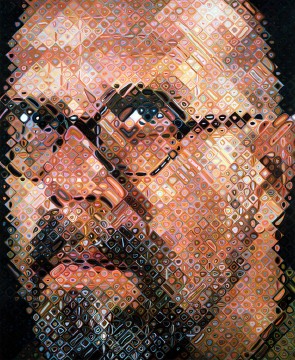 to be filled with joy. Herman Cornejo seemed to me to embody this particularly well. The overcoming of obstacles, conquering of adversity, realization that life goes on after tragedy? Even the discovery of something new--like Close's current style of painting--out of the wreckage of the old? In the end though, the stiff movement came back, and here I thought that maybe there was a reminder that we cannot go back and what is done can't be undone.
I really loved the whole piece. I don't know enough about the idiom to judge the choreography as such, but I was continuously interested in what was happening on stage and, more importantly, I thought that the dancers were wonderfully expressive of the emotional content. I felt that, in both the music and the dance, it was a truly moving tribute to Close.
As an aside, while I certainly have liked Gomes's dancing in other things, I really loved his dancing in this.
I suppose it's only fair to note that that the elderly gentlemen sitting next to us liked it rather less than I did, saying it was their "least favorite Jorma." I'm sure it comes as no shock to you to hear that I've never seen anything choreographed by Elo before.
Wendy liked it after the beginning but said that she really prefers the tutus and the pretty dancing and stories. I, meanwhile, am finding that I really don't. I just remain unconvinced that dance, which I think can express ideas and emotion brilliantly, is the best way of conveying a narrative. I don't know--I'd be happy to be proven wrong.
And to just add one more note, I really liked that Close was actually involved in this work and came out for the bows. At least in the rear mezzanine, it was when he came out that everyone stood up.
The third and final ballet of the evening was From Here on Out choreographed by Benjamin Millepied, which had it's premier on Friday and is danced to a commissioned score by Nico Muhly, something that has been presented as a big deal. David Hallberg and Gillian Murphy were dancing the leads tonight. On the whole it rather reminded me of some of Wheeldon's work that I saw when we went to see Morphoses, except it has more lateral movement (a good thing) and less invention (not such a good thing) then what I saw there.
The title seems to imply some kind of prescriptive for the future--from here on out it will be this way, from here on out you should do this, etc.--but I wasn't sure how that related to what I was watching on stage. It was interesting in parts and less interesting in others. On the balance I enjoyed watching it, but unlike with C. to C. I don't have much interest in watching it again. I thought that Murphy was lovely but not, I thought, particularly expressive and Hallberg didn't have much to do but was enjoyable to watch anyway. I wasn't a fan of the purple unitards. Beyond that I find myself with not all that much to say about it. The much-talked-up score was fine and had a lot of energy, but didn't speak to me in any particular way either.
Subscribe to:
Posts (Atom)