Last Friday I joined the P. Club at a performance of Moving Theater's Armory Show. I was particularly looking forward to this one because I'd never been to the Park Avenue Armory before and was excited to see it (and it was worth the excitement).
Several days later I'm still having trouble thinking of the show as a cohesive whole. But I was certainly interested in all the constituent parts. I particularly liked the way they addressed history and militarism in a space rife with both.
Go here for the Performance Club post and discussion.
Showing posts with label dance. Show all posts
Showing posts with label dance. Show all posts
Sunday, February 21, 2010

Saturday, September 26, 2009
Miscellany (part whatever)
1. When The Millions began posting their "Best of the Millenium" list last Monday I was excited that it seemed evenly divided between men and women. Equal representation on a best-of list isn't exactly common. And several of the women were people whose work I'm not familiar with as well. But then 9 of the top 10 were men. So, in the end the panel put together a fairly typical list when it comes to gender representation. And the list put together by Millions readers was roughly the same. I'm in no way criticizing the panelists or the readers; a quick glance at my shelves is enough to remind me that a list I put together would be roughly the same in that respect.
I also find it interesting that more than half of the six books by women on the panelists' list are short story collections. Meanwhile all but one of the books written by a man are novels. The readers list--also featuring six female writers--only has two short story collections by women. But none at all by men. I don't really have an explanation for this, but I do wonder if we, collectively, are judging literature by standards that are disadvantageous to women.
2. Alastair Macaulay seems a little baffled by the reception some of the performances are receiving at Fall for Dance. I think there are a few things at work here:
- The tickets are only $1o so people are generally going to be happy whether they love something or not.
- The wine is $2 a glass and nearly everyone is louder after a few drinks
- To a greater extent than at other dance performance you have a mixed crowd that includes not only people who go to watch dance all the time but people like myself who attend performances regularly but not frequently and people who almost never see dance. So if something features terrible cliches or whatever a large portion of the audience isn't going to recognize that those things are so done.
- It's kind of a loud, relaxed atmosphere.
I haven't actually seen any of the Fall for Dance shows this year, but hey, that's not stopping me from making conjectures.
Friday, August 14, 2009
I managed to come down with a nasty cold at the beginning of August and as soon as I started feeling fully functional my cat managed to hurt the feline equivalent of his wrist. Which sucks for numerous reasons, including the fact that I had to cancel a trip to the Adirondacks with my father to take care of his pathetic, barely-upright self. And as if that weren't enough to deal with, my mother has been in town. Which is fantastic, actually, because I love seeing my mother, but has also contributed to my feeling like I have a lot on my plate. On the bright side though, I'm more caught up at work than I've been in at least a year. Our summer interns? They are fabulous.
So while I haven't been doing much that's interesting to blog about here in the dog days of summer, I have been reading.
The -Ookies are counting down to hockey with fabulous pictures that make me wish that my camera wasn't broken. And that it was better. And that I could take such nice pictures. And that I had jars of chocolate chips.
I'm not fussed about Gia Kourlas saying bad things about the program Tulsa Ballet performed at the Joyce. I didn't see it so I'm not in the position to agree or disagree with her, but if she didn't like it she didn't like it and should say so. But I do wish she hadn't started her review with a somewhat condescending paragraph that begins by saying, "State government doesn’t normally shut down for ballet, but you wouldn’t have believed it judging by the dignitaries who spilled into the Joyce Theater on Monday night," and finishes up by claiming, "It was surreal—the whoops that erupted as the curtain was raised were a bit much—but it was also sweet to see such hometown pride." It just feels to me like she's looking down her nose at the Oklahomans. Of course small cities are proud of their cultural institutions. Of course they're going to come and support said institutions when they perform in a cultural capital like New York. It's a big fucking deal when it's something they only do once every few decades instead of all the time. I can't say I'm at all surprised that Oklahoma bigwigs came. And as for the whooping at the curtain raising . . . yeah, that doesn't surprise me either. People tend to be a bit more vocally enthusiastic outside New York. It doesn't mean they need to be portrayed like they just might be overexcited yokels.
I just read most of Love Begins in Winter. Then it became the first book in quite some time that I actively chose not to finish. Van Booy's writing is full of lovely lines and scenes, moments of genuine beauty, but they seem to come without real regard for the stories themselves. This one for example: "In the far distance, Sunday parked over the village like an old mute who hid his face in the hanging thick of clouds." I don't even know what that means. That it was quiet and foggy? That the author is trying rather too hard on the evocative imagery front? That he thought up that line and had to get it in there no matter what? Some combination?
My big issue though, is that there's so much that just doesn't feel true to me. The story that really killed me though is one that contains a scene wherein the protagonist and her boyfriend go on a trip to the Adirondacks. They hike nine miles “up into the white breath of the mountain” go off trail to a river with a large and flat enough rock for them to make love on, which isn’t soaked although it’s just been raining because “it’s amazing how quickly the sun dries the earth after it has been washed.” Now having spent some time in the Adirondacks I find it hard to believe that if it's just been raining you're going to be amazed at how quickly the sun dries things. Or that you'll feel like said rain has cleaned anything. Because you'll be hiking in mud. And if you've been hiking up for nine miles you are a) on a hell of a long day hike and b) probably not near any rivers large enough to contain a rock that sizable and flat. It doesn't seem real; it feels like Van Booy just wanted the scene. Particularly because while they've been busy having sex and taking a nap, their champagne glasses have rolled off into a rock pool where they stand upright. There, we are told, “Each glass held the weight of an entire river without knowing where it came from and how much was left.” Say what? That sounds nice and serious and all but it doesn't mean much of anything, which is pretty much how I felt about so much in this story collection.
Thursday, May 21, 2009
3 Dancers, 4 Chairs, 26 Words
I attended this on Saturday with performance club and very much enjoyed it. It felt like such a fragile thing . . . so contained and particular and carefully crafted. The performance club post and discussion is here.
Monday, April 20, 2009
Hawksley Workman, St. Matthew Passion, Death is Certain
 I've loved Hawksley Workman's music for years. He's pretty eclectic and, frankly, his work is fairly uneven, but when it's good it's really good. So I was looking forward to seeing him perform live, particularly since he doesn't play in New York very often. As it happened, he was ill and the performance was pretty so-so, although the talky guy who got to go on stage and play guitar for one of the songs seemed thrilled. And I was tired enough that even if it had been an awesome concert I would have probably felt sort of blah about it. Fortunately it was at Joe's Pub and started at 7:00 then ended by 8:30-ish.
That was Wednesday and on Friday I went to BAM to see St. Matthew Passion (why no apostrophe in that title?). Which was a bit too much Jesus for me. I mean, I'm not stupid so obviously I knew it was about Jesus. But still. That's more religion than I've subjected myself to in quite some time. Which would have been fine, I think, if the guy singing the role of Jesus hadn't bored me so much. I know nothing about music and for all I know he's actually fantastic. But he just seemed kind of lumpen (his presence not his singing since, again, I certainly couldn't judge anyone's singing and wouldn't know what constitutes lumpen singing anyway). I did think the circular staging was neat and also liked that everyone was dressed casually. And I very much enjoyed the guy singing the Evangelist--Rufus Müller--probably at least in part because I could understand everything he was singing. What I really loved though, were the chorale parts.
As a sidenote, I sat next to a very nice man who gave me a cough drop during the intermission (the two of us had a little two-person chorus of allergy-related sniffling during the first act) and chatted with me. Also, there was a guy on the subway Friday afternoon asking me about my e-reader (I have it for work) and then I ran into him at BAM as well. Which has nothing to do with anything but was kind of funny in a small world sort of way.
Then on Saturday, wrapping up my happening week, I went to see Jack Ferver's Death is Certain at St. Mark's Church, which was a Performance Club outing (P. Club post here). I'm not really sure what I thought of the performance as a whole but there were a lot of things going on that I was interested in; I felt like there was a kind of overflowing of ideas which is far preferable to watching something that's lacking ideas. And there were numerous times when I felt emotionally engaged/invested in these people and scenarios I was watching. I also spent a lot of time thinking, ooh, that even sounds painful. You could really hear the dancers hitting the floor, hitting each other, etc. At one point Tony Orrico (one of the three dancers in the performance) was shaking Ferver hard enough that you could hear Ferver's cheeks flapping and I was a bit worried that it could cause whiplash. What I liked best though was the way the piece explored how the same people can be both a burden and a support, at one time pulling you back or obstructing you, at another time lifting you up, the ways we have power over one another. Or maybe this is too literal an interpretation? Anyway, I'm really glad I went.
Monday, September 29, 2008
Fall for Dance, September 25th and 27th
I thought that Thursday was a really entertaining night at Fall for Dance, but not for the reason I expected. I was really excited about seeing the Suzanne Farrell Ballet in Pithoprakta, but I was disappointed in their performance. Tonya Plank thought the dancers looked nervous and I don't disagree, particularly with regard to Elisabeth Holowchuk who also seemed, perhaps, overly cautious. I think if she had seemed more in command it could have gone a long way. I wouldn't say, necessarily, that I disliked the piece because of the dancers though because with a few momentary exceptions, I didn't take much pleasure in the choreography. In her New York Times review Claudia La Rocco describes it as, "good weird," and writes,
The rest of the night I found enjoyable although I didn't love anything without reservations. I thought Talia Paz was marvelous but her music was incredibly repetitive and nothing more than bland to begin with. The Lombard Twins had good music but seemed like something I could see on So You Think You Can Dance? which is fine as far as it goes. And I liked the Kate Weare Company but had trouble seeing parts of it because it was blocked by the head of one of the people sitting in front of me (you have to love City Center). Garth Fagan Dance brought From Before, which the program described as, "a look at movement before Western Civilization," which is a rather bold claim. It's from the 70s and looks it, and those shiny, colorful unitards certainly don't leave much to the imagination, but I thought it was a lot of fun.
I saw the final program of Fall for Dance on Saturday. It felt like a bit of a loaded final program what with the Twyla Tharp choreography, the San Francisco Ballet dancing Robbins, and the Paul Taylor Dance Company dancing Esplanade.
The Twyla Tharp, Sweet Fields, was performed by the Aspen Santa Fe Ballet, and seemed a bit different from the other Tharp dances I've seen so far in that it seemed less busy and more...reverential, I suppose. Which is appropriate considering the dance is performed to Shaker hymns--which would be so much nicer performed live. What I liked best about the performance, though, might have been Jennifer Tipton's lighting. It looked light light streaming in the windows of an old church and while I may not be wild about religion in general I've always loved old churches.
They were followed by the San Francisco Ballet, performing In the Night by Jerome Robbins. They provided the best showing for ballet in Fall for Dance. For starters, the men weren't stuck in costumes that were either pink and blousey or attacked with a bedazzler. More importantly though, the dancers weren't dull (ABT), seemingly uncertain (Suzanne Farrell Ballet), or apparent victims of facial paralysis (Houston Ballet). And while the Christopher Wheeldon pas de deux that Oregon Ballet Theater performed was perfectly pleasant--and their dancers were lovely--In the Night was rather more interesting, what with the distict characters Robbins created through movement. Wheeldon's dancers seemed much more generic, through no fault of their own.
My least favorite part of the night was the Compania Nacional de Danza performing Nacho Duato's Cor Perdut. I didn't dislike it, I just felt kind of indifferent to it and a couple days later don't remember much of anything about it.
Meanwhile, my main thought while watching Paul Taylor's Esplanade was how exhausting it looked. All that running! I'd just gone to a yoga class for the first time in a couple years and trying to do that stuff really brought home how out of shape I am, so I was in an especially appreciative mood Saturday night. Esplanade is such a good-natured, friendly feeling dance, though not universally light in mood, that it seemed to me to be a perfect way to end the festival.
Balanchine’s choreographic response to this dizzying aural architecture is wild-eyed and surprisingly but suitably gravity-conscious. Dancers drop and roll, stagger back, shudder and seem always about to collapse. The lead dancers (on Thursday, Elisabeth Holowchuk and Matthew Prescott) are constantly being separated: by pools of light; by the sinister and sexy black-clad dancers, resembling a chorus line seen through a glass, darkly; and by their own perverse actions in pushing each other away.I'd like to watch it again, looking for those things.
The rest of the night I found enjoyable although I didn't love anything without reservations. I thought Talia Paz was marvelous but her music was incredibly repetitive and nothing more than bland to begin with. The Lombard Twins had good music but seemed like something I could see on So You Think You Can Dance? which is fine as far as it goes. And I liked the Kate Weare Company but had trouble seeing parts of it because it was blocked by the head of one of the people sitting in front of me (you have to love City Center). Garth Fagan Dance brought From Before, which the program described as, "a look at movement before Western Civilization," which is a rather bold claim. It's from the 70s and looks it, and those shiny, colorful unitards certainly don't leave much to the imagination, but I thought it was a lot of fun.
I saw the final program of Fall for Dance on Saturday. It felt like a bit of a loaded final program what with the Twyla Tharp choreography, the San Francisco Ballet dancing Robbins, and the Paul Taylor Dance Company dancing Esplanade.
The Twyla Tharp, Sweet Fields, was performed by the Aspen Santa Fe Ballet, and seemed a bit different from the other Tharp dances I've seen so far in that it seemed less busy and more...reverential, I suppose. Which is appropriate considering the dance is performed to Shaker hymns--which would be so much nicer performed live. What I liked best about the performance, though, might have been Jennifer Tipton's lighting. It looked light light streaming in the windows of an old church and while I may not be wild about religion in general I've always loved old churches.
They were followed by the San Francisco Ballet, performing In the Night by Jerome Robbins. They provided the best showing for ballet in Fall for Dance. For starters, the men weren't stuck in costumes that were either pink and blousey or attacked with a bedazzler. More importantly though, the dancers weren't dull (ABT), seemingly uncertain (Suzanne Farrell Ballet), or apparent victims of facial paralysis (Houston Ballet). And while the Christopher Wheeldon pas de deux that Oregon Ballet Theater performed was perfectly pleasant--and their dancers were lovely--In the Night was rather more interesting, what with the distict characters Robbins created through movement. Wheeldon's dancers seemed much more generic, through no fault of their own.
My least favorite part of the night was the Compania Nacional de Danza performing Nacho Duato's Cor Perdut. I didn't dislike it, I just felt kind of indifferent to it and a couple days later don't remember much of anything about it.
Meanwhile, my main thought while watching Paul Taylor's Esplanade was how exhausting it looked. All that running! I'd just gone to a yoga class for the first time in a couple years and trying to do that stuff really brought home how out of shape I am, so I was in an especially appreciative mood Saturday night. Esplanade is such a good-natured, friendly feeling dance, though not universally light in mood, that it seemed to me to be a perfect way to end the festival.
Wednesday, September 24, 2008
Fall for Dance, September 23rd
So it's been an interesting experience for me to sit so close to the stage. I'm usually about as far back in the theater as I can get so it's different to be able to see so many small things. Of course it's not always an improvement. For example the Houston Ballet's costumes for Tchaikovsky Pas de Deux would probably have looked marginally better from a distance. I mean, I'd probably have needed to be watching from the nosebleeds of a football stadium for Connor Walsh's getup to look decent. Still, a little distance might have been helpful. Even more so because from my usual seats I might not have noticed the fact that Sara Webb's face seemed paralyzed. I mean, sure, look happy. But the same exact expression for the entire eight minutes? It's just discomfiting and feels completely fake. I liked Webb's dancing other than that--moreso than Walsh's--but the frozen rictus of a smile was consistently distracting.
And in BeijingDance/LDTX's performance--in which they were apparently animated pieces of a Go game and also players of Go, according to the program notes--I sometimes couldn't see everything on stage as well as I would have liked. I don't think I would have been terribly fond of the work anyway, but I do think I like sitting further back and looking at the stage from above better.
 Also subject to my annoyance last night was the choreography for Single Room. Fang-Yi Sheu is a gorgeous dancer but she was apparently narrating a girl's loneliness in a relationship by dancing with a table. Because I know when I'm feeling lonely what I really want to do is roll around on (and under) my kitchen table while showing off my legs in various ways. (Granted, I certainly don't have legs like that and hers are worth showing off.) I know I'm being far too literal there, but nevertheless I definitely could have lived with less of the table.
The other two performances though, I really liked. The Richard Siegal choreographed The New 45 went on a bit too long but was so witty and fun that I didn't much mind. And Ayman Harper and Mario Zambrano were engaging, entertaining performers. I thought they were fantastic. Also, this was another performance that made me want to see more of both the choreographer and the dancers.
I also really enjoyed The Gentlemen of Hälau Nä Kamalei. I'd never seen hulu performed before either by men or by women so that was a treat. And while this was another piece that had a story I couldn't follow in the least--maybe the music told the story?--I did get a kick out of reading about it in the program. It's described as the, "myth, legend, and love story of a surfer from Kauai who comes to the North Shore of Oahu to ride the waves of Sunset Beach." I imagine it's cultural ignorance, but I'm so cheerfully entertained by the idea of watching a dance by a guy who goes ot Oahu to surf. It was a nice way to end the evening.
Photo from the City Center Web site.
Tuesday, September 23, 2008
Fall for Dance, September 21st (by way of self-indulgent rambling)
What I'm enjoying most about the Fall for Dance festival is the opportunity it gives me to see all sorts of new things and figure out what I'd like to see more of. I've been watching dance on what amounts to a semi-regular basis for such a short time. Two years ago I could have fit everything I knew about dance on a 3 x 5 index card (one side of a 3 x 5 index card). Knowing that Balanchine was the answer to a particular Cranium trivia question was a total accomplishment for me. So almost everything I go to see is still new to me. And as a result, I don't know what I'm going to like or dislike; it's a constant process of discovery. Sometimes--often, really--even after I see something I don't quite know why I feel the way I do about it. I wind up feeling like my reaction is a puzzle I have to work out. Which is why I write about the performances I see on this blog. The writing forces me to think about things more clearly. And knowing that other people will be able to read what I've written forces me to be at least somewhat less muddled than I would be if I were writing in a journal that only I would see. So it's all part of some self-assigned learning experience or personal improvement project or whatever, I suppose.
 Anyway, I'd never seen any of the performers that I saw Sunday afternoon and the only choreographer I was at all familiar with going in was Christopher Wheeldon. I've seen a few of Christopher Wheeldon's ballets now, but I'm still not quite sure what I think of him. Generally speaking I'd enjoy less partnering and more women dancing on their own two feet, but I don't dislike his work. His choreography is beautiful and musical and he seems to avoid the most obnoxious of cliches. So all in all I find his ballets that I've seen perfectly pleasant. But at the same time I don't find myself anxious to go see more. Perhaps I just haven't seen the right Wheeldon piece yet. That's perfectly plausible paricularly because what I've seen has been kind of same-y. The pas de deux from Rush didn't really change that. It was lovely--although that costume did nothing for Alison Roper-- and I really liked both Oregon Ballet Theatre dancers, but it didn't seem particularly different from what I've seen from him before. I understand that the pas de deux is atypical with reference to the rest of the ballet so I wish I could have seen the whole thing.
I liked watching Madhavi and Arushi Mudgal and I loved how the dancers were also involved in creating the music with the bells they wore. Whenever I watch Indian dance though, I'm ready for it to end before it actually ends. There are all kinds of storytelling elements, right? But they're completely over my head. And Sheron Wray was a wonderful dancer but the piece she did, Harmonica Breakdown, didn't really leave an impression on me. So the middle section of the program left me feeling fairly neutral. I had stronger reactions to the first and last performances though.
Uprising, which came last and was performed by the Hofesh Schecter Company, was the first piece I've seen so far during the festival where I couldn't wait for it to end just so I could stop watching it. But that wasn't the universal opinion by any means. Much of the audience clearly loved it and while leaving I heard people talking about how much they had liked the first and last dances. It can't have helped that my viewing situation was less than ideal--for this final dance only I was behind a woman taller than myself and had trouble seeing part of the stage around her head--but I just found the whole thing almost entirely uninteresting. I don't know why other people enjoyed it while I was so unentertained. And I couldn't even tell you precisely why I didn't think much of it.
 The other piece that I had a strong reaction to was the first, Les Chambres des Jacques, performed by [bjm_danse] Les Ballets Jazz de Montreal, which I thorougly enjoyed. The program notes say that it's, "an exploration of the inner life and drama of the individual dancers." I'm not sure that came across, at least in the excerpt we saw, but the dancing was just so much fun to watch. I particularly liked the solos and how individual the dancers, who I though were wonderful, seemed. And it seemed to me that Aszure Barton along with the dancers created a very particular sense of a community in which the dance took place. I also loved the music. The performance made me want to see more of the company and more of Barton's choreography. And after all, that's what the festival is supposed to do isn't it?
Rush photo from OregonLive.com. Les Chambres des Jacques photo from the New York Sun.
Sunday, September 21, 2008
Fall for Dance, September 19th
This time around I was going to Fall for Dance with my grandmother. She remembered seeing Merce Cunningham in the 60s or 70s (I don't remember which she said) and not liking it so thought she should give it another try all these years later. We met for mediocre Italian food at one of the restaurants that would give her double air miles--she uses them for all the travelling she's done in recent years and I think this next year is including Italy, India, China, and somewhere else so she needs those miles--and then walked over to City Center. It was nice and chilly Friday night--we're getting into my favorite sort of weather and I'm excited about that. I love autumn, although it's also the time I most miss living somewhere where it was easy to go apple and pumpkin picking. I'm going hiking in the Adirondaks with my father in a couple weeks and hopefully the trees will all be mid-change. But anyway...
 I felt completely unequipped to watch the Merce Cunningham piece, Sounddance. I just don't get it. I mean I watched it and it was kind of like watching controlled chaos, and it was interesting at points but overall I just felt, well, baffled. And man are those costumes ugly. It didn't help that we were sitting just a wee bit too close to the speakers and the music--which I can't imagine enjoying under any circumstances--was verging on painful. Anyway, it seems clear that I need to learn more about Cunningham's choreography before I see something of his again so I'll be able to get more from it.
Next up was Dayton Contemporary Dance Company, which featured an African American man in a feathered loincloth impersonating an ostrich (but with more pelvic gyration than any ostrich could manage). It was interesting and the man dancing was certainly impressive, but I don't know that I feel much need to see people impersonating other animals with any frequency. Question though: Just how contemporary is something that premiered in 1932? Does "contemporary" refer to a certain era or kind of dance? I thought it just meant that the dance was, well, contemporary. Which something from 1932 really isn't at this point, is it?
 The final bit of dancing before the intermission was from ABT, with Xiomara Reyes and Gennadi Savaliev in the pas de deux from The Leaves are Fading. I saw the full ballet with Julie Kent and Marcelo Gomes (pictured) when ABT performed it last year and enjoyed it very much. I like Reyes fine but not nearly as much as Kent and have no general opinion one way or another on Savaliev (I don't think I've seen him dance much) but I felt like he was sort of stiff. Or perhaps not stiff but somehow unconvincing. Of course it's probably hard to be convincing while wearing a flowy pink blouse. Talking about making a man work extra hard.
After spending the evening thinking uncharitable thoughts about that particular look I was amused to see that Claudia La Rocco had a post up about ballet costumes in which she wrote, "anyone who has gone to the ballet with me a few times (OK, maybe only once) knows that a lot of the design concepts leave me feeling like I’m watching an extended commercial for feminine hygiene products. What’s with all the pastels??!" It hadn't occurred to me to think much beyond, "God, I hate that look," but feminine hygeine commercials certainly are an accurate comparison.
 After the intermission there was a solo performance by Louise Lecavalier in an excerpt from a piece called Lone Epic that I thought was just wonderful. The program notes said that it, "explores the possibility of human emotion within a facade of presentation, recognizing that the emotions of love and loss, while intensely personal, are of epic importance." That was actually a bit more spelled out than I needed it to be for a change as the themes came through clearly. I particularly liked how the music stands and conducting were used as a "facade of presentation" (a performance within a performance) with that facade breaking down to reveal the personal emotions expressed through dance. I thought Lecavalier was a fantastic performer.
The final dance of the night was a tap performance by Ayodele Casel, Sarah Savelli & Dancers. We saw excerpts from a piece called Tap into Peace and while the tapping was a lot of fun to watch I thought the presentation was far less entertaining (particularly right after seeing Lecavalier's performance). There was something hokey about the bits of acting we saw and the setups just weren't that interesting. The dancing itself was better without the stuff that came with it.
All in all a fun night. Next up we're going to see All My Sons, which is making me very glad I found something cheap for us to do this month. Next on the to-do-list: finding a super-inexpensive restaurant for us to eat at in October.
Sounddance photo from Merce Cunningham's Web site. ABT photo is from their Web site. Lone Epic photo from here.
Thursday, September 18, 2008
Fall for Dance, September 17th
I went to the first night of Fall for Dance on Wednesday and enjoyed it very much. I'm actually going to see all the programs this year which I'm excited about. A friend and her boyfriend who are in town came with me which was particularly nice. With my regular dance-going companion off in vet school learning to save the animals I'm left to drag other people off to shows with me so I was delighted that they enjoyed themselves.
The first group of the night was Shen Wei Dance Arts. They were performing excerpts from a piece called Maps. I was looking forward to seeing this group and, to my surprise, found the dance interesting without being particularly appealing on a personal level. I can't help but wonder if I would have liked it more if we had seen it in its entirety instead of in excerpts. I also wonder if going to their Web site before attending might have allowed me to connect more to it as they have a lot of information about what the dancers are doing and what the intention of the choreography is. Something that I think is great. Less great? That it's one of those obnoxious flash sites that doesn't allow me to link directly to the information I'm talking about.
As I think about it, I wonder if the reason it didn't engage me emotionally is because it seemed so divorced from anything other than the exploration of movement as its own end. I'm not saying that's not worthy but that I don't think it's what I enjoy most as a member of the audience. I found it interesting how one dancer would begin a certain movement and then the other dancers would pick it up and I also found myself following some of the patterns avidly. But what I kept coming back to was that no one on the stage ever touched. It seemed dehumanizing in a way to me and overly repetitive. Those two things being connected to my way of thinking.
The second group to dance was Pichet Klunchun Dance Company doing a piece called Chui Chai. The program explained the story that the dance told and while I couldn't actually follow that I still found the dancing to be incredibly beautiful. The dancers control, particularly in their slow movements is amazing to me. The silent beginning of the dance, with women dressed in gorgeous ornate costumes moving ever so slowly, was marred by a cell phone going off and a man who felt the need to get his two cents in by yelling about it--as if adding to the disruption isn't also disrespectful to both the performers and the audience. Honestly, good manners aren't difficult. Anyway, I found that I couldn't take my eyes off the the dancers' fingers, the way they bent them back and moved them so precisely and how noticeable the subtle changes are. The other thing that fascinated me was the way that, when walking quickly, the dancers seemed almost to be gliding because their bodies never changed height. I don't know if I'm describing that right. I felt fortunate to have a chance to see this.
After the intermission was Keigwin + Company performing the "Fire" segment of Elements. It's funny. Occasionally. Not, I think, nearly as funny as it's meant to be. Mostly it seems like the dance is going for cheap laughs. Look at how silly these dancers look in these unflattering costumes with the corsets and the bathing caps. Look at how incongruous it is to see them doing hip hop. It was just frivolous, but while frivolity can be a great deal of fun, in this case it seemed lazy more often than not.
The final work of the evening was the National Ballet of Canada in Jiri Kylian's Soldiers' Mass. Like Shen Wei in Maps, Kylian frequently uses dancers moving in unison and creating patterns or picking up a movement from one dancer and repeating it, to create his effect. And yet if the dancing in Maps seemed dehumanizing then Soldiers' Mass is its opposite. The ballet's power comes from the fact that its soldier dancers are never anything more or less than humans. The comradeship, the fear, the grief, the bravery of the soldiers...those things are the point of the ballet. And although it's sad it's not entirely dark as there felt to me to be a strain of hopefulness running through it. I kept thinking--perhaps because it's the war I've read the most about--of the trench warfare of the first World War and the soldiers just sitting and waiting. Although I thought that at times it didn't work perfectly--I'm not sure here how to explain how I felt--I did find it quite moving.
Thursday, December 13, 2007
The Nutcracker
 Wendy and I went to see the Nutcracker yesterday evening. Six o'clock start times are so not my favorite thing in the world, particularly since they mean I can't eat first. I mean, I understand that a lot of children go to see Nutcracker so they don't want it running too late, but honestly, if it's hard for me to get from work to Lincoln Center by six, I can only imagine that it's even harder for the many working parents who want to bring their kids to the ballet. I just don't get it. On the bright side, it does mean we got to watch Project Runway yesterday.
Anyway, the Nutcracker is lovely and all. Our tickets, as they were last year, were way up in the 5th ring, which is an odd almost vertigo inducing perspective (there's a picture below that might give you an idea). You have to lean forward against the railing in order to see the whole stage, and my hands kept falling asleep. Teach me to try and get cheap--aka within my budget--tickets long after they've gone on sale.
 I tend to find myself a bit bored during the first bits. I mean, it's a lovely Christmas party with the dancing and the children and the toys, etc. but once you've seen it once, it kind of feels like a prelude to the real magic which is to come. For me, the delight of the ballet comes when the tree starts growing upward--although the 5th ring does ruin that particular magic a bit since you can see the hole from which the tree grows.
For the most part the ballet was delightful, and I actually felt, watching it, like I was seeing it differently than I had in the past. I felt like I actually have been learning something about watching in the past year. So that was nice too. Anyway, I particularly liked Alina Dronova as Marzipan and Megan Fairchild as Dewdrop. Dronova was full of vivacity and delight while Fairchild seemed to have the kind of clarity that a dewdrop would have. I also always particularly the candy canes with their hoops. Although I imagine most do. The only performance I was disappointed by, and unfortunately it was a big one, was that of the Sugarplum Fairy.
 I'm sure that Teresa Reichlen, who danced the role, is usually a lovely dancer--I've never seen her before--but she wasn't good yesterday. While I was at a weird angle so it's sometimes hard to say, she appeared to be very unsteady at times. On at least one occasion it seemed like her cavalier, Stephen Hanna, had to catch her to prevent her from doing a face plant, and there were wobbly arms all over the place when she had to balance (I think I'm describing this correctly). Setting aside such obvious things though, I felt like her dancing lacked the authority, sureness, and grandeur that the role and music seem to call for. Well, I confident that she's been much better in the past and will be much better in the future. I sure don't do my job brilliantly every day. I mean, my boss walked up yesterday and I was totally watching the Gary Robert-Ben Eager fight on YouTube. So I can't point fingers.
 Still, it was a nice night and we left the New York State Theater very satisfied. It was quite a bit colder when we left than it had been earlier that day and we rushed home feeling decidedly chillier than we would have hoped. It probably would have helped if either of us would have remembered to wear our hats that morning. Live and learn? Pay for your mistakes? Some other cliche? Oh well, unsurprisingly we survived.
Thursday, October 18, 2007
Morphoses
At Fall for Dance, which Wendy and I went to, they gave out these cards with a 3 companies or more for $15 a piece offer. Being the sort of people who justify what they want by saying, "Oh, I have to buy it, it's on sale," we naturally had to take advantage of this. Which is how we ended up in the second to last row of City Center's rear mezzanine tonight. And which is how you get to read me trying to talk about dance without really describing it, since I don't really have the vocabularly or understanding to do so.
I've been trying to read up on the dances I'm going to see so that I can feel a little less ignorant when watching them but there wasn't a ton to read. Reviews of their recent London performances were only partially helpful because the program is different, and none of the American newspapers had reviews up yet. The only review of this particular show that I found was Tonya Plank's review on her blog, "Morphoses' First Full Program: A Complete and Utter Bore, Unfortunately" which was about as positive as it sounds. It didn't leave me feeling very optimistic going into this evening, but maybe that's a good thing, because it gave me the opportunity to be pleasantly surprised. Because I was neither completely or utterly bored. In fact, for most of the evening I was downright interested.
Which is not to say that I entirely disagree with her assessment. I was interested in what I was seeing, but I didn't enjoy all of it. She points out the prevalence of pas de deux, and the lack of variety in the choreography, and I think those are both valid criticisms. She also, if I understand correctly, particularly disliked "There Where She Loved," and I do think it was less interesting than some of the other pieces I saw tonight. And yet the idea that the entire evening was made up of, "completely meaningless weird abstract shape after completely meaningless weird abstract shape after completely meaningless weird abstract shape," and that the dances did nothing to engage the intellect is a one I can't get behind. And that an entire night of abstract dances--which I'm not convinced this was, anyway--is an insult to the intelligence of the audience is a view that I don't really understand. As I've mentioned before, I have very little experience with dance, but I don't necessarily think that going to see an evening of abstract dances is that different than going to an art show comprised entirely of abstract works--something I've done and enjoyed. The abstraction does engage one's mind. It's just that it engages the mind differently. You might not think about a Renoir and a Kandinsky in the same way, but you will think about both.
More often then being bored, I found myself annoyed. I'd never seen any of Wheeldon's choreography prior to tonight, but watching "There Where She Loved" I immediately understood what Alistair Macaulay was talking about when he wrote of "After the Rain" that:
There were other times, however, when I found the partnering more enjoyable and surprising than obnoxious, such as in "Tryst." I was a bit distracted while watching that piece by the fact that the music undeniably belongs in a bad Sci Fi movie--particularly considering the fact that it includes the sound of a spaceship taking off--but I thought there were times when the movement was beautiful. Particularly the geometry of Bussell and Cope's bodies and the ways in which they connected and disconnected.
I also found "Fool's Paradise" to be beautiful, and was grateful for the occasional breakup of all the pas de deux. I found it most interesting and memorable at these times, when there were multiple couples on the stage moving in the same way, or when the men or women were dancing together.
"Dance of the Hours," meanwhile, was delightful and light, which makes sense given the context, and was a nice break from all the less delight-filled fare of the evening. I felt like it, combined with "Slingerland" which, though also a pas de deux, was not choreographed by Wheeldon but Forsythe, and felt somewhat different in its aesthetic, helped to break up the sameness of the evening. The sense I got from Forsythe's piece was that of anxiety permeating things. That's not something I felt a lot of in Wheeldon's works.
Wheeldon, on the other hand, at moments manages real moments of poignancy, although they never seem to be sustained over the course of an entire piece. It seems to me that Wheeldon's work is neither genius nor revolutionary but it is interesting. In part because the abstraction makes the work like a puzzle I want to solve. I imagine it would help to talk about it, but talking endlessly about the meaning and intention of things after seeing them isn't really Wendy's cup of tea. So I'm trying to muddle along on my own because there's meaning and emotion there, and I can catch glimpses of it, threads that I want to tease out, but I don't know how to unravel them. Those threads are, to my mind, a definite positive. It's also interesting work to me for another, less positive reason, which is that it feels to me like his dances should, or could, be more memorable and affecting than they are.
I've been trying to read up on the dances I'm going to see so that I can feel a little less ignorant when watching them but there wasn't a ton to read. Reviews of their recent London performances were only partially helpful because the program is different, and none of the American newspapers had reviews up yet. The only review of this particular show that I found was Tonya Plank's review on her blog, "Morphoses' First Full Program: A Complete and Utter Bore, Unfortunately" which was about as positive as it sounds. It didn't leave me feeling very optimistic going into this evening, but maybe that's a good thing, because it gave me the opportunity to be pleasantly surprised. Because I was neither completely or utterly bored. In fact, for most of the evening I was downright interested.
Which is not to say that I entirely disagree with her assessment. I was interested in what I was seeing, but I didn't enjoy all of it. She points out the prevalence of pas de deux, and the lack of variety in the choreography, and I think those are both valid criticisms. She also, if I understand correctly, particularly disliked "There Where She Loved," and I do think it was less interesting than some of the other pieces I saw tonight. And yet the idea that the entire evening was made up of, "completely meaningless weird abstract shape after completely meaningless weird abstract shape after completely meaningless weird abstract shape," and that the dances did nothing to engage the intellect is a one I can't get behind. And that an entire night of abstract dances--which I'm not convinced this was, anyway--is an insult to the intelligence of the audience is a view that I don't really understand. As I've mentioned before, I have very little experience with dance, but I don't necessarily think that going to see an evening of abstract dances is that different than going to an art show comprised entirely of abstract works--something I've done and enjoyed. The abstraction does engage one's mind. It's just that it engages the mind differently. You might not think about a Renoir and a Kandinsky in the same way, but you will think about both.
More often then being bored, I found myself annoyed. I'd never seen any of Wheeldon's choreography prior to tonight, but watching "There Where She Loved" I immediately understood what Alistair Macaulay was talking about when he wrote of "After the Rain" that:
this dance also exposes how dismayingly passive his presentation of women often is. Perhaps only with a strong-looking dancer like Ms. Whelan can it be tolerable to watch a woman repeatedly swoon, drape herself on her partner’s neck or back, ecstatically abase herself at his feet, and let him lift her like the sail to his mast or the prow to his ship.I agree that this passivity is distasteful. I found myself thinking at times about how much I would like it if the ballerinas could just dance on their own two feet as opposed to constantly being carried around in various positions. When the women were allowed to dance instead of being carried to and fro, then I enjoyed the piece. And I did find the end affecting, even if that which came before was more frustrating than emotionally engaging. I wish there had been some guidance in the program. Because while I understood the ending (I don't know much French, but even I know enough to understand that) I feel that there were relationships being shown throughout for which I didn't understand the dynamic. The best thing might have been to provide a translation of the song lyrics--although perhaps that would have been too difficult and space-consuming a task.
There were other times, however, when I found the partnering more enjoyable and surprising than obnoxious, such as in "Tryst." I was a bit distracted while watching that piece by the fact that the music undeniably belongs in a bad Sci Fi movie--particularly considering the fact that it includes the sound of a spaceship taking off--but I thought there were times when the movement was beautiful. Particularly the geometry of Bussell and Cope's bodies and the ways in which they connected and disconnected.
I also found "Fool's Paradise" to be beautiful, and was grateful for the occasional breakup of all the pas de deux. I found it most interesting and memorable at these times, when there were multiple couples on the stage moving in the same way, or when the men or women were dancing together.
"Dance of the Hours," meanwhile, was delightful and light, which makes sense given the context, and was a nice break from all the less delight-filled fare of the evening. I felt like it, combined with "Slingerland" which, though also a pas de deux, was not choreographed by Wheeldon but Forsythe, and felt somewhat different in its aesthetic, helped to break up the sameness of the evening. The sense I got from Forsythe's piece was that of anxiety permeating things. That's not something I felt a lot of in Wheeldon's works.
Wheeldon, on the other hand, at moments manages real moments of poignancy, although they never seem to be sustained over the course of an entire piece. It seems to me that Wheeldon's work is neither genius nor revolutionary but it is interesting. In part because the abstraction makes the work like a puzzle I want to solve. I imagine it would help to talk about it, but talking endlessly about the meaning and intention of things after seeing them isn't really Wendy's cup of tea. So I'm trying to muddle along on my own because there's meaning and emotion there, and I can catch glimpses of it, threads that I want to tease out, but I don't know how to unravel them. Those threads are, to my mind, a definite positive. It's also interesting work to me for another, less positive reason, which is that it feels to me like his dances should, or could, be more memorable and affecting than they are.
Friday, August 17, 2007
Mozart Dances

So I went to see Mozart Dances at Lincoln Center yesterday. Just barely made it on time. The thing is, while I don't mind going to things alone--I do it all the time and even enjoy it--I refuse to go to things alone while looking like something the cat dragged in. Not that my cats drag anything in, since it's not exactly safe to have outdoor cats in Manhattan, but you get the point. Anyway, I was looking rather conspicuously shabby yesterday evening, and decided I needed to shower which almost made me late. But I wasn't. Which was good since me tickets were, of course, in the fourth tier so I had a lot of stairs to climb once I got there.
Anyway, I was feeling rather good about seeing this because I'd read the Joan Acocella article in the New Yorker in which she wrote of Mark Morris:
Why is he so popular? One reason, I think, is that he gives people the modern pleasure of seeing abstract work without leaving them scratching their heads over what it was about. Though he may not have a story on the surface, he always has one underneath, in the form of movement motifs.I read that and though, well that sounds accessible. And accessible is totally what I need when it comes to dance, since if it's not easy to follow I'm completely lost. I'd also read about how musical his choreography is and I figured that would help me as well.
And as is turned out I enjoyed it very much. I don't have the proper vocabulary to describe what I saw--which is ok, because in New York at least, it's showing on PBS again on Sunday so check your listings and see it yourself--but the way that the dancers moved just seemed to be right. It seemed like the movement was the only possible movement, and even when the motions were unnatural, they didn't look contrived. And the repetition, the "movement motifs" Acocella refers to, were mixed with moments that were delightfully surprising.
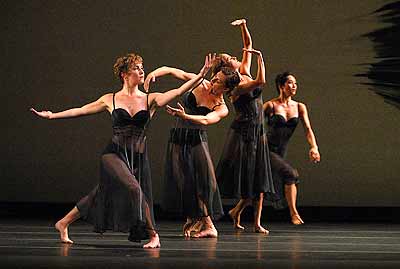
The kind of inevitable feeling to the dance seemed to match Mozart's music which always seems to me to have come into the world fully formed, as if each note can only be that which it is. And this quality seems to connect with all the Millay I've been reading as well. In her best poetry, the words just seem to have fallen into place. None of these three things--the dance, the music, the poetry--are natural. The succession of notes Mozart puts together aren't natural, nor is the movement Morris choreographs, nor is Millay's diction. So it seems to me a great triumph to make them feel as though they are.
Wednesday, August 15, 2007
Trisha Brown Dance Company
 So my sister's in town and yesterday we went up to Lincoln Center to see the Trisha Brown Dance Company because we'd seen the listing in TONY and thought it sounded interesting. We stayed until part way through the 4th and last piece, at which point my sister decided she'd had about as much as she could take and we left. I wish I'd known more about what I was watching, because I was interested and certainly wouldn't have left if my sister hadn't wanted to, but I was very confused and wouldn't say I enjoyed it either. Also, I feel rather embarrassed about leaving something that was not, in fact, bad, and keeping wanting to point out that many other people left throughout as well. So there, now I've done it. The appropriate response to this, in case you're not already thinking it, would be, "And if everyone else jumped off a bridge would you jump too?" But back to the dance.
The program described her work as postmodern dance which, to be honest, I didn't even know existed. I mean, it makes sense since there's a postmodern branch of so many things, it's just not something I had ever considered. From what I can figure out (and, admittedly, I only read the Wikipedia article) it seems to encompass many of the same elements as postmodern literature: deconstruction (ew), irony, parody, etc. So I understand that a bit better. What I don't understand is how the dancing I saw reflects those elements. I don't know how to read--or, to use a word I became ever so familiar with in college, "unpack"--the dances.
There were four separate pieces (and I lost my program so I hope I'm putting the correct titles with the dances). The first, Accumulation featured one woman, standing in the middle of the stage and dancing to Uncle John's Band by the Grateful Dead, at first moving only one arm and then gradually incorporating other limbs, without ever moving from the place she was standing.
The second, Canto/Pianto was a longer piece. At various times the dancers would come on stage in neat lines and then break into joyful seeming dance, only to stop again suddenly. At other times they would stand on stage gesturing (which I found far less intersting). The most distinctive part, to me, was toward the end when a woman was held up and moved almost as though floating and spinning in water.
In the third, Spanish Dance, which was set to Bob Dylan singing In the Early Morning Rain, a group of dancers took the stage, dressed in white and standing in a line, with several feet between each dancer. First only the one on the right of the stage (from the viewer's perspective) moved, and then, as she reached the next dancer in the line, that dancer began moving as well, as so on and so forth until all the dancers were moving in tandem, at which point they reached the left side of the stage (so, stage right) and stopped moving. This one I liked very much. Unlike the others, particularly the final one which I'll get to, I felt like I understood both the movement and, more importantly for me, how the movement related to the music, something I couldn't see very well in the rest of the dances.
PRESENT TENSE is the one we left during. So unsurprisingly I can't say that much about it. We didn't have a very good view from where we were sitting and of all the dances this seemed to be the one we could see least well. It seemed to me that the shapes the dancers made with their bodies, particularly as the linked themselves together and maneuvered around each other, were very interesting. I thought the music was nearly unbearable though, and particularly disconnected from the dancing itself.
Well, to throw out a cliche, I'm expanding my horizons. I do find myself wishing though, that at some point I'd taken a class--if such things are even offered--on how to be an informed dance viewer. I'd be much less at sea now.
Tuesday, July 24, 2007
Fred Astaire Brings Sexyback
Ok, so the whole bringing sexy back thing got incredibly old a long time ago, I know. And what's more, I would really, really not choose "sexy" as an adjective to describe Astaire. But I was puttering around YouTube and found this and it was really too fun not to post.
Subscribe to:
Posts (Atom)