Showing posts with label books. Show all posts

Friday, July 09, 2010

American Stories

These two books don't actually have much in common. I just read them around the same time and had sharply differing reactions to them.

Although I had somewhat mixed feelings about the previous Geraldine Brooks novel I'd read, People of the Book, I was excited to read March. I have vivid memories of being in second grade, sitting on the swing during recess and reading Little Women. At the time Pizza Hut was doing some kind of reading promotion with elementary schools and if you read enough books you got free pizza, It was a giant hardcover copy of some 600 pages and when I was done I was rather proud of my accomplishment and got so many reading credits that I got a free personal pan pizza for that book alone. So it's a fond association. Also I like historical novels and think the history of the Civil War is interesting.

March has a lot going for it. It's well--if unremarkably--written and tidily constructed. There are no loose ends, no bits of story that go wandering drunkenly off. One feels that their reading experience is in the hands of a thoroughly competent novelist. In the end though, I felt like the connection to Little Women was tenuous, even gimmicky. There seemed little narrative reason for the protagonist to be Mr. March as opposed to some other man not featured in a classic novel. And although, by centering the story around an abolitionist during the Civil War Brooks takes as her subject what is arguably the most important war, the most important period of American history, the book feels small. Under a veneer of thoughtfulness, it's an safe, comfortable novel that doesn't challenge readers. Maybe if Marmee were a real person she wouldn't be as supportive and perfect as she seems in Little Women--it can't be! Abolitionists were well meaning but still blinded by white privilege and even racism--surely you jest!

One of the great joys of reading fiction is that the author can reveal something new and truthful to the reader through their work. Your world can suddenly expand in small but noticeable ways. You can learn something you never expected to. A book doesn't have to do that, of course, to be enjoyable. But I think that a novel that asks the reader to take it seriously--to devote time and thought to it--should. It ought to challenge its audience in some way.

The Ballad of Trenchmouth Taggart is a far messier book than March. But it has a delightful energy and sense of risk that made me want to forgive it all its flaws and just go along for the ride. Rather than feeling like the author is simply showing the reader things he or she already knows, M. Glenn Taylor introduces a story in which the elements are familiar but skewed in such a way as to make them feel new.

Like many ballads and folk tales, this one presents us with the story of its protagonist's life from birth to death (at a very advanced age). Divided into three sections--roughly speaking, youth, middle age, and old age--it begins more strongly than it ends and takes odd detours along the way. Trenchmouth Taggart is a larger than life figure, a sharp-shooting union man, a snake charmer, and a harmonica player, among many other things. At its best, the novel is a modern tall tale and feels quintessentially American. The story is one that couldn't take place anywhere else because it so clearly springs from the culture and landscape of its setting.

It makes sense then that the first and longest section, which embraces the oddness and distinctiveness of both the characters and the rural Appalachian setting, is the strongest. In middle age Trenchmouth becomes a bit Forrest Gump-ish, constantly encountering famous historical figures, and by the end of the book he slips into the cliche of an elderly man uncomfortable with the modern world. One can't help but wish that the focus had remained on these earlier years and people. But by that point the novel has earned so much good will (at least from me) that these flaws can be forgiven.

Wednesday, June 23, 2010

Miscellany

Having fried myself at the beach over the weekend (and I thought I was being so good about sunscreen too) I've spent all my non-working hours this week lying in bed trying not to move too much. So I've mostly been doing a lot of puttering around on the internet at night reading things.

Like Laura Miller's article on the growth of self-publishing and the fun of slush piles, which brought back cringe-worthy memories of reading for a literary agency:
People who have never had the job of reading through the heaps of unsolicited manuscripts sent to anyone even remotely connected with publishing typically have no inkling of two awful facts: 1) just how much slush is out there, and 2) how really, really, really, really terrible the vast majority of it is. Civilians who kvetch about the bad writing of Dan Brown, Stephenie Meyer or any other hugely popular but critically disdained novelist can talk as much trash as they want about the supposedly low standards of traditional publishing. They haven't seen the vast majority of what didn't get published -- and believe me, if you have, it's enough to make your blood run cold, thinking about that stuff being introduced into the general population.

Everybody acknowledges that there have to be a few gems out in the slush pile -- one manuscript in 10,000, say -- buried under all the dreck. The problem lies in finding it. A diamond encased in a mountain of solid granite may be truly valuable, but at a certain point the cost of extracting it exceeds the value of the jewel.
I can't say reading through all those submissions is something I miss.

And today I also read the latest installment in Tobi Tobias's series of ballet diaries (all of which have been such a treat). In this case she's writing primarily about the retirement of two dancers--Philip Neal and Albert Evans--I have seen perform but not often enough to have formed any particularly strong impressions of them. Still, the best dance writing, much like great writing about the visual arts, seems to me to be an act of transformation--turning something that is visual into words on a page while still capturing something of its essence. Reading Tobias's post about the qualities of these particular dancers recalled to me the times I have seen them more clearly than would otherwise have been possible. Then again, perhaps that's a trick of the memory.

The most fun reading I've been doing, however, is ESPN's Off the Ball blog. Since I don't get to watch most of the games--although it appears that a large number of people at work are streaming the games at their desks so maybe I really can watch and just hadn't realized it until now--this is proving a nice supplement to live updates.

Sunday, June 13, 2010

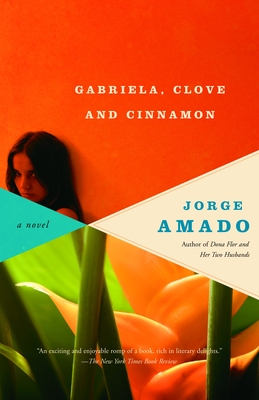
Gabriela, Clove and Cinnamon

I was out last night at a rooftop bar, which served to remind me of just how much I love the indoor smoking ban. I got home sometime after 3 am with hair that smelled of smoke and a sore throat. And now, in the mid-afternoon, I've washed my hair twice and am drinking tea with more than a little honey in an attempt to ease my sore throat while watching Germany take the Australians to school in a thoroughly entertaining manner. (As a side note, these guys are amazing. How is it even possible to be in such good shape?) We're having the perfect gray and rainy weather for a lazy Sunday here in New York though, which makes me feel far less guilty than I otherwise would about sitting around in my pajamas.

Happily, when I was reading Gabriela, Clove and Cinnamon a couple weeks ago, New York was having positively summery weather. And while I, alas, read it in all the usual places--my home, the subway, on a plane ride home from Buffalo--it would make the most delightful of beach reads. It's warm and lightly satirical and ends, as a great comic novel ought, not entirely predictably but happily.

If the makes it sound like a shallow novel, it's unintentional. The story has two strands: an upcoming election that pits the old guard of cacao planters against a modernizing newcomer from Rio and a love story that revolves around the titular Gabriela and Nacib, bar owner and friend to all. Amado concerns himself with a number of serious topics--the position of women in society, the formation of culture and society, class--while skillfully avoiding didacticism. In fact, such self-importance is cheerful sent up throughout the novel. In one of the most entertaining sequences a self-important poet comes to town to give a lecture that all the book's important characters attend.
Tonico broke the silence:
"Do you know the title of the lecture?"
"No, what is it?"
"Tears and Longing."
"Good title," said Ribeirinho, "We'll be bored to tears and longing to go home."
It's a feeling that Amado's readers (and anyone else who has attended their fair share of lectures) is surely familiar with. And a reminder to be grateful for books like this one, the first goal of which is to entertain.

As much as I enjoyed the book though, Gabriela herself, the object of everyone's desire, full of charm and childish whims, resolutely herself in the face of those who would try to change her, struck me more as a plot construct than a character. She exists, it seems, to illuminate the character of those around her and, at times, to provide a catalyst for events. I found myself entertained by, but not terribly involved in, the romantic thread of the novel and not particularly concerned with what happened to Gabriela. Fortunately, the pleasure I took from reading about the political machinations and the healthy dose of comic relief Amado provided in the form of spinsters and philanderers and lovestruck scholars among others more than compensated for that.

It's a thoroughly winning book. The sort that demands little of the reader and yet pays you back richly for your time and attention and reminds you just what a pleasurable experience reading can be.

Saturday, June 12, 2010

Nancy Drew and the Mystery of the Ghostwriters

You know those books that sit on your shelf for ages, patiently waiting for you to summon up the motivation to actually start reading them? This was totally one of those books for me. My grandfather gave it to me, oh, three or four years ago and I was somewhat interested, sure, but not interested enough to actually read the thing. Maybe it's because the Nancy Drew books don't really hold any special place in my heart. I read them, of course, like pretty much every little girl. In fact, Nancy Drew and the Hidden Staircase was the first chapter book I read on my own (my father read me Nancy Drew and the Old Clock). But I can't say I remember any of them particularly well or that I've thought of them much in the years since reading them. I was fonder of the Boxcar Children series and the Black Stallion books.

Even without any particular nostalgia though, I did find the idea of reading about the creation of a character who is, in many ways, the most important heroine in American literature interesting. So finally, after years of guiltily avoiding Melanie Rehak's Girl Sleuth: Nancy Drew and the Women Who Created Her I finally buckled down and read it. It turns out that, for me at least, it was one of those perfectly fine books that you're not sorry to have read but also are not particularly happy to have read.

Girl Sleuth is a dual biography of two women: Harriet Stratemeyer Adams and Mildred Wirt Benson. Adams was the daughter of Edward Stratemeyer, who founded a syndicate that produced series books for boys and girls using ghost writers who were provided with outlines and who created Nancy Drew. After her father's death she--along with her sister--put together the outlines for and edited the Nancy Drew books and eventually, years later, she took over writing the Nancy Drew books. Benson was the hired hand who wrote most of the early Nancy Drews.

Dual biographies are a bit of a double-edged sword. On the one hand, a writer can illuminate her characters through their relationship to one another. On the other hand, you often wind up with a hero and a villain . . . or at least with one character who comes off as far more likable than the other. In this case, I was far fonder of Benson. Both women were pioneers of a sort, striking out into male-dominated fields and finding personal success outside the home at a time when married women were not expected to work. But Benson was the more modern of the two and comes off as being largely responsible for Nancy's can-do attitude and independence. Adams's Nancy is more feminine and lacking in rough edges which, as a modern reader, feels like a step backward. And Adams, toward the end of her life, takes credit for things she wasn't responsible for in a way that makes it seem like her grip on reality wasn't entirely firm. Again and again I found myself far happier to be spending time with Benson than Adams.

What's more, while Rehak clearly loves the Nancy Drew books and she does an excellent job of depicting their cultural importance--although perhaps not for the current generation?--in the end I'm not sure if her book made me appreciate the series more or less. It brings into high relief just how studied and commercial a creation Nancy Drew is for all her good points. And while that's not surprising, I might have preferred to leave the wizard(s) behind the curtain.

Monday, June 07, 2010

Miscellany

1. am New York and I are totally on the same page about the World Cup:I may not know who the favorites are. I'm pretty sure I don't understand all the rules. But I'll certainly be watching.

2. In order to make some extra money I've been working for the US Census--which, if it were a permanent job would drive me to alcoholism in no time flat--and that means that I now how to deal with the management office of the apartment complex where I live. Which is staffed by some of the most unpleasant people I have ever encountered in a professional capacity. So in preparation for having to get information from them tomorrow I am baking them some of the most fabulous cookies in the world. Not thanks to my baking skills--the recipe is just that good. I dislike the people in management so much that I'm having a tough time coming to grips with giving them cookies though, so this had better inspire them to be nice to me.

3. I'm moving in a couple months and while I'm only going to another area of the city, I'm trying to use it as an opportunity to get rid of things I don't want. It turns out that I'm quite good at getting rid of clothing and very bad at getting rid of books. Even books that I bought for 50 cents because I liked the covers and am never, ever going to read. I think that I'm going to need my sometime roommate to go through them with me and remind me that it really is a good idea to pass on books that I didn't even remember I owned in the first place.

Saturday, June 05, 2010

My Dream of You

At times, My Dream of You resembles nothing so much as Philip Larkin's "This Be the Verse" born again as a novel and dolloped with sentimentality. If only the protagonist's parents had been sufficiently warm and involved in the lives of their children there might be no story at all.

Kathleen de Burca is a single, middle-aged Irish expatriate who has organized her life in response to the pain of her youth. She has no real home, few friends. A travel writer, she has shut herself off from the world even as she visits far-flung locales, writing invariably cheerful and witty missives from places that are often anything but. Then her closest friend dies suddenly and this new heartbreak, coupled with the encroachments of age, seems to shake something loose in Kathleen. In short order, she leaves her job and the basement flat she's lived in for decades and heads back to Ireland to research a book.

O'Faolain interweaves the story of Kathleen's return to Ireland with that of the book she begins to write while there--an account of an affair between an Irish servant and the wife of an English landlord during the potato famine--to mostly good effect. What Kathleen wants to find in the events of the past is the kind of idealized passion she has always sought and felt was so absent in her life. History, though, is never so convenient and the story grows steadily more complicated.

I feel like in order to really enjoy this novel (and I find this is often the case with books written in the first person) I would have needed to care about the main character. But I couldn't quite manage to do so. It's not that Kathleen, intelligent and honest although only intermittently capable of self-examination, not unkind though thoughtless and selfish, is somehow beyond the pale. She's not a character who ought to repulse one's sympathy. And yet I found it impossible to summon up much in the way of fellow-feeling. For me, her pain was too often rendered in shorthand: Her father was absent and dictatorial. Her mother, always pregnant, weak, and ill, had little to offer. And this, in the world of the novel, explains everything about Kathleen.

Reading My Dream of You, I began to think that perhaps my experiences, age, and preoccupations are simply too far from hers. These gaps, however, are all things that novelists can overcome; the opportunity to step outside oneself is one of the great joys of reading. I think the problem is that, for Nuala O'Faolain, it seems like the most natural thing in the world that Kathleen would end up the way she does. There's no need to interrogate the subject. So it isn't until the end of the novel that O'Faolain actually made me understand the source of Kathleen's anger and pain. The historical background the author provides is focused on the potato famine--which I actually knew quite a bit about already--and not the Ireland of the mid-20th century which I know virtually nothing about. And that's fine. I'm sure many other readers didn't need more information. But it made me feel that I, a generation or two younger, from a different country and economic background, wasn't the audience for the novel.

Which is a shame, because there was a lot about the book that I liked, starting with writing that is decidedly unfussy and yet vivid, particularly in its evocations of setting and descriptions of nature:

I knew this Atlantic where it broke on western coasts, all the way down to the curve of the earth. I could picture ten or twelve places I’d been where this same ocean met land, from a sturdy village among artichoke fields in Brittany, to the baking sand dunes of Namibia. I’d watched the fog roll in from it every day when I was writing a piece about golf courses in Portugal. I’d lived a few feet from it in a run-down tourist camp on a beach in Senegal, where the crabs clacked around the legs of my bed all night. But I had never before been on the west coast of an Atlantic island, at the turn of spring into earliest summer—never before seen such a wide slope of small fields, their grass patched with the brown of weeds and rushes, fields of a muted and glowing green that lulled the eye, that then was shocked by the huge vista of the turbulent, turquoise sea beyond.

Kathleen sounds like a real person and, more than that, like a travel writer. Observant and occasionally prosaic, she has a knack for picking out a few small details that create a picture. Even if you don't like her, she's a solid, believable character. And as her protagonist changes, coming to terms with both her present and past, O'Faolain explores relationships between women in a way that is genuinely touching, if secondary to the story. The other lives Kathleen could have lived are right there in front of her in the form of her sister-in-law, an elderly librarian helping her with research, and the daughter of an innkeeper, among others.

But if you don't care much about her emotional journey the story begins to feel a bit leaden and repetitive. There's simply not all that much going on and Kathleen spends a lot of time spinning her wheels. Eventually the reader, too, feels stuck in neutral.


Wednesday, May 26, 2010

Books that Defeat Me

Despite the fact that I majored in history in college and minored in classics, pretty much everything I knew about Claudius prior to starting I, Claudius came from A Scandalous History of the Roman Emperors by Anthony Blond. This was also the book that taught me that Romans ate things like sow's nipples in tuna brine and fermented fish sauce. Exhibit A in the argument that the more you learn about history the happier you are to live in the hear and now. Anyway, this lack of knowledge was probably because I got my classics minor by taking four semesters of Latin for my language requirement--of which I remember next to nothing--and one class on the Roman republic for the aforementioned history major. This is what I knew:
  1. Claudius probably had cerebral palsy.
  2. Unlike pretty much all the other Julio-Claudian emperors, there don't appear to be questions about his heterosexuality.
  3. Despite the fact that he's popularly thought of as being one of the more benevolent Julio-Claudian emperors--not a role for which there is much competition--he was actually a bloody ruler who had a crapload of people killed.
So I figured that, given my fondness for historical fiction, I, Claudius would be a good way to dip my toe into the historical waters (theoretically made more entertaining by a heavy dose of make-believe) before taking the plunge into an actual history. Which I still think is a good theory. But three years later I'm only about 150 pages into the book. And it's not a short book. I think it might be time to admit defeat.

And normally I would have no problem with this. I stop books part way through on a regular basis. After all, why waste time on something that is giving you no pleasure? But somehow I got it into my head that this was a book I should read. And then, in year two of my struggle to read it, I decided that I needed to finish it because I'm not a quitter. But now, in year three, my relationship with the book is entirely adversarial and there's no way I'll ever enjoy it at this point in time because it's an obligation above all else. So fine, Robert Graves, you win. Your writing has defeated me and the appeal of your classic work of literature is beyond me. And now the time I spent pretending to read your book will be spent actually reading something I enjoy. So maybe I win too?

Saturday, December 19, 2009

The Good Thief

New York is slowly being carpeted by fine snow tonight. Not nearly a blizzard but just enough to make a person want to stay inside with a cup of hot chocolate and read an adventure story. Or, in my case, post about an adventure story I read at the beginning of the month. It's the kind of weather that lends itself to adventures of the mind while the body tucked up in a chair.

I can understand why a person would read comparisons to Dickens and Robert Louis Stevenson and think that's totally the book for me. What I can't understand is why I would read them and think that. I don't like Dickens at all and I got all of one chapter into Treasure Island. But I read about The Good Thief on some "best of the year" list at the end of 2008, something about the description captured my imagination, and I decided I just had to read it. I think it was the fact that it was set in a kind of alternate New England that appealed to me.

I put it out of my head for awhile but when I saw the paperback (which has a rather less appealing cover) I couldn't resist. Nevermind that I was in the middle of any number of other books and trying to use the library more. I had to buy it because I just knew I was going to love it. And, perhaps unsurprisingly, I wound up disappointed. It's not that I didn't like the book--I did--but that I wanted it to be more than it was.

Tinti creates an engagingly creep, gothic New England full of giants and grave robbers and sinister, behatted men, and it's never short of entertaining. But I wanted the scope of the story to be larger. I wanted to be swept away into the world I was reading about and emotionally invested in the fate of the characters. Instead I felt like it didn't go much beyond a fun, very nicely constructed plot. Which is nothing to sneeze at, really, but I keep insisting on getting my expectations up and then I'm disappointed about books I otherwise would have liked.

Saturday, December 05, 2009

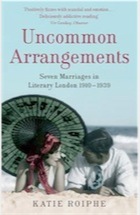
Uncommon Arrangements

You would think that a book about marriages within the Bloomsbury group--the famous "circle of friends who lived in squares and loved in triangles"--would be interesting. Or I would think that anyway. At the very least the gossip should be good. So why was Uncommon Arrangements so boring for me?

I'm not hugely familiar with the work of the Bloomsbury group outside of Virginia Woolf--of whom I'm just not hugely fond--but I did visit Charleston a few years back and found the home, long inhabited by Vanessa Bell and Duncan Grant, beautiful and charming and fascinating. It's why I picked up this book. And my enjoyment of that place is also what made me particularly disappointed by how little I liked the book.

A large part of my issue is that I disliked the structure of the book. Each of the seven couples Roiphe discusses gets a chapter of roughly equal length, and these seven chapters are bookended by an introduction and a postscript. This means that roughly equal time is devoted to each couple even though some are a good bit more interesting than others. It also means that while certain people--Virginia Woolf, for one--flit through a number of the chapters, the central couple in each often feels divorced from their social and artistic milieu (two things that are, after all, not so different with from one another when it comes to the Bloomsbury group).

But more fatal still, for me, is the fact that while you'll finish Uncommon Arrangements with a good idea of how people like H.G. Wells and Vanessa Bell constructed their romantic relationships you won't be much the wiser when it comes to the connections between their work and their views on relationships. Roiphe writes with great insight about the feelings, the ideas, the negotiations, etc. that formed the seven relationships under consideration. But she has less to say about the work that keeps us interested in these people. Well, some of them anyway.

It's not particularly fair to judge a book on what you want it to be rather than what it intends to be. But I don't think fairness has much of anything to do with reading enjoyment. And while Roiphe no doubt succeeded on her own terms--by which I mean she examines the nature of marriage by looking at the unusual arrangements of these famous literary figures--Uncommon Arrangements isn't the book I wanted it to be.

Tuesday, October 13, 2009

On the Nobel Prize for Literature

I can't say that I'm ever particularly excited to find out who has won the Nobel Prize for Literature. It just doesn't generally seem like an effective way to discover new authors whose work I'll actually enjoy. There's a nice essay on Literary Kicks though about the predictable dismay--in the English speaking world, that is--that has greeted Herta Müller's win. Dedi Felman writes:
The problem many non-specialists (and here I count a large swath of publishers, press, booksellers, lovers of literature and non-Germanists etc) have with Herta Müller isn’t that she isn’t known. It’s that, at least until they’ve all had a chance to read her and perhaps discover differently, she’s not better loved. She’s critically acclaimed in Germany, but she’s not a bestseller. She’s topical, but it’s unclear whether her writing is all that accessible.
I think it's a good point that gets lost in all the vaguely (or not so vaguely) nationalistic, decidedly provincial hoopla surrounding the award.

Also I totally agree re: the delightfulness of Wislawa Szymborska. Her Nonrequired Reading is just about the most perfect subway commute reading I can imagine. You know, in case anyone was looking for a recommendation.

Saturday, September 26, 2009

Miscellany (part whatever)

1. When The Millions began posting their "Best of the Millenium" list last Monday I was excited that it seemed evenly divided between men and women. Equal representation on a best-of list isn't exactly common. And several of the women were people whose work I'm not familiar with as well. But then 9 of the top 10 were men. So, in the end the panel put together a fairly typical list when it comes to gender representation. And the list put together by Millions readers was roughly the same. I'm in no way criticizing the panelists or the readers; a quick glance at my shelves is enough to remind me that a list I put together would be roughly the same in that respect.

I also find it interesting that more than half of the six books by women on the panelists' list are short story collections. Meanwhile all but one of the books written by a man are novels. The readers list--also featuring six female writers--only has two short story collections by women. But none at all by men. I don't really have an explanation for this, but I do wonder if we, collectively, are judging literature by standards that are disadvantageous to women.

2. Alastair Macaulay seems a little baffled by the reception some of the performances are receiving at Fall for Dance. I think there are a few things at work here:
  • The tickets are only $1o so people are generally going to be happy whether they love something or not.
  • The wine is $2 a glass and nearly everyone is louder after a few drinks
  • To a greater extent than at other dance performance you have a mixed crowd that includes not only people who go to watch dance all the time but people like myself who attend performances regularly but not frequently and people who almost never see dance. So if something features terrible cliches or whatever a large portion of the audience isn't going to recognize that those things are so done.
  • It's kind of a loud, relaxed atmosphere.
I haven't actually seen any of the Fall for Dance shows this year, but hey, that's not stopping me from making conjectures.

Wednesday, September 02, 2009

Sometimes the internet is an amazing thing...

For some reason today I was thinking about a book I read about fifteen years ago. I couldn't remember the title or the author or the plot. The only things I could remember were that it was about a strange boy and I loved it. It was driving me up the wall though and so I tried googling "young adult book strange boy" and didn't see anything familiar. But then I remembered that the word "alien" came into it somehow, added that to the google search and voila: The Only Alien on the Planet.

Somehow I suspect that this is one of those books that doesn't hold up so well once you're past childhood though.

Monday, August 31, 2009

Augustus

My summer has been going pretty much the way every other season has been going for the last year, which is to say that, for the most part, if it can go wrong it will go wrong. That applies to things both petty (all the shoes I wear to work are falling apart) and more serious (my apartment is a disaster story and my cat is broken), but to top it all off, I'm in a total reading rut. To be fair, I've actually been having decent luck on the nonfiction front. It's just that my feelings about the fiction I've been reading lately have ranged from indifference, to irritation, to irrational loathing. I have to admit, I was even more than a little relieved to read that other people are also experiencing the reading doldrums this summer. But unfortunately, as is usually the case with the whole misery-loves-company thing, that hasn't made my own problem (or my desire to whine about it) go away. I thought I'd write then, about the last novel I completely enjoyed.

There's nothing particularly original about what John Williams does in Augustus. That's not a complaint. I'm just saying that the epistolary novel has been around for about as long as the novel itself, at least in Western literature, and to write about Augustus Caesar is to go down a well-travelled path. But that doesn't matter here.

Augustus covers, roughly speaking, three separate subjects in the life of Augustus Caesar: his rise to power, the exile of his daughter, and his death. John Williams tells the story through letters, diaries, and memoirs. In the first two sections of the novel, these are the works of Augustus' contemporaries. Only in the final section does Williams give voice to the emperor himself.

In his author's note Williams wrote,"if there are truths in this work, they are the truths of fiction rather than of history." Augustus isn't meant to be a biography, fictional or otherwise, and Williams isn't interested in presenting facts. He understands the limits of fiction and nonfiction and chooses not to tell us what happened or why but instead concerns himself with an exploration of power and duty and the sacrifices those twin gods demand. He illuminates the interior worlds that history cannot show us with a broad-minded empathy and in doing so tells us something about who we are--our loves, our needs, our friendships, the way we govern ourselves and the way we are governed--without asking the novel to carry a greater burden than it can bear.

There's something restorative about an author for whom writing is a means of communicating and not a chance to show off their talent for linguistic acrobatics. Williams style is modest and draws no attention to itself. His writing is clean and clear, neither spare nor overwrought but perfectly balanced. This quality seems most refined, appropriately enough, toward the end of the novel, when Williams gives us Caesar through his own eyes.

Letter: Octavius Caesar to Nicolaus of Damascus (A.D. 14)
August 9
Though it was nearly sixty years ago, I remember that afternoon on the training field when I got the news of my Uncle Julius's death. Maecenas was there, and Agrippa, and Salvidienus. One of my mother's servants brought me the message, and I remember that I cried out as if in pain after I read it.

But at that first moment, Nicolaus, I felt nothing; it was as if the cry of pain issued from another throat. Then a coldness came over me, and I walked away from my friends so that they could not see what I felt, and what I did not feel. And as I walked on that field alone, trying to rouse in myself the appropriate sense of grief and loss, I was suddenly elated, as one might be when riding a horse he feels the horse tense and bolt beneath him, knowing he has the skill to control the poor spirited beast who in an excess of energy wishes to test his master. When I returned to my friends, I knew that I had changed, that I was someone other than I had been; I knew my destiny, and I could not speak to them of it. And yet they were my friends.

At this point in the book, we have witnessed the scene where Augustus learns of Julius Caesar's death before. Williams has unfurled the story of the emperor's life already. Early on this particular moment was described by Salvidienus Rufus. He describes a cry, "grating and loud and filled with uncomprehending pain, like the bellow of a bullock whose throat has been cut at a sacrifice," and Octavius alone, "a slight, boyish figure walking on the deserted field, moving slowly, this way and that, as if trying to discover a way to go." But now, with Augustus at the end of his life, we reflect back with all the clarity of hindsight. It's an elegant conceit, and effective because it feels utterly natural. This moment, horrible and marvelous and world-changing, deserves to be revisited and enriched. In his old age, Williams's Augustus can see so clearly, he has become a kind of oracle who knows what will come of all he has built, the limit of his power, and accepts it. It's a beautiful thing in its way.

It's surprisingly hard for me to write about Augustus. Here I have this beautiful object in my hands, this work that is complete and whole, and I find that I don't want to pick at it too much. I've been working on this post for much longer than I'd like to admit (because something with this much time devoted to it ought to be less half-assed). So it goes.

Friday, August 14, 2009

I managed to come down with a nasty cold at the beginning of August and as soon as I started feeling fully functional my cat managed to hurt the feline equivalent of his wrist. Which sucks for numerous reasons, including the fact that I had to cancel a trip to the Adirondacks with my father to take care of his pathetic, barely-upright self. And as if that weren't enough to deal with, my mother has been in town. Which is fantastic, actually, because I love seeing my mother, but has also contributed to my feeling like I have a lot on my plate. On the bright side though, I'm more caught up at work than I've been in at least a year. Our summer interns? They are fabulous.

So while I haven't been doing much that's interesting to blog about here in the dog days of summer, I have been reading.

The -Ookies are counting down to hockey with fabulous pictures that make me wish that my camera wasn't broken. And that it was better. And that I could take such nice pictures. And that I had jars of chocolate chips.

The Millions tackled Malcolm Gladwell's (shabby) stab at literary criticism. The main problem, as I see it, is that Gladwell doesn't really seem to appreciate the difference between the kind of fun cultural criticism he normally does and writing about literature. He tackles the two things the same way and treats the characters as if they're real historical people, the novel as if it's artless. And his conclusion is particularly egregious: "A book that we thought instructed us about the world tells us, instead, about the limitations of Jim Crow liberalism in Maycomb, Alabama." Even if we accept the idea that To Kill a Mockingbird "instruct[s] us about the world" in a way that's different than the way that all great literature and art does so--a conclusion I'm not particularly inclined to agree with--we're still left with the fact that telling us about the limits of Jim Crow liberalism in a particular place in time is instructing us about the world. Not the way we're instructed by a history class though--the way we're instructed by a novel: through thoughtful reading and fierce attention.

I'm not fussed about Gia Kourlas saying bad things about the program Tulsa Ballet performed at the Joyce. I didn't see it so I'm not in the position to agree or disagree with her, but if she didn't like it she didn't like it and should say so. But I do wish she hadn't started her review with a somewhat condescending paragraph that begins by saying, "State government doesn’t normally shut down for ballet, but you wouldn’t have believed it judging by the dignitaries who spilled into the Joyce Theater on Monday night," and finishes up by claiming, "It was surreal—the whoops that erupted as the curtain was raised were a bit much—but it was also sweet to see such hometown pride." It just feels to me like she's looking down her nose at the Oklahomans. Of course small cities are proud of their cultural institutions. Of course they're going to come and support said institutions when they perform in a cultural capital like New York. It's a big fucking deal when it's something they only do once every few decades instead of all the time. I can't say I'm at all surprised that Oklahoma bigwigs came. And as for the whooping at the curtain raising . . . yeah, that doesn't surprise me either. People tend to be a bit more vocally enthusiastic outside New York. It doesn't mean they need to be portrayed like they just might be overexcited yokels.

I just read most of Love Begins in Winter. Then it became the first book in quite some time that I actively chose not to finish. Van Booy's writing is full of lovely lines and scenes, moments of genuine beauty, but they seem to come without real regard for the stories themselves. This one for example: "In the far distance, Sunday parked over the village like an old mute who hid his face in the hanging thick of clouds." I don't even know what that means. That it was quiet and foggy? That the author is trying rather too hard on the evocative imagery front? That he thought up that line and had to get it in there no matter what? Some combination?

My big issue though, is that there's so much that just doesn't feel true to me. The story that really killed me though is one that contains a scene wherein the protagonist and her boyfriend go on a trip to the Adirondacks. They hike nine miles “up into the white breath of the mountain” go off trail to a river with a large and flat enough rock for them to make love on, which isn’t soaked although it’s just been raining because “it’s amazing how quickly the sun dries the earth after it has been washed.” Now having spent some time in the Adirondacks I find it hard to believe that if it's just been raining you're going to be amazed at how quickly the sun dries things. Or that you'll feel like said rain has cleaned anything. Because you'll be hiking in mud. And if you've been hiking up for nine miles you are a) on a hell of a long day hike and b) probably not near any rivers large enough to contain a rock that sizable and flat. It doesn't seem real; it feels like Van Booy just wanted the scene. Particularly because while they've been busy having sex and taking a nap, their champagne glasses have rolled off into a rock pool where they stand upright. There, we are told, “Each glass held the weight of an entire river without knowing where it came from and how much was left.” Say what? That sounds nice and serious and all but it doesn't mean much of anything, which is pretty much how I felt about so much in this story collection.

Tuesday, July 28, 2009

The Nimrod Flipout

We had a briefly impressive storm here in New York on Sunday night. I had to run around closing windows and by the time I got to the balcony door--I leave just the screen door shut pretty much all summer, rain or shine--there was a puddle on my kitchen floor. Yesterday morning there were big branches covering the sidewalk near my apartment. I don't think there've been any storms like that in the time I've lived in New York so it felt a little bit like being back in Buffalo.

I finally read a book that cured my case of the blahs. Unfortunately that's because I really didn't enjoy it. It's an awfully slim book--about 160 pages--and yet it includes thirty separate stories. And they all start to seem awfully similar pretty rapidly. The names are different, and the details of the story are different, but really, underneath the frippery, they're the same: anxiety-ridden, jittery, relentlessly modern. The characters are glib and disconnected, the storytelling truncated. And, with the exception of the sameness, there's not really anything wrong with those things. It's a sort of fiction that's not really to my taste, but I think it's good that someone's writing it and I think it engages with the present day in a different way than a lot of the fiction I like best.

At first I thought maybe it was the length, or lack there of, that was giving me a problem. That the stories didn't have a chance to develop properly. But the longer stories--and "longer" is relative here--get tedious quickly. Maybe it's the prose that throws me. It's not a prose style I'm particularly fond of and that probably contributes to my boredom. I'm reading this in translation and speak no Hebrew whatsoever so it's hard to know where exactly the problem lies for me. But nevertheless, the stories have a very distinctive (and consistent) tone.

One story, "Glittery Eyes," starts:
This is the story of a little girl who loved glittery things more than anything else in the whole world. She had a glittery dress, and glittery socks, and glittery ballet slippers. And a glittery black doll named Christy after their maid. Even her teeth glittered, though her father insisted that they sparkled, which wasn't quite the same.
In the story the little girl wants glittery eyes to go with her glittery dress, and her glittery teeth, etc. But she can't have them. Another story, "A Thought in the Shape of a Story" features a similar theme, and that one begins like so:
This is a story about people who once lived on the moon. Nowadays, there's no one up there, but up until just a few years ago, the place was mobbed. The people on the moon thought they were very special, because they could think their thoughts in any shape they wanted. In the shape of a pot, or a table, or even in the shape of flared pants. [. . .] It was all very impressive, all those shaped thoughts, except that as time passed, all the people on the moon came to a kind of agreement about how every thought should look.
There's a man on the moon and he wants to think his thoughts into different shapes. But he doesn't get what he wants. Both stories are about three pages long. They're not next to each other in the book, and are separated by a good number of stories, but they're close enough that you can easily read them in one sitting and they're not the only two such stories in the book anyway. Individually, I don't dislike the stories. In fact I find the ending of the one about the people on the moon oddly, beautifully sad. they're not really as interesting in combination as they are on their own merits.

I think that's what was particularly frustrating about this book for me. Keret has something to say and the skills to say it. But actually sitting down and reading my way through The Nimrod Flipout made me want to toss it out the window. Perhaps it's a book I would have been better off dipping in and out of rather than reading straight through . . .

Thursday, July 09, 2009

A Woman in Jerusalem

I love my family, but oh do they make me long for quiet (well, the loud side of my family anyway, which is the side I mostly spent this latest holiday with). I got home and it was totally quiet and such a relief. Of course my apartment is a train wreck and my cat is essentially dying of a nice heart disease/kidney failure combo (although hopefully he's dying very slowly--keep your fingers crossed, folks) so you can't have it all.

Between the bus rides to and from Virginia though, and some stolen moments during my stay there, I was able to finish A Woman in Jerusalem by A. B. Yehoshua. It's not that I didn't like it, but I had the same problem with it that I've had with most of the books I've read so far this year: I enjoyed it, but I could put it down; it had as its subject an interesting topic, but it never seemed to go as far as it needed to; I wanted to like it but was, in the end, was left with vague feelings of dissatisfaction.

Jerusalem explores issues of societal responsibility, the kinds of love--most particularly those sudden and inexplicable bursts of fellow feeling, sympathy, and affection that can take us unawares--that tend to get short shrift both in literature and in life, and guilt. By identifying the characters by occupation or position in life--the human resource manager, the emissary, the ex-wife, the consul, etc.--Yehoshua seems to be making a sort of gesture toward universality as well as situating his characters within a larger society. It's not an uninteresting set of preoccupations for a book. The problem is that it's so damn tasteful (even the jacket cover is polite). I feel like it's a book that needs a bit of dirt under its fingernails.

Still, I'm beginning to wonder if the problem is really the books or if it's me. Am I too distracted or preoccupied to appreciate what I'm reading? Have I become a lazy reader who wants to be hand fed? Am I just doing a shitty job of choosing books that will speak to me? Whatever it is, I hope my reading luck turns around soon because I could really use some time with a great book just now.

Tuesday, June 23, 2009

The Woman in the Dunes

My office has summer Fridays, which means I get out at 1:00 every Friday between Memorial Day and Labor Day. And every Friday this year I've made plans about the things I'm going to do with my free time: I'm going to go see the High Line, I'm going to wash my windows, I'm going to find a father's day gift . . . but every Friday I've gone home and taken a long nap. This week I'm blaming The Woman in the Dunes for that. Seriously, even the cover makes me feel like sleeping.

The story here is that an amateur entomologist spends the day at a beach looking for some kind of beetle, only to have the residents of a nearby village entrap him in a pit. There he is to help a woman shovel away the ever-encroaching sand that threatens to destroy her home. He plots various ways to escape--sometimes rather hysterically--only to pass up an opportunity at the end of the book. This is no surprise to the reader, not only because he seems like a fairly incompetent person but also because we were told at the beginning of the book that he was declared dead after being missing for seven years.

For me, the book was mostly a reminder of just how much I dislike novels where symbolism and allegory take precedence over character (and how little I enjoy existentialism in novels). Here we are, the people in the sand pit, endlessly shoveling away a la Sisyphus. Oh, the meaningless of life. The way the daily grind wears down any desire we have for freedom or joy. Blah fucking blah.

I'm being dismissive though, of a novel that doesn't deserve such treatment. It's not a bad book, just not to my taste. Abe is an evocative and stylish writer and the plot is neatly constructed and spare. The sand, pervasive, unrelenting, corrosive, becomes a character. After his first night in the sand pit that is to be his home, our protagonist wakes coated by sand:
Quickly he jumped up. The sand that had accumulated on his face, head, and chest fell away with a rustling sound. Around his nose and lips sand was encrusted, hardened by perspiration. He scraped it off with the back of his hand and cautiously blinked his eyes. Tears welled up uncontrollably under his gritty, feverish eyelids. But the tears alone were not enough to wash away the sand that had become lodged in the moist corners of his eyes.
[. . .]
The whole surface of [the woman's] body was covered with a coat of fine sand, which hid the details and brought out the feminine lines; she seemed a statue gilded with sand. Suddenly a viscid saliva rose from under his tongue. But he could not possibly swallow it. Were he to swallow the sand that had lodged between his lips and teeth would spread through his mouth. He turned toward the earthen floor and spat. Yet no matter how much he ejected he could not get rid of the gritty taste. No matter how he emptied his mouth the sand was still there. More sand seemed to issue constantly from between his teeth.
The combination of the unpleasant nature of the sand and its inescapability is unpleasantly vivid. After all, most things become nearly unbearable when constantly present but anyone who has ever been to the beach knows how badly you want to wash the sand off after leaving. Reading the book I felt itchy and grit-covered myself. And any desire to go to the beach in the near future? Gone. (Convenient given the shit weather we've been having here in New York of late.) For me though, the quality of the writing wasn't enough to make up for the fact that I just didn't care about the characters or what happened to them.


Sunday, May 03, 2009

Enchantress of Florence

This seems to be a polarizing book. The people who hate it--and they are numerous--really, really loathe it. The New York Times review said that the novel, "revels in writerly self-congratulation," and even if you, like me, wind up liking it, I don't think you can argue with that. That Rushdie is a flashy writer isn't a surprise at this point. He likes to show off, to pull literary tricks our of his hat, to draw attention to just how good he is. That's a feature of even his best books like Midnight's Children and there it's a part of what makes it a great novel. But here there's no restraint and it leads to a book that's fun but horribly overwritten.

The real problem with this--setting aside the eye-rolling moments--is that it's all surface. There's a lot going on but nothing getting done and you don't really give a shit about the characters or what happens to them. So I guess how much you like the book depends on how much you care about that.

Wednesday, April 29, 2009

Dribs and Drabs

So much to say and so little time to say it. Isn't that always the story. A few things:

  • I like to talk but don't definitely don't love to hear myself talk. Still, I loved listening to the Performance Club audio that Claudia just put up. Despite cringing when I heard my own voice (I find that so unnerving) I liked revisiting bits of conversation with more distance from the performance and also hearing things I missed. And selfishly I hope that these audio recordings are done for more events, particularly ones I can't attend with the P. Club, because the post-show conversations are such an enriching experience for me and it would be fun to sort of eavesdrop when I can't take part. 

  • I'm really enjoying New York magazine's "Vulture Reading Room." I have no desire to read Charlotte Roche's Wetlands. It sounds genuinely awful, and not in a fun way but in a just-plain-atrocious way. But reading about it has been genuinely entertaining and this back-and-forth particularly so. Hopefully they'll continue the feature for other books. 

  • My younger sister is hiking the Appalachian Trail right now and the other day she did 29 miles. Seriously. In one day.  I, meanwhile, walked to Central Park and, entering from the southeast,went up around the Great Lawn, and back. I promised I'd hike with her for a few days later on, you see, and I need to train. So far? Not such a good start. 

  • PEN World Voices has started and as always I'm looking forward to it. Although it's a disappointment that the NYPL doesn't seem to be taking part this year as their panels, etc. are usually particularly interested. Tomorrow--today, really--I'm going to watch a panel about women translating women. I'm looking forward to that.

Thursday, April 23, 2009

A Handbook for Visitors from Outer Space

There are so many books published every year, such a deluge of good, bad, and indifferent writing, that it's easy for books--even very good books--to disappear. They get tucked onto shelves, or added to reading lists only to be forgotten about. And eventually time passes and they haven't become classics so they fall out of print. Which is all to say that there are more good books than there's time to read and as a result, every reader has their little--or big--mental list of books that aren't as well known as they deserve to be and/or are out of print when they should be in print. Kathryn Cramer's A Handbook for Visitors from Outer Space is one of the books on my list. I bought it several years ago at a Strand sidewalk sale where you could fill a bag with books for $10. I've been thinking about the book lately and was surprised that I'd never blogged about it before. I must have read it just before I started this particular exercise in solipsism. 

Published in 1984, Handbook now feels very much like a product of it's time. It opens describing a war that isn't the Cold War but resembles it: 
The war had been going on for some time now, through sun and sleet, through lenient days when the buds bloomed according to the old seasons and the light breeze rattling windows and doors brought thoughts of white triangles scudding across a blue surface, through March thaws when the heavy, wet snow slid from the tankslike blankets from people asleep.

No one knew when the war had started, by whom or with what purpose. It had not been declared. Those who tried to join up could not discover where to present themselves. They knocked on doors of official-looking buildings, wrote letters to the government, but received no response. The government appeared to draft its forces according to some rationale not divulged to the public. Nor did it provide information about the progress of the war; ambiguous reports occasionally appeared in the newspapers but were printedin the back pages among advertisements for notepaper and knitting wool, so that onehad to look hard to find them. Tradition, people complatined, entitled them to more than vague uneasiness--someplace to volunteer their services for the wounded, a slogan or two, a battle hymn. But in this war there was nothing to do except wait around to see what would happen next.

An apocalyptic novel (which is normally really not my thing) that revolves around the disintegration of the traditional world and of meaning, Handbook slots in nicely with contemporary post-modern novels like White Noise.  Except without the pop culture reference piled atop pop culture references (which are also really not my thing). Instead Cramer gives us a memorably quirky royal family in exile, about as far removed from popular culture as it's possible to be.
"Royalty in exile is a curse, like insanity or an enherited inclination to murder," the woman who had called herself the Crown Princess Theobalda said on her deathbed. "Find the cure!" she whispered hoarsely, and expired. (This was in New Jersey, in 1902.) But her son Langoustino (so named in tribute to one of the Crown Princess's gastronomical fondnesses, not by way of a clue to the Ludwickers' country of origin) was more impressed by the cleverness of his mother's epigram than by its entreaty and did little during his unofficial reign to advance the family cause. His only contribution was to produce, with the half-hearted assistance of a frivolous but apathetic local girl named Jeannine, four children to carry on the Ludwicker line.
The Ludwicker family lives in isolation from the rest of the world, and whenever they leave their estate they upset the balance and bring chaos with them and this clash between old and new is what the book revolves around. But as nutty and divorced from normal people as they are, they do, on a certain level, represent tradition. They're a stand-in for modern people, overwhelmed and unable to comprehend the pace at which the world has changed around them. This is all a tremendous oversimplification of course, and it doesn't sound terribly appealing. I mean, if someone told me about this book I would probably think hmm . . . doesn't sound like my thing. But I love Handbook despite that. Or perhaps because of that. Unexpected loves are always particularly satisfying.