Tuesday, December 04, 2007

What I'm Reading...

...or at least what I'm reading when not totally stressed out. Normally I'm totally chill about the holidays, but this year I somehow got behind the ball and can't get back in front of it. Yikes. Anyway, today was my company's "End of Year Celebration" which was a surprisingly pleasant early evening thing. And on a holiday side not, happy Chanukah to those who celebrate. As the atheist daughter of a Catholic and a Jew I grew up celebrating the holidays of both religions and I still take a great deal of pleasure in lighting my menorah, even if it is only because it's pretty.

But anyway, on to my reading material:
  • Last week's New Yorker was particularly good, I thought. They had a piece on endogenous retroviruses called Darwin's Surprise that was just fascinating. I also had reason this week to revisit one of my very favorite New Yorker articles, Angels and Ages: Lincoln's language and legacy. I'm very interested in rhetoric and the way that slight changes can significantly alter tone and meaning, so this is very up my alley.
  • There's been discussion (debate even) in the hockey blogosphere lately about just what hockey blogs are for and how they should operate. The most recent round of discussion started with a post on James Mirtle's blog. That post inspired Pookie and Schnookie of Interchangeable Parts to examine their goals as bloggers with a series of very interesting questions and they've invited others to do the same. So far they have responses from Katebits of The Willful Caboose and Amy of Shots off the Crossbar, with more answers expected. It's an interesting topic to me not only because it relates not only to issues of access, methodology, and professionalism, but to the fostering of community and communication, something I consider to be among the most significant internet-related benefits in my life. (Edit: Heather B. has her responses up as well at Top Shelf.)
And now, I have some presents to wrap.

Sunday, December 02, 2007

New Look

Figured we'd go with a new, wintery look now that we've had our first snow.

Rugelach

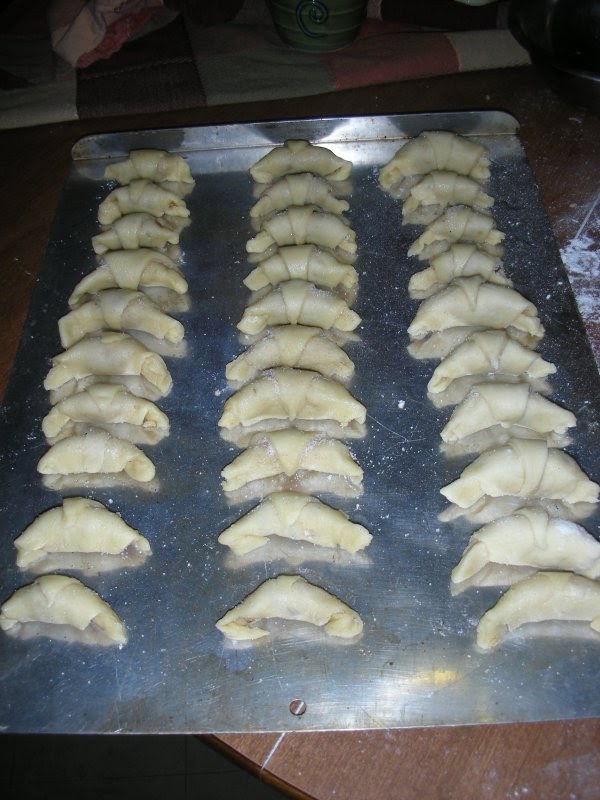
Well, if you've got a new oven you have to cook stuff in it, right? So of course I choose to make one of the few things that cooked up just fine in the old oven as well. Hey, it may be time consuming, but it's also easy to make.

The recipe was my great-great grandmother's and like most people of her generation, she didn't actually measure the ingredients when she made things. My grandmother, who used to bake with her, did take the time to figure out general measurements, but there's still a lot of "add about . . . " and "add cinnamon until light brown" type stuff, so if you get the amounts off, it's not the end of the world. I've yet to truly mess them up, and I can cook pretty much anything badly.

And below is the reason it's so time consuming . . . all that cutting and rolling.
Of course, the recipe also makes about 60 , but they always seem to go pretty fast.

Saturday, December 01, 2007

Ode to Ovens Old and New

I feel like buying an oven is my first really big adult purchase. I bought an appliance so I must be a grown up now, right? Of course it was also quite necessary and I'm totally excited to have a new oven. Our old one was about 45 years old, so to say that it was time is quite the understatement.

It was a charming shade of avocado green--not captured in all it's vibrancy in these pictures--and possessed of peeling paint.

Dating from the days before self-cleaning ovens, and owned by lazy people who rarely cooked, its interior was less than immaculate.

It was none of these features, however, that convinced us to dump our faithful oven for a younger, sexier model. Sure, it may have been nearly a quarter-century older than either of us, but we like to think we could have made the age difference work. Sadly the oven had a fatal flaw. Whatever doohickey regulated its temperature no longer worked, so it was always either off or on it's way to 525 degrees. The only way to control the temperature was to monitor it with a thermometer and open and close the oven door--all the way because you couldn't open it a crack the way you can a young, fit model--and you just can't bake that way. Everything comes out icky and unevenly cooked. Or it burns on one side and not on the other.

So it was that we bought a new oven. And while we bought the stove Consumer Report rated at the best value and it is by any definition a cheap stove, it is an unavoidable fact that compared to the old stove it is rather beautiful.

Oh, and if anyone reading this has ever wondered what the floor under something that hasn't been moved in over forty years would look like, wonder no more. It would look like this:
Lovely, huh?

Friday, November 30, 2007

Sweet Honey in the Rock

You know those colds that just hit you suddenly--one second you're fine and the next you feel like absolute shit? Yeah . . . I have one of those. I was fine until about 3 o'clock today and then BAM! So more than anything I wanted to go home and crawl into bed. Wasn't possible though because I had to meet my grandmother for dinner and a show.

Yesterday, when I was feeling fine, I'd chosen a Chinese food place. About the last kind of food I want when I'm sick. So it's fortunate that the place turned out to be quite good. The food was arguably a bit on the bland side but I'm pretty much the queen of bland food so that's fine with me. Anyway, what I liked was that the food was not greasy or oily. And the asparagus I had with my meal actually had some crunch to it still. Very nice.

Anyway, we were going to see Sweet Honey in the Rock at Carnegie Hall. If you're not familiar with them, and I certainly wasn't, they're an African American female a cappella group. They basically sing spirituals, hymns, gospel, jazz, and blues. I'm sure I've mentioned before that I'm not in any way religious. And my tolerance for most religious things is . . . limited, let's say. My tolerance for religious music like gospels, hymns, and spirituals on the other hand, is nigh endless. So that stuff was fine.

Less fine was the mother earth, light in the soul, just being good and kind to each other will bring about world peace stuff. I don't do well with that sort of tripe at all, particularly when I've got a sinus headache and my nose is running like a faucet. Still, the music was very lovely, they're incredibly talented women, and it was a nice evening out.

Tuesday, November 27, 2007

Andrea Zittel

So the other day, in talking about Project Runway's decidedly quirky Elisa on a message board I frequent, I was reminded of the clothing that Andrea Zittel creates. When I was in Buffalo last Christmas my mother and I went to see an exhibition of her work at the wonderful Albright-Knox Art Gallery. Her work investigates the conventions of everyday life: what we need, what we want, what we do or possess because it's expected of us, the interplay between freedom and restriction, etc.

Zittel creates multi-functional living spaces and conducts experiments on herself, living within strictly established parameters for set periods of time. She creates tiny living units, islands, and furniture among other things. It's all rather fascinating, I think, although it must require rather more self-discipline than I have.

But the connection I made between Elisa and Zittel is in regard to Zittel's Uniform Project. She makes uniforms that can be worn every day for six months. No more decisions about what to wear in the morning. But she didn't only simplify the act of dressing in this manner. She also created her clothing out of progressively more basic elements. Initially she made clothing entirely out of rectangles (the shape fabric is in when you purchase it) and then she moved on to clothing made out of yarn, first crocheting these "single strand" garments and then developing a technique for hand knotting them, thus eliminating the need even for crochet hooks. Finally she began creating fiber form clothing, which involves hand felting and requires no cutting or sewing at all.

Now, I'm not saying that what Elisa does is the same as what Zittel does. For starters she comes off as more flaky and spiritual and less intellectual than Zittel. It seems more like she is trying to find a happy coexistence with the world at large than to interrogate it. But I do think that there are similarities in the desire to meld art with craft and design. That's rather more interesting than designing art for celebrities. It might make her wrong for the television show, but I'm definitely interested to see what she comes up with.

There's not much point to this entry except to say that Zittel is awesome, and Elisa just might be as well.

Sunday, November 25, 2007

Thanksgiving

Spent the holiday in southern Pennsylvania with my father's side of the family as we've been doing for the last few years. It's always nice to get out of the city for a few days. And we spent a lot of time walking around on wooded paths.


Wednesday, November 21, 2007

This and That

I'll be traveling to my aunt and uncle's for the holiday, where I'll see a whole bunch of family, so after today things will be silent here for a few days. Though I imagine most people will be doing cooler things than looking at my blog anyway. Not that that's difficult.

And speaking of cooler things, here are some of the things I've been reading lately:

HLOG has the preview for Breakfast with Scot up
. The movie looks fairly sweet and it's nice to see the Leafs, and, shock of shock, the NHL doing something slightly forward thinking by giving the movie their approval.

One of my favorite dance blogs, Apollinaire Scherr's Foot in Mouth, has a discussion going on about choreographers and the audience here, here, and here, which has given me lots of stuff to think about.

The New York Times has a very positive review of the Dylan biopic I'm Not There. I have no idea if I'll like the movie, but I'm very much looking forward to seeing it anyway.

Well, have a good holiday folks.

Monday, November 19, 2007

Henning Kronstam: Portrait of a Danish Dancer

Part of my ongoing learning-about-dance project. How I decided I was going to read a rather lengthy biography of Kronstam as opposed to a dancer I had actually heard of--there admittedly aren't many--I don't actually remember but I somehow came to the conclusion that this would be the thing to do so off I went the Library of the Performing Arts to borrow it. Of course I took it out just before I went to Japan and I couldn't take it with me because, I'm telling you, it's like a brick, so I had to put off reading it. Then I got home and was in the middle of a bunch of other stuff. Long story short, I only finished it just now. So as usual I "saved" money by getting something from the library only to undermine myself by keeping it forever while forgetting that I could renew it online. Ladies and gentlemen, I am nothing short of a genius.

So, about the book itself . . . I think that you can very often tell how a biographer feels about their subject and it seems clear that Tomalonis liked and respected Kronstam as both an artist and as a person. This is not particularly surprising given that the book was written with his cooperation. Unlike some biographers working with the subject's assent, Tomalonis traffics in neither rumors nor outright lies: she makes clear when she or someone else is speculating, when there is not enough evidence to support an assertion, and when something is simply unknowable. There are other ways too in which she is clearly a writer motivated by what is moral. There are times where she could have pushed Kronstam to talk about or explain things and it would have been better for the biography but also, it seems, unkind. Likewise, Tomalonis shows a respect for her subject's privacy than many biographers do not. This isn't actually something I have much of an opinion on. If someone wants to cross the boundaries of good taste--and Tomalonis doesn't even approach those boundaries in my opinion--that's their business. The only place where I thought more elaboration would have helped was when it came to his life with Gerstenberg. Not because I'm nosy and want personal details, because I don't, but because it seems to me that this man who lived with Kronstam for so many years might have interesting things to say about him as an artist or opinions on how his life and experiences effected his art. Perhaps not though. It could be that there was nothing to write in that direction and that's why Tomalonis doesn't go there. Beyond that, I didn't love the I'm-a-doctor-who-never-met-the-man-but-I'll-give-my-medical-opinion-based-on-the-book note at the end, but I can live with that. So anyway, it's a lovely biography.

As I see it, the biography had two main purposes: first to provide an accurate picture of Kronstam as a dancer and second to defend his reputation against various misconceptions that were--are?--prevalent. I'm glad she undertook the second--though at times her treatment of him approaches hagiography--but it was the first that I was more interested in.

What particularly struck me was that the focus for him always seemed to be "why" of the movement, not on the "how." While a dancer obviously needs to know how to move in the proper way, what concerned him was that he or, when he was teaching, they, understood why they were moving in that way--what they were trying to convey. And by understanding this why he--or they--could communicate emotion and story to the audience. Hmm . . . needless to say this is more clearly expressed in the book, often through extensive quoting. Tomalonis writes:
Nearly every dancer had an example of how Kronstam would insist on finding the meaning behind the movement: "You should feel that you are at one with the part you are doing. With Henning, I never felt that I should be trying to do the steps and do a character, " asid Alexander Kolpin. "He would always make you understand that this character is not dancing a variation to show off his beats. He is showing the love for the slyph--or whatever. He felt that when you are a dancer, you are a human being, and the steps are your tool to express feelings. Henning was always good at encouraging people to feel emotionally involved with what they're doing. The whole atmosphere makes the character. It's not that everyone can do James the same way."
Obviously here Kolpin is talking about the development of a specific character but the approach isn't exclusive to the one character. It was really quite fascinating.

Aside from presenting Kronstam's view of dance, Tomalonis is wonderful at describing dance in a way that's thankfully un-flowery while being quite clear. Reading the book, you could actually see the movement being described. And perhaps more importantly, the qualities of the movement. Good stuff.

I'm not convinced that this is going to suddenly make me a better observer of dance in general, but I do think that if I were to see one of the ballets that's actually discussed I would notice things that I would otherwise miss. Which is good because I need all the help I can get. And frankly, the little program notes explaining the story--if there is a story--don't do much of anything. They tell you what is going on but they don't explain how the movement is related to what's going on. And that's what Kronstam, through the interviews Tomalonis conducted, does. That seems to me to be a very valuable service indeed.

Sunday, November 18, 2007

Cuteness Break

I was having a lazy day at home today, and if there's one thing the cats love it's when my roommate or I spend a lazy with them.

Considering sleep.

Deciding it's actually quite a good idea.

Friday, November 16, 2007

Fire from Heaven

The first Mary Renault book I read was The King Must Die, which my father gave me to read when I was in 5th grade. I recall feeling like it was a very adult book. No doubt because it had sex in it. It was all thoroughly non-explicit but hey, I was in 5th grade. Anyway, I remember it being a good book with a fully-realized hero who had a definite dark streak. And it's precisely the lack of these shades of gray that is the problem with the first two books of Renault's Alexander trilogy (I haven't read the third).

I suppose the thing to know about Renault's Alexander novels is that she quite clearly adored Alexander. To the extent that he's not so much a human character in her books as a repository of ideas and virtues. There's a clear agenda: to absolve Alexander of any great crimes in some way or another while establishing what a great man he was. This attitude is more problematic in The Persian Boy because the historical Alexander commits his actual atrocities after becoming king of Macedon, but it's certainly evident in Fire from Heaven as well. Now I'm not saying Alexander was a monster, or that he should be judged outside the context of his time, but the fact remains he that he killed an awful lot of people and that should throw something of a wrench in Renault's podium building, but it seems to have no effect.

Setting aside the two-dimensional wonder of a hero, Fire from Heaven has the typical strengths of Renaults historical fiction: a vividly depicted world, a clear manner of conveying historical information, and a deep understanding of the culture she is writing about.

Tuesday, November 13, 2007

The Master and Margarita

Now that I'm done with the Japan trip recap and life should be fairly slow for the next week or so, I can go back to the more usual material of this blog: rambling inanely about things I've been reading. And for the record, the forthcoming post is both rambling and inane, and doesn't say all that much of value about the book. Go figure. I'm behind on that too...this is a post I started back in September.

I've managed to get this far in my life without reading the new testament. I mean, I've had to read bits of the Bible in school: Genesis, Exodus, one of the gospels although I don't remember which one...but for the most part, I've been able to get away with avoiding all the Jesus stuff. So it's a good thing this book has plenty of endnotes. Although, on that subject, let me just say that I fucking hate endnotes. Having to constantly flip around in a book is a pain in the ass. I wonder if a book with footnotes is more expensive to print because, as a reader, they are so much easier to use. Actually, thinking about it, I doubt their more expensive to print these days...it's probably that most people inexplicably prefer endnotes.

And speaking of things I haven't read, I also haven't read much Russian literature. Some poetry of course, and some Chekhov, but I only got about seventy pages into Crime and Punishment and that pretty much rounds out my Russian lit experience. When you major in English literature you really don't read much work in translation and don't have much time to read anything other than what's assigned. Or I found that to be the case, anyway. I've been trying to read more literature in translation for the past year and a half (slightly more time since finishing school) but I'm very pokey. So what I'm saying here is that I have no context in which to consider this book.

While I haven't read any of the other translations, I found the one I was reading--by Diana Burgin and Katherine Tiernan O'Connor--to be very good. It's simultaneously a funny, witty satire filled with puns and jokes, and an allegory, neither of which can be easy things to translate. And yet there are none of the signs of strain or stiffness that so often appear in translated work. In the excerpt below the Devil, who has descended upon the officially atheist Moscow, is putting on a magic show with his assistants Fagot and Behemoth.
"And by the way," said Fagot, pointing at Bengalsky, "this fellow is getting to be a bore. He keeps butting in when nobody asks him to and spoiling the performance with his bogus comments. What should we do with him?"

"Tear off his head!" came a stern voice from the balcony.

"What did you say? What was that?" said Fagot, responding to the ugly suggestion. "Tear off his head? Now that's an idea! Behemoth!" he screamed to the cat, "Do it! Eins, zwei, drei!!"

Then an incredible thing happened. The cat's black fur stood on end, and he let out a spine-tingling "meow." Then he shrunk into a ball, and like a panther, lunged straight at Bengalsky's chest, and from there leapt onto his head. With a low growl, the cat stuck his chubby paws into the emcee's greasy hair, and with a savage howl, tore the head off its thick neck in two twists.

The two and a half thousand people in the theater screamed in unison. Fountains of blood spurted from the severed arteries in the neck and poured down the emcee's shirtfront and tailcoat. The headless body's legs buckled absurdly, and it plopped onto the floor. The hysterical screams of women were heard. The cat handed the head to Fagot, who lifted it up by the hair and showed it to the audience, and the head cried out desperately to the whole theater, "Get a doctor!"
The humor there, black as it is, comes through clearly. In other places it's more difficult, and there the references and allusions are carefully explained in the footnotes. Although I'm sure many of the jokes are funnier when they don't have to be explained--as jokes tend to be. Still, the kind of satirical, dark humor the book is rife with probably comes across better than other sorts would.

Of course, the humor isn't the most important thing about the book. It's also about the freedom of the spirit, our responsibility to what is true, love, and many other things. And if I wasn't both tired and feeling a bit removed from writing about this at the moment I'd write more about those things. Oh well. Suffice it to say, it's a wonderful book.

Monday, November 12, 2007

Excuse me?

I was reading James Wolcott's blog, as I do from time to time when I feel that I can stomach the whole snide and arrogant persona, when I reached this post. After mentioning that Laura Jacobs is his wife, while making it seem as though this is a silly thing to have to do--which, as an aside, it most certainly is not--he quotes a long section of her latest review in the New Criterion.

Now, in my effort to learn more about ballet, I've been reading quite a bit of dance criticism lately, but I haven't read much of Jacobs's work beyond some criticism of Mark Morris with which I strongly disagreed, because I'm not a New Criterion subscriber. So I was quite interested in reading this excerpt from her review of ABT's Sleeping Beauty. She writes:
As always, Part's first appearance, her entrance in Act One, lifted the ballet to a higher and, because of her height, stranger place. She seemed born not of this king and queen but of vine-covered history. Her climactic port de bras in the Rose Adagio--dipping, reaching, rising over a turning spindle of bourrees (Petipa's brilliance: he's hinting at her fate just minutes away)--really was petaled, a long-stemmed rose ecstatically opening. And in the Vision Scene, no one performs that reaching pique arabesque which whorls 'round into an extension en avant with the centrifugal pull and plumb of Part, creating a wave, opening space. Notice how Petipa reverses this move in the Wedding Pas. Facing the Prince, holding his hand, Aurora unfurls a developpe en avant on pointe, arches her upper body backward from it, then flick, she pivots into an attitude that has them both facing the audience. It's a cantilevered strength move, very difficult, and where most dancers lay back stiffly, Part's arch sinks back into dream, revisiting the spell and giving us a glimpse of the curve, stress, and bevel that held her in that hundred-year sleep, and still holds in classical dancing. This is Part's power: radiant, radical imagining. In an era of allegro, she emerges--like something in a fairy tale--from the rhythms, the river, of adagio, with its rising inner life and ardor arrested, explored.

After Part has been in a ballet it can be difficult to see others come in. It isn't a question of interpretation, rather of dimension. Part has a way of opening the physical parameters of a role, not through conventional virtuosity, such as adding extra turns on a pirouette (her doubles are calla lilies; don't ask for triples), but by enlarging the measure of give within a phrase: deepening the plies; hitting the high note of a developpe with singingly perfect placement; bringing a blossom, a volumetric expansion, to a seemingly thin linearity. Part is a tautology: If you can't see what makes her great you're not really fit to judge her.
Now first we have the rather over-the-top and uninteresting purpleness of her prose. Because really, she seems to be born of "vine-covered history"? An arch that "sinks back into dream"? Those are descriptions I could really live without. And I could go into more detail on why, but I'll spare you that because I'm willing to look past that. For the most part, I find her descriptions of the actual movement evocative and clear and that's certainly the kind of criticism that helps me to learn.

But at the end of this excerpt we run into a statement that's neither purple nor evocative--and far more difficult to ignore than some violet-hued writing: "If you can't see what makes her great you're not really fit to judge her." I beg your pardon? To imply that someone who cannot see what you yourself see in an artist is not only patronizing but frankly rather ugly. Art is by its very nature subjective. And that very subjectivity is a large part of what makes it so important. How boring it would be if everyone agreed on who was great and who was not. Now, I have not yet been fortunate enough to see Part dance so I don't have an opinion on her one way or the other. But I don't think whether or not I like the dancer in question is particularly relative here. To try to shut off any debate like that, to say that anyone who doesn't agree with you is not fit to judge, to demand some sort of hegemonic understanding of a dancer, is a thoroughly distasteful thing.

What makes matters worse is the fact that Wolcott is using this decidedly suspect piece of writing, and his agreement with it, to attack another critic for his biases. I'm not sure that saying the pot is calling the kettle black is a strong enough term for this but it's certainly true.

*The picture used above was taken from Veronika Part's rather nice Web site*

Saturday, November 10, 2007

Japan Day 13: Final Day in Osaka

Saturday the 13th was my final day in Japan, and because I still had some souvenir shopping to do we planned to spend part of the day on that. First though, we wanted to visit the Japanese-style garden in Shittenoji temple. So that morning we walked across the street and paid for entrance into the garden. It was really the last touristy, fun thing I did so I figure it's the last thing I need to blog about. Which I'm going to do by simply leaving you with a bunch of pictures.

Ungyō (1 of the 2 guardians [Niō] that stand at the gates of most temples)

Niō: Agyō (the other of the two guardians [Niō])

Inside the garden.

One of the garden's two waterfalls.

There were two ponds, each with many large fish.

This little building symbolises something (as do many of the things in the garden) but I'm too lazy to look it up at the moment.

The larger pond was full of lotuses.

Even in mid-October there were some flowers.

And a lovely looking tea room on the way out.

And for all intents and purposes that concluded my stay in Japan. From which I returned very nearly a month ago. Whew.

Friday, November 09, 2007

Japan Day 12: Still More Tokyo

Friday the 12th was our final day of Tokyo and we started it by going to Kabuki-za to get single act tickets.

Our guide book--or something we'd read, anyway--said that Kabuki was the most accessible of traditional Japanese theater and it wasn't necessary to understand the language to follow the story. So we were all, ok, we'll experience it the way it's meant to be experienced and not rent the English language guides. Yeah, so, around the time the actors spent 30 minutes sitting and talking we realized that had been a definite mistake. Still, it was interesting to see the stylized movement and acting. A girl who did have the guide later filled us in on the story; it was quite the melodrama.

From Kabuki-za we grabbed the subway to Roppongi and looked at the giant mall that is Roppongi Hills. Roppongi, according to our guidebook, is the area for nightclubs at such. No surprise then that it wasn't particularly happening at 1 in the afternoon. From there we took a long walk up to Shibuya, doing some gift shopping along the way. And then it was time to head back to Tokyo Station so we could make sure we didn't miss the Shinkansen back to Osaka.

Funny, as fun and interesting as Tokyo was, I'm glad the city I spent the most time in was Osaka. It's so much calmer feeling and made me less anxious and overwhelmed.

Wednesday, November 07, 2007

Japan Day 11: Tokyo

Our second day in Tokyo was a big sightseeing day. We began by visiting the Imperial Palace park. It was another hot and sunny day, which meant that the sun umbrellas were out and there were groups of tourists all over the place.
You can't actually get anywhere near the palace here of course.
We then went off to the East Garden (I think). The earlier part of the garden has huge walls:

A few guardhouses:
This is one of them.
And a pretty neat decorative arts museum, of which I did not take a picture. The garden itself is, in this area, Western style. I'm sure it's pretty in the summer when things are blooming, but it's a bit boring in the second week of October. The later section we walked through is a Japanese style garden and, while I suspect it is also prettier in the summer, it's lovely in the fall--all watery and nice as Japanese gardens tend to be.

We then went to Tokyo Tower, which is like a tackier and uglier Eiffel Tower.
The view from the top though, is one of those that gives you a real idea of the size of Tokyo. On all sides the city stretches out, not ending but fading hazily into the distance. Seriously, it's just so fucking big; I couldn't get over it.
It also had these clear pieces of floor so that you could look straight down. Even though I'm not particularly afraid of heights and I knew it was totally safe, it took some genuine mental effort to make myself step onto the clear section. It's funny how some things you know in your head are safe still seem instinctively wrong.

And we finished our day off by going shopping in Shibuya and Harajuku. Because I misread the map, we also walked several miles when we could have easily taken the subway. Oops.
Not someplace we were shopping, but certainly the most photo-worthy store.

I only have two days to go on the Japan trip and I'm totally relieved. This is what happens when I set myself a blogging project--I get all burned out by it.