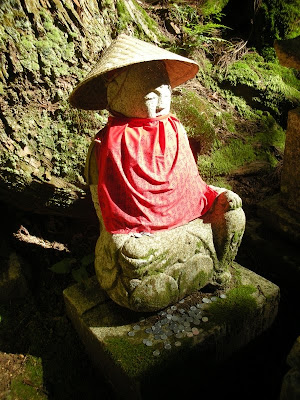
And for all intents and purposes that concluded my stay in Japan. From which I returned very nearly a month ago. Whew.
Showing posts with label Japan. Show all posts
Saturday, November 10, 2007
Japan Day 13: Final Day in Osaka
Saturday the 13th was my final day in Japan, and because I still had some souvenir shopping to do we planned to spend part of the day on that. First though, we wanted to visit the Japanese-style garden in Shittenoji temple. So that morning we walked across the street and paid for entrance into the garden. It was really the last touristy, fun thing I did so I figure it's the last thing I need to blog about. Which I'm going to do by simply leaving you with a bunch of pictures.
Ungyō (1 of the 2 guardians [Niō] that stand at the gates of most temples)
Niō: Agyō (the other of the two guardians [Niō])
This little building symbolises something (as do many of the things in the garden) but I'm too lazy to look it up at the moment.
And for all intents and purposes that concluded my stay in Japan. From which I returned very nearly a month ago. Whew.
Friday, November 09, 2007
Japan Day 12: Still More Tokyo
Friday the 12th was our final day of Tokyo and we started it by going to Kabuki-za to get single act tickets.

Our guide book--or something we'd read, anyway--said that Kabuki was the most accessible of traditional Japanese theater and it wasn't necessary to understand the language to follow the story. So we were all, ok, we'll experience it the way it's meant to be experienced and not rent the English language guides. Yeah, so, around the time the actors spent 30 minutes sitting and talking we realized that had been a definite mistake. Still, it was interesting to see the stylized movement and acting. A girl who did have the guide later filled us in on the story; it was quite the melodrama.

From Kabuki-za we grabbed the subway to Roppongi and looked at the giant mall that is Roppongi Hills. Roppongi, according to our guidebook, is the area for nightclubs at such. No surprise then that it wasn't particularly happening at 1 in the afternoon. From there we took a long walk up to Shibuya, doing some gift shopping along the way. And then it was time to head back to Tokyo Station so we could make sure we didn't miss the Shinkansen back to Osaka.
Funny, as fun and interesting as Tokyo was, I'm glad the city I spent the most time in was Osaka. It's so much calmer feeling and made me less anxious and overwhelmed.
Our guide book--or something we'd read, anyway--said that Kabuki was the most accessible of traditional Japanese theater and it wasn't necessary to understand the language to follow the story. So we were all, ok, we'll experience it the way it's meant to be experienced and not rent the English language guides. Yeah, so, around the time the actors spent 30 minutes sitting and talking we realized that had been a definite mistake. Still, it was interesting to see the stylized movement and acting. A girl who did have the guide later filled us in on the story; it was quite the melodrama.
From Kabuki-za we grabbed the subway to Roppongi and looked at the giant mall that is Roppongi Hills. Roppongi, according to our guidebook, is the area for nightclubs at such. No surprise then that it wasn't particularly happening at 1 in the afternoon. From there we took a long walk up to Shibuya, doing some gift shopping along the way. And then it was time to head back to Tokyo Station so we could make sure we didn't miss the Shinkansen back to Osaka.
Funny, as fun and interesting as Tokyo was, I'm glad the city I spent the most time in was Osaka. It's so much calmer feeling and made me less anxious and overwhelmed.
Wednesday, November 07, 2007
Japan Day 11: Tokyo
Our second day in Tokyo was a big sightseeing day. We began by visiting the Imperial Palace park. It was another hot and sunny day, which meant that the sun umbrellas were out and there were groups of tourists all over the place.

You can't actually get anywhere near the palace here of course.
We then went to Tokyo Tower, which is like a tackier and uglier Eiffel Tower.
The view from the top though, is one of those that gives you a real idea of the size of Tokyo. On all sides the city stretches out, not ending but fading hazily into the distance. Seriously, it's just so fucking big; I couldn't get over it.
It also had these clear pieces of floor so that you could look straight down. Even though I'm not particularly afraid of heights and I knew it was totally safe, it took some genuine mental effort to make myself step onto the clear section. It's funny how some things you know in your head are safe still seem instinctively wrong.

And we finished our day off by going shopping in Shibuya and Harajuku. Because I misread the map, we also walked several miles when we could have easily taken the subway. Oops.
I only have two days to go on the Japan trip and I'm totally relieved. This is what happens when I set myself a blogging project--I get all burned out by it.
We then went off to the East Garden (I think). The earlier part of the garden has huge walls:

A few guardhouses:
And a pretty neat decorative arts museum, of which I did not take a picture. The garden itself is, in this area, Western style. I'm sure it's pretty in the summer when things are blooming, but it's a bit boring in the second week of October. The later section we walked through is a Japanese style garden and, while I suspect it is also prettier in the summer, it's lovely in the fall--all watery and nice as Japanese gardens tend to be.

A few guardhouses:
And a pretty neat decorative arts museum, of which I did not take a picture. The garden itself is, in this area, Western style. I'm sure it's pretty in the summer when things are blooming, but it's a bit boring in the second week of October. The later section we walked through is a Japanese style garden and, while I suspect it is also prettier in the summer, it's lovely in the fall--all watery and nice as Japanese gardens tend to be.
And we finished our day off by going shopping in Shibuya and Harajuku. Because I misread the map, we also walked several miles when we could have easily taken the subway. Oops.
I only have two days to go on the Japan trip and I'm totally relieved. This is what happens when I set myself a blogging project--I get all burned out by it.
Sunday, November 04, 2007
Japan Days 9 &10: Osaka and Tokyo
On the Tuesday after Hiroshima Steph had a private lesson to teach. So I hung around Osaka and shopped. Next.
That Wednesday was the start of the only multi-day trip we went on. We stayed with my aunt's lovely friend Marie (home-cooked meals, yum) who lives just outside Tokyo. The ride on the Shinkansen from Osaka to Tokyo is three hours, and when we got there we put our stuff in a locker and went to look for a tourist information booth such as they had in all the other Japanese cities we'd been to. A tourist information booth that didn't exist. After searching anxiously for an hour (we didn't have a map or anything) Steph saw a giant bookstore and we went in there and bought a Lonely Planet guide to Tokyo.
The first touristy thing we did was go and take a river tour. It was listed as a highlight in the Lonely Planet guide and I love river tours so I was excited about it. Yeah . . . it turned out to be just about the most boring river tour I've ever been on. It wasn't particularly pretty and they only told us the name of each bridge we passed under . . . no further information. Although you do get a view of Tokyo.


Our other plan for the day was to see Shinjuku, which is supposed to be like the Times Square of Tokyo at night. So we took the subway into Shinjuku and wandered around for a bit. And you guys? Shinjuku is crazy. It's like Times Square if its size was multiplied exponentially.
We decided that we'd had a rough day--the whole not knowing where we were and not having an English map thing really stressed out--and we were going to an Irish pub for dinner. So over chicken fingers, wings, and fries we puzzled over the rules of the Rugby game they were showing. When we went outside it was mostly dark and the madness was fully evident.
Tokyo is so crazy and huge and overwhelming. I don't know how people deal with it on a day to day basis. Leaving Shinjuku we took the train out to Marie's town (really a city of about 500,000) where she picked us up at the airport. At her lovely and quiet house we drank tea and ate delicious food and had a chance to relax.
That Wednesday was the start of the only multi-day trip we went on. We stayed with my aunt's lovely friend Marie (home-cooked meals, yum) who lives just outside Tokyo. The ride on the Shinkansen from Osaka to Tokyo is three hours, and when we got there we put our stuff in a locker and went to look for a tourist information booth such as they had in all the other Japanese cities we'd been to. A tourist information booth that didn't exist. After searching anxiously for an hour (we didn't have a map or anything) Steph saw a giant bookstore and we went in there and bought a Lonely Planet guide to Tokyo.
The first touristy thing we did was go and take a river tour. It was listed as a highlight in the Lonely Planet guide and I love river tours so I was excited about it. Yeah . . . it turned out to be just about the most boring river tour I've ever been on. It wasn't particularly pretty and they only told us the name of each bridge we passed under . . . no further information. Although you do get a view of Tokyo.
Our other plan for the day was to see Shinjuku, which is supposed to be like the Times Square of Tokyo at night. So we took the subway into Shinjuku and wandered around for a bit. And you guys? Shinjuku is crazy. It's like Times Square if its size was multiplied exponentially.
We decided that we'd had a rough day--the whole not knowing where we were and not having an English map thing really stressed out--and we were going to an Irish pub for dinner. So over chicken fingers, wings, and fries we puzzled over the rules of the Rugby game they were showing. When we went outside it was mostly dark and the madness was fully evident.
Tokyo is so crazy and huge and overwhelming. I don't know how people deal with it on a day to day basis. Leaving Shinjuku we took the train out to Marie's town (really a city of about 500,000) where she picked us up at the airport. At her lovely and quiet house we drank tea and ate delicious food and had a chance to relax.
Friday, November 02, 2007
Japan Day 8: Hiroshima and Miyajima
The day after Kobe we had a rather less lighthearted day planned. We got up early that morning, met Steph's friend Yumiko again, and took the Shinkansen--bullet train--to Hiroshima. Arriving there we got on a trolley and took it to the Atomic Bomb Dome in Peace Park. It was supposed to be a rainy day but instead it was incredibly sunny and hot.

The dome was once a huge building--it's remains are not so huge--and it's now one of the few buildings remaining close to where the bomb dropped. From there we walked to the memorial for the mobilized youth--more on that later--which is a tower with a angel standing at the bottom surrounded by cranes that people have sent in from all over the world.


And from there we walked to the children's memorial.
The bell has a golden crane hanging from it and the little glass sided boxes contain more of the cranes that people send. Leaving that memorial we went to the Peace Museum. Which is, I think, the sort of place that one doesn't particularly want to go to but instead feels that they must. And don't get me wrong, I'm glad I went because I think it's important to confront these sorts of realities, particularly when your own country is responsible, but it was certainly one of the most depressing places I'd ever been.
The museum is actually wonderfully well done and accessible. Everything is in English as well as Japanese and there's an audio guide as well. You're allowed to take pictures but I didn't take any. I'm sure you could find photographs online if you wanted to.
The first section of the museum is dedicated to the bomb itself: it's development, the decision to drop the bomb on Hiroshima, the facts of the damage, the letters of protest successive mayors of Hiroshima have sent for every nuclear test done since, the later developments in nuclear weaponry, etc. They do an impressive job of being even-handed and non-accusatory about everything.
The second part of the museum concentrates on the victims of the bomb and it's just indescribably sad. Many of the people outside in the center of the city at the time of the bombing were students who were working to create firebreaks and prepare for conventional bombing. So the museum displays scraps of their clothing, lunch boxes, hair and bone, and tells us about parents going into the smoldering city to search for their missing children. And they would find them, often recognizing them--if they were fortunate enough to find them--by the sound of their voice because they were burned beyond recognition. So they would take them home and nurse them until they died, hours or days later. Other parents found only remains, or belongings, or nothing at all. Going through the exhibit, from a scrap of coat, to a toddler's tricycle, to a pair of broken glasses it was almost unbearable.
Exhibits tell you about the lack of medical supplies and doctors, the long-term health consequences for survivors, the effort to rebuild after the incredible heat that burned buildings, melted roof tiles, and scarred such buildings as survived, and the slow rebirth of the city. It's very thorough and makes you feel a bit wrung out.
Over four hours later we went back out into the sunny day. Yumiko had suggested going to Itsukushima Shrine in Miyajima, which is across the harbor from Hiroshima. So we took the trolley down to the harbor and got on the ferry just as dusk was falling. The harbor is wreathed with mountains receding into the distance and it's incredibly beautiful. Also comforting after the horror of the museum. It seems so peaceful that it's hard to imagine something so awful could have happened here.
And while there was no multicolored sunset, as it grew darker the mountains grew more misty and indistinct, while the lights of Hiroshima began to come on.
Looking back at Hiroshima, not yet lit.
We were there at some point between high and low tide and so got both water and mud.
It was almost empty and quite quiet as the night continued to fall. There were only a few other people walking around the shrine taking photographs and talking softly.
The dome was once a huge building--it's remains are not so huge--and it's now one of the few buildings remaining close to where the bomb dropped. From there we walked to the memorial for the mobilized youth--more on that later--which is a tower with a angel standing at the bottom surrounded by cranes that people have sent in from all over the world.
And from there we walked to the children's memorial.
The museum is actually wonderfully well done and accessible. Everything is in English as well as Japanese and there's an audio guide as well. You're allowed to take pictures but I didn't take any. I'm sure you could find photographs online if you wanted to.
The first section of the museum is dedicated to the bomb itself: it's development, the decision to drop the bomb on Hiroshima, the facts of the damage, the letters of protest successive mayors of Hiroshima have sent for every nuclear test done since, the later developments in nuclear weaponry, etc. They do an impressive job of being even-handed and non-accusatory about everything.
The second part of the museum concentrates on the victims of the bomb and it's just indescribably sad. Many of the people outside in the center of the city at the time of the bombing were students who were working to create firebreaks and prepare for conventional bombing. So the museum displays scraps of their clothing, lunch boxes, hair and bone, and tells us about parents going into the smoldering city to search for their missing children. And they would find them, often recognizing them--if they were fortunate enough to find them--by the sound of their voice because they were burned beyond recognition. So they would take them home and nurse them until they died, hours or days later. Other parents found only remains, or belongings, or nothing at all. Going through the exhibit, from a scrap of coat, to a toddler's tricycle, to a pair of broken glasses it was almost unbearable.
Exhibits tell you about the lack of medical supplies and doctors, the long-term health consequences for survivors, the effort to rebuild after the incredible heat that burned buildings, melted roof tiles, and scarred such buildings as survived, and the slow rebirth of the city. It's very thorough and makes you feel a bit wrung out.
Over four hours later we went back out into the sunny day. Yumiko had suggested going to Itsukushima Shrine in Miyajima, which is across the harbor from Hiroshima. So we took the trolley down to the harbor and got on the ferry just as dusk was falling. The harbor is wreathed with mountains receding into the distance and it's incredibly beautiful. Also comforting after the horror of the museum. It seems so peaceful that it's hard to imagine something so awful could have happened here.
And while there was no multicolored sunset, as it grew darker the mountains grew more misty and indistinct, while the lights of Hiroshima began to come on.
Itsukushima is most recognizable for its gate that stands out in the water, so that at high tide it's so far out that a boat can sail up to it.
The gate as viewed walking to the shrine (sorry it's such a horrible photo--I had to use flash on something too far away for the flash to really cut it).
The shrine itself is actually built out into the water, and while there's mud around it during low tide, at high tide the water washes up under the wooden boardwalks so it's like you're standing on a very complicated dock. We had expected it to be closed when we got there so we would only be able to look from the outside, but it was actually open slightly later then we expected and we were able to go into the complex.
Thursday, November 01, 2007
Japan Day 7: Kobe
So on a Sunday way back in the mists of time, by which I mean October 7th, Steph, her friend Yumiko, and I went to Kobe. Our first stop was Chinatown which, like every Chinatown I've been to outside New York, is basically a tourist area, complete with pretty gates at each end.

Beyond that, they sell all sorts of street food. It's totally different from any Chinese food I've had at home and rather delicious. I had a fried bread ball, which was basically like a giant hush puppy but not made with cornmeal, and chicken on a stick. Yum.
From Chinatown we went down to the harbor. There was an art exhibition going on there with tens of trailers in which people had created installations. Like so:
We didn't pay to go into the exhibition area but you could see quite a few of them from the outside.

The other really neat thing about the harbor is that it has a bunch of excellent street performers. They were good showmen who did quite a few different things. They also did similar things at certain points so I haven't uploaded those. I don't have video editing software so these videos aren't as entertaining as they could be, but here's a look at some of the more entertaining bits of their performance. Guy number one was doing tricks with a ball when we got there. He had a wooden spoon type thing in his mouth and was using it to catch and throw the ball in various ways. Unfortunately I didn't get any good video of that, but I did get some videos of the end of his act.
The second guy had a lot to say and talked very very fast. Although the only thing that I was able to catch was that he thanked us many times.


Even better though, it has a beautiful view of Kobe's harbor. The red tower in the photo below is Kobe tower and the area to the left is where we were watching the street performers earlier in the day.

After that we hopped on the train and went back to Osaka, where we went to a public bath. Of which there are, as one would expect, no pictures. It was fun though.
I was planning to get Hiroshima and Miyajima done today as well but then uploading all those videos took a year and a day. My internet connection? It is not fast. So tomorrow it is.
Beyond that, they sell all sorts of street food. It's totally different from any Chinese food I've had at home and rather delicious. I had a fried bread ball, which was basically like a giant hush puppy but not made with cornmeal, and chicken on a stick. Yum.
From Chinatown we went down to the harbor. There was an art exhibition going on there with tens of trailers in which people had created installations. Like so:
We didn't pay to go into the exhibition area but you could see quite a few of them from the outside.
The other really neat thing about the harbor is that it has a bunch of excellent street performers. They were good showmen who did quite a few different things. They also did similar things at certain points so I haven't uploaded those. I don't have video editing software so these videos aren't as entertaining as they could be, but here's a look at some of the more entertaining bits of their performance. Guy number one was doing tricks with a ball when we got there. He had a wooden spoon type thing in his mouth and was using it to catch and throw the ball in various ways. Unfortunately I didn't get any good video of that, but I did get some videos of the end of his act.
Juggling knives while standing on a board that's on top of a cylinder.
Jumping through a ring of knives while holding teacups.
The second guy had a lot to say and talked very very fast. Although the only thing that I was able to catch was that he thanked us many times.
Juggling knives while eating an apple (and talking).
Juggling torches.
And more torch juggling.
We went to a mall called Mosaic for dinner where we got Indian food. Unlike the Chinese food, this was just like what we have here. Good stuff. By the time we got out of dinner it was dark. The mall has a small amusement park in it, which we went to look at.Even better though, it has a beautiful view of Kobe's harbor. The red tower in the photo below is Kobe tower and the area to the left is where we were watching the street performers earlier in the day.

After that we hopped on the train and went back to Osaka, where we went to a public bath. Of which there are, as one would expect, no pictures. It was fun though.
I was planning to get Hiroshima and Miyajima done today as well but then uploading all those videos took a year and a day. My internet connection? It is not fast. So tomorrow it is.
Tuesday, October 30, 2007
Japan Day 6: Koyasan
You know what sucks, forgetting to buy allergy medicine when you're allergic to your pets. I think I've sneezed about 20 times in the last two minutes. Anyway . . .
Of everywhere I went in Japan, Koyasan was my favorite place. It was entirely fantastic. Many people stay overnight in one of the 110 temples in this small town, but we weren't staying and therefore only had the day. It wasn't quite enough time to see everything I would have liked to see but we did get to see quite a lot.
We got up early in the morning and caught the train there. For a change the ride was through countryside and small towns rather than cities and suburbs. At times we were going through tunnels under mountains, at times along the sides of mountains, looking over small valley towns. At least in this part of the country the mountains are rolling and soft looking, never above the tree line, and falling into successive ridges like folds of cloth. Most of the trees look to be deciduous and the forest are positively filled with Maples. In November the mountains probably look as though they're on fire. When the train passed through towns we saw gardens and rice paddies and tiny small town stations. It was an utterly picturesque ride.
At the end of the train line we had to switch to a cable car. It's not like any cable car I'd ever seen. It's built at the same angle as the tracks with broad, shallow steps inside like you'd find inside a theater. The backs of the seats are so straight it feels as though they are angled forward and the people sitting across from you are very close indeed. The ride takes about ten minutes and you end up on the decidedly chill top of a mountain. A bus then takes you down into the center of town--which is, happily, slightly warmer.
When we got to Koyasan, the first place we went was the Tokugawa Mausoleums. They're not actually particularly exciting because all the decoration is on the inside of the fenced portion in the picture below and you have to kind of peer through the slats.
The buildings within the fence are beautifully decorated and quite lavish, it's just not possible to really look closely at them or see them from the angles you'd really want to. Still, it's clear that these were constructed as memorials to important people. Anything with that much gold decor generally is.

After the slight disappointment of the mausoleum we headed to Okunoin, which is on the Eastern edge of the town, to see Koyasan's very old graveyard full of important people. Since we didn't get the audio guide we didn't know which important people those were or where they were. Didn't really matter though--it was interesting to see an old Japanese graveyard, mostly because it was beautiful.
The older section of the graveyard was filled with old growth Cedars and monuments that were entirely unlike any I'd ever seen in a Western graveyard. It would actually be really interesting to know the meaning and symbolism but even without knowing that it was a lovely place to spend time, as older graveyards so often seem to be. Only problem was that there were hordes of mosquitoes.


Leaving Okunoin and the mosquitoes behind we walked to Kongobuji temple, which is the principal monastery and was my favorite of the temples I saw in Japan. When we entered the huge building we had to put our shoes in little cubbies--at many of the temples you visit you can't go inside so you get to keep your shoes--and then put on the slippers they provide.
When we paid for our admission we were told that there was a tea service at the end of a long hall, so we went there first. The tea room was covered with tatami mats so we put our sandals on shelves just outside the door and went in bare-footed. Inside we were given a tray with slightly bitter tea and a cookie that was rather sweet. We sat on the floor and a monk came in and told us something or other than chanted a bit, while we sat there pretending we had any idea what was going on.
After the tea service we walked around the tea room to see the biggest rock garden in Japan. If I'm remembering correctly, the design is supposed to represent two dragons emerging from the clouds.
After seeing the rock garden we checked out the real highlight of the temple: its beautifully painted sliding doors. Some depict the founding of Koyasan in the 9th century, others the seasons, and so on and so forth. They were really fantastic. No pictures were allowed, and I've had no luck finding any online, so you'll just have to take my word for it.
Walking on from Kongobuji, we went to see the Konpon Daito, which has lots of Buddhas inside and then walked around the grounds there, which are full of interesting buildings.

After leaving the area of the Konpon Daito we finally reached the West end of the town, marked by a giant gate called the Daimon. As we approached the sun was setting and visible directly through the center of the gate.

As it became truly dark, we took a bus up to the cable car and then, after waiting some time, the cable car back to the train to Osaka.
Of everywhere I went in Japan, Koyasan was my favorite place. It was entirely fantastic. Many people stay overnight in one of the 110 temples in this small town, but we weren't staying and therefore only had the day. It wasn't quite enough time to see everything I would have liked to see but we did get to see quite a lot.
We got up early in the morning and caught the train there. For a change the ride was through countryside and small towns rather than cities and suburbs. At times we were going through tunnels under mountains, at times along the sides of mountains, looking over small valley towns. At least in this part of the country the mountains are rolling and soft looking, never above the tree line, and falling into successive ridges like folds of cloth. Most of the trees look to be deciduous and the forest are positively filled with Maples. In November the mountains probably look as though they're on fire. When the train passed through towns we saw gardens and rice paddies and tiny small town stations. It was an utterly picturesque ride.
At the end of the train line we had to switch to a cable car. It's not like any cable car I'd ever seen. It's built at the same angle as the tracks with broad, shallow steps inside like you'd find inside a theater. The backs of the seats are so straight it feels as though they are angled forward and the people sitting across from you are very close indeed. The ride takes about ten minutes and you end up on the decidedly chill top of a mountain. A bus then takes you down into the center of town--which is, happily, slightly warmer.
When we got to Koyasan, the first place we went was the Tokugawa Mausoleums. They're not actually particularly exciting because all the decoration is on the inside of the fenced portion in the picture below and you have to kind of peer through the slats.
After the slight disappointment of the mausoleum we headed to Okunoin, which is on the Eastern edge of the town, to see Koyasan's very old graveyard full of important people. Since we didn't get the audio guide we didn't know which important people those were or where they were. Didn't really matter though--it was interesting to see an old Japanese graveyard, mostly because it was beautiful.
The older section of the graveyard was filled with old growth Cedars and monuments that were entirely unlike any I'd ever seen in a Western graveyard. It would actually be really interesting to know the meaning and symbolism but even without knowing that it was a lovely place to spend time, as older graveyards so often seem to be. Only problem was that there were hordes of mosquitoes.
Leaving Okunoin and the mosquitoes behind we walked to Kongobuji temple, which is the principal monastery and was my favorite of the temples I saw in Japan. When we entered the huge building we had to put our shoes in little cubbies--at many of the temples you visit you can't go inside so you get to keep your shoes--and then put on the slippers they provide.
When we paid for our admission we were told that there was a tea service at the end of a long hall, so we went there first. The tea room was covered with tatami mats so we put our sandals on shelves just outside the door and went in bare-footed. Inside we were given a tray with slightly bitter tea and a cookie that was rather sweet. We sat on the floor and a monk came in and told us something or other than chanted a bit, while we sat there pretending we had any idea what was going on.
After the tea service we walked around the tea room to see the biggest rock garden in Japan. If I'm remembering correctly, the design is supposed to represent two dragons emerging from the clouds.
Walking on from Kongobuji, we went to see the Konpon Daito, which has lots of Buddhas inside and then walked around the grounds there, which are full of interesting buildings.
After leaving the area of the Konpon Daito we finally reached the West end of the town, marked by a giant gate called the Daimon. As we approached the sun was setting and visible directly through the center of the gate.
As it became truly dark, we took a bus up to the cable car and then, after waiting some time, the cable car back to the train to Osaka.
Subscribe to:
Comments (Atom)