Friday, July 09, 2010

American Stories

These two books don't actually have much in common. I just read them around the same time and had sharply differing reactions to them.

Although I had somewhat mixed feelings about the previous Geraldine Brooks novel I'd read, People of the Book, I was excited to read March. I have vivid memories of being in second grade, sitting on the swing during recess and reading Little Women. At the time Pizza Hut was doing some kind of reading promotion with elementary schools and if you read enough books you got free pizza, It was a giant hardcover copy of some 600 pages and when I was done I was rather proud of my accomplishment and got so many reading credits that I got a free personal pan pizza for that book alone. So it's a fond association. Also I like historical novels and think the history of the Civil War is interesting.

March has a lot going for it. It's well--if unremarkably--written and tidily constructed. There are no loose ends, no bits of story that go wandering drunkenly off. One feels that their reading experience is in the hands of a thoroughly competent novelist. In the end though, I felt like the connection to Little Women was tenuous, even gimmicky. There seemed little narrative reason for the protagonist to be Mr. March as opposed to some other man not featured in a classic novel. And although, by centering the story around an abolitionist during the Civil War Brooks takes as her subject what is arguably the most important war, the most important period of American history, the book feels small. Under a veneer of thoughtfulness, it's an safe, comfortable novel that doesn't challenge readers. Maybe if Marmee were a real person she wouldn't be as supportive and perfect as she seems in Little Women--it can't be! Abolitionists were well meaning but still blinded by white privilege and even racism--surely you jest!

One of the great joys of reading fiction is that the author can reveal something new and truthful to the reader through their work. Your world can suddenly expand in small but noticeable ways. You can learn something you never expected to. A book doesn't have to do that, of course, to be enjoyable. But I think that a novel that asks the reader to take it seriously--to devote time and thought to it--should. It ought to challenge its audience in some way.

The Ballad of Trenchmouth Taggart is a far messier book than March. But it has a delightful energy and sense of risk that made me want to forgive it all its flaws and just go along for the ride. Rather than feeling like the author is simply showing the reader things he or she already knows, M. Glenn Taylor introduces a story in which the elements are familiar but skewed in such a way as to make them feel new.

Like many ballads and folk tales, this one presents us with the story of its protagonist's life from birth to death (at a very advanced age). Divided into three sections--roughly speaking, youth, middle age, and old age--it begins more strongly than it ends and takes odd detours along the way. Trenchmouth Taggart is a larger than life figure, a sharp-shooting union man, a snake charmer, and a harmonica player, among many other things. At its best, the novel is a modern tall tale and feels quintessentially American. The story is one that couldn't take place anywhere else because it so clearly springs from the culture and landscape of its setting.

It makes sense then that the first and longest section, which embraces the oddness and distinctiveness of both the characters and the rural Appalachian setting, is the strongest. In middle age Trenchmouth becomes a bit Forrest Gump-ish, constantly encountering famous historical figures, and by the end of the book he slips into the cliche of an elderly man uncomfortable with the modern world. One can't help but wish that the focus had remained on these earlier years and people. But by that point the novel has earned so much good will (at least from me) that these flaws can be forgiven.

Thursday, July 01, 2010

All-Ashton at ABT (with bonus complaining about hockey)

Today was not a good day for Sabres fans (make sure the sound is on when you follow that link). I hate days like the trade deadline and the beginning of free agency because the Sabres never do anything exciting (unless one counts losing players as exciting). Which would only be partially bad except certain Sabres fans (not linked to here) then proceed to flip out about the lack of activity even though said dullness has been the GM's m.o. for years and is therefore entirely predictable. It makes me cranky.

On the other hand--and be prepared to admire this incredibly smooth transition--I did have a lovely evening at the ballet last night. I went to see American Ballet Theatre's beautiful All-Ashton program. Having never seen any of Ashton's work I was excited to go and was even more excited when the box office sold me a student ticket for a seat toward the front of the orchestra. So different from sitting in the Family Circle and watching the tiny dancers.

The first ballet--Birthday Offering--featured roles for seven female soloists and costumes gaudy enough that they might have been improved by watching from the Family Circle. But I loved how distinct each of the seven variations were and particularly liked Misty Copeland's, in which she repeatedly flicked her feet rapidly in front of and behind the knee as if knitting with her legs. And Stella Abrera and Eric Tamm looked wonderful both separately and together. They're two dancers I'd so like the opportunity to see more often.

I was much less sure of the partnership of Sascha Radetsky and Hee Seo in Thais Pas de Deux. The pas de deux achieves a delicate exoticism without veering as sharply into orientalism as other ballets do although the orange costumes don't help. Seo looked graceful and soft and otherwordly but her beautiful lines made Radetsky's look short in comparison and he couldn't match her air of mystery. I usually like him very much--I just think this role might not serve him well.

The second pas de deux of the evening was the Awakening from Ashton's Sleeping Beauty which I don't think works particularly well as a stand-alone piece. Although maybe it would with a more charismatic pair of dancers. Particularly problematic for me was that Paloma Herrera seemed so much the stronger of the two. Cory Stearns seemed almost superfluous when partnering her; it felt as though she could do all the same things with no help at all. Maybe if he had been more authoritative it would have helped. I feel as though my lack of knowledge when it comes to dance really hurts me at times like this. I don't know if my problem is the choreographers or the dancers and I don't know if my problem is something technical or if it's just that I'm watching dancers that don't quite do it for me for whatever reason. Well, it's something that I imagine I'll understand better the more I see.

Even if I hadn't enjoyed the first three ballets of the evening though, it would have been more than worth it to see The Dream. I particularly appreciated the clarity of the storytelling and the way that the dancing constantly moved the story forward. Maybe it's the result of having no background in dance but the utter frivolity of so many story ballets can drive me crazy. I sit there wondering why I'm watching a variation in a particular place or what purpose some bit serves other than obstructing the story or if it was really quite necessary for the dancers to do that move again. Then again, maybe it's just that a lot of these ballets are very silly indeed. But with Ashton's take on The Midsummer Night's Dream there was none of that. The dancing--coupled with the lovely set and costumes--served to create characters and atmosphere with very little that felt like excess. And such dancing from all involved (I saw the cast with Herman Cornejo as Puck and David Hallberg and Gillian Murphy as Oberon and Titania respectively)! I felt fortunate to be sitting in the theater, watching people who are capable of creating something so beautiful and funny and charming.

Wednesday, June 23, 2010

Miscellany

Having fried myself at the beach over the weekend (and I thought I was being so good about sunscreen too) I've spent all my non-working hours this week lying in bed trying not to move too much. So I've mostly been doing a lot of puttering around on the internet at night reading things.

Like Laura Miller's article on the growth of self-publishing and the fun of slush piles, which brought back cringe-worthy memories of reading for a literary agency:
People who have never had the job of reading through the heaps of unsolicited manuscripts sent to anyone even remotely connected with publishing typically have no inkling of two awful facts: 1) just how much slush is out there, and 2) how really, really, really, really terrible the vast majority of it is. Civilians who kvetch about the bad writing of Dan Brown, Stephenie Meyer or any other hugely popular but critically disdained novelist can talk as much trash as they want about the supposedly low standards of traditional publishing. They haven't seen the vast majority of what didn't get published -- and believe me, if you have, it's enough to make your blood run cold, thinking about that stuff being introduced into the general population.

Everybody acknowledges that there have to be a few gems out in the slush pile -- one manuscript in 10,000, say -- buried under all the dreck. The problem lies in finding it. A diamond encased in a mountain of solid granite may be truly valuable, but at a certain point the cost of extracting it exceeds the value of the jewel.
I can't say reading through all those submissions is something I miss.

And today I also read the latest installment in Tobi Tobias's series of ballet diaries (all of which have been such a treat). In this case she's writing primarily about the retirement of two dancers--Philip Neal and Albert Evans--I have seen perform but not often enough to have formed any particularly strong impressions of them. Still, the best dance writing, much like great writing about the visual arts, seems to me to be an act of transformation--turning something that is visual into words on a page while still capturing something of its essence. Reading Tobias's post about the qualities of these particular dancers recalled to me the times I have seen them more clearly than would otherwise have been possible. Then again, perhaps that's a trick of the memory.

The most fun reading I've been doing, however, is ESPN's Off the Ball blog. Since I don't get to watch most of the games--although it appears that a large number of people at work are streaming the games at their desks so maybe I really can watch and just hadn't realized it until now--this is proving a nice supplement to live updates.

Sunday, June 13, 2010

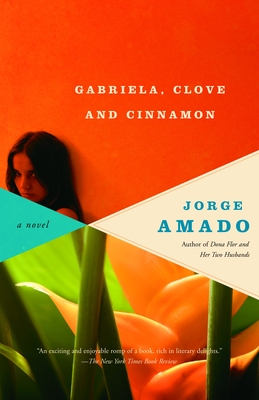
Gabriela, Clove and Cinnamon

I was out last night at a rooftop bar, which served to remind me of just how much I love the indoor smoking ban. I got home sometime after 3 am with hair that smelled of smoke and a sore throat. And now, in the mid-afternoon, I've washed my hair twice and am drinking tea with more than a little honey in an attempt to ease my sore throat while watching Germany take the Australians to school in a thoroughly entertaining manner. (As a side note, these guys are amazing. How is it even possible to be in such good shape?) We're having the perfect gray and rainy weather for a lazy Sunday here in New York though, which makes me feel far less guilty than I otherwise would about sitting around in my pajamas.

Happily, when I was reading Gabriela, Clove and Cinnamon a couple weeks ago, New York was having positively summery weather. And while I, alas, read it in all the usual places--my home, the subway, on a plane ride home from Buffalo--it would make the most delightful of beach reads. It's warm and lightly satirical and ends, as a great comic novel ought, not entirely predictably but happily.

If the makes it sound like a shallow novel, it's unintentional. The story has two strands: an upcoming election that pits the old guard of cacao planters against a modernizing newcomer from Rio and a love story that revolves around the titular Gabriela and Nacib, bar owner and friend to all. Amado concerns himself with a number of serious topics--the position of women in society, the formation of culture and society, class--while skillfully avoiding didacticism. In fact, such self-importance is cheerful sent up throughout the novel. In one of the most entertaining sequences a self-important poet comes to town to give a lecture that all the book's important characters attend.
Tonico broke the silence:
"Do you know the title of the lecture?"
"No, what is it?"
"Tears and Longing."
"Good title," said Ribeirinho, "We'll be bored to tears and longing to go home."
It's a feeling that Amado's readers (and anyone else who has attended their fair share of lectures) is surely familiar with. And a reminder to be grateful for books like this one, the first goal of which is to entertain.

As much as I enjoyed the book though, Gabriela herself, the object of everyone's desire, full of charm and childish whims, resolutely herself in the face of those who would try to change her, struck me more as a plot construct than a character. She exists, it seems, to illuminate the character of those around her and, at times, to provide a catalyst for events. I found myself entertained by, but not terribly involved in, the romantic thread of the novel and not particularly concerned with what happened to Gabriela. Fortunately, the pleasure I took from reading about the political machinations and the healthy dose of comic relief Amado provided in the form of spinsters and philanderers and lovestruck scholars among others more than compensated for that.

It's a thoroughly winning book. The sort that demands little of the reader and yet pays you back richly for your time and attention and reminds you just what a pleasurable experience reading can be.

Saturday, June 12, 2010

Nancy Drew and the Mystery of the Ghostwriters

You know those books that sit on your shelf for ages, patiently waiting for you to summon up the motivation to actually start reading them? This was totally one of those books for me. My grandfather gave it to me, oh, three or four years ago and I was somewhat interested, sure, but not interested enough to actually read the thing. Maybe it's because the Nancy Drew books don't really hold any special place in my heart. I read them, of course, like pretty much every little girl. In fact, Nancy Drew and the Hidden Staircase was the first chapter book I read on my own (my father read me Nancy Drew and the Old Clock). But I can't say I remember any of them particularly well or that I've thought of them much in the years since reading them. I was fonder of the Boxcar Children series and the Black Stallion books.

Even without any particular nostalgia though, I did find the idea of reading about the creation of a character who is, in many ways, the most important heroine in American literature interesting. So finally, after years of guiltily avoiding Melanie Rehak's Girl Sleuth: Nancy Drew and the Women Who Created Her I finally buckled down and read it. It turns out that, for me at least, it was one of those perfectly fine books that you're not sorry to have read but also are not particularly happy to have read.

Girl Sleuth is a dual biography of two women: Harriet Stratemeyer Adams and Mildred Wirt Benson. Adams was the daughter of Edward Stratemeyer, who founded a syndicate that produced series books for boys and girls using ghost writers who were provided with outlines and who created Nancy Drew. After her father's death she--along with her sister--put together the outlines for and edited the Nancy Drew books and eventually, years later, she took over writing the Nancy Drew books. Benson was the hired hand who wrote most of the early Nancy Drews.

Dual biographies are a bit of a double-edged sword. On the one hand, a writer can illuminate her characters through their relationship to one another. On the other hand, you often wind up with a hero and a villain . . . or at least with one character who comes off as far more likable than the other. In this case, I was far fonder of Benson. Both women were pioneers of a sort, striking out into male-dominated fields and finding personal success outside the home at a time when married women were not expected to work. But Benson was the more modern of the two and comes off as being largely responsible for Nancy's can-do attitude and independence. Adams's Nancy is more feminine and lacking in rough edges which, as a modern reader, feels like a step backward. And Adams, toward the end of her life, takes credit for things she wasn't responsible for in a way that makes it seem like her grip on reality wasn't entirely firm. Again and again I found myself far happier to be spending time with Benson than Adams.

What's more, while Rehak clearly loves the Nancy Drew books and she does an excellent job of depicting their cultural importance--although perhaps not for the current generation?--in the end I'm not sure if her book made me appreciate the series more or less. It brings into high relief just how studied and commercial a creation Nancy Drew is for all her good points. And while that's not surprising, I might have preferred to leave the wizard(s) behind the curtain.

Monday, June 07, 2010

Miscellany

1. am New York and I are totally on the same page about the World Cup:I may not know who the favorites are. I'm pretty sure I don't understand all the rules. But I'll certainly be watching.

2. In order to make some extra money I've been working for the US Census--which, if it were a permanent job would drive me to alcoholism in no time flat--and that means that I now how to deal with the management office of the apartment complex where I live. Which is staffed by some of the most unpleasant people I have ever encountered in a professional capacity. So in preparation for having to get information from them tomorrow I am baking them some of the most fabulous cookies in the world. Not thanks to my baking skills--the recipe is just that good. I dislike the people in management so much that I'm having a tough time coming to grips with giving them cookies though, so this had better inspire them to be nice to me.

3. I'm moving in a couple months and while I'm only going to another area of the city, I'm trying to use it as an opportunity to get rid of things I don't want. It turns out that I'm quite good at getting rid of clothing and very bad at getting rid of books. Even books that I bought for 50 cents because I liked the covers and am never, ever going to read. I think that I'm going to need my sometime roommate to go through them with me and remind me that it really is a good idea to pass on books that I didn't even remember I owned in the first place.

Saturday, June 05, 2010

My Dream of You

At times, My Dream of You resembles nothing so much as Philip Larkin's "This Be the Verse" born again as a novel and dolloped with sentimentality. If only the protagonist's parents had been sufficiently warm and involved in the lives of their children there might be no story at all.

Kathleen de Burca is a single, middle-aged Irish expatriate who has organized her life in response to the pain of her youth. She has no real home, few friends. A travel writer, she has shut herself off from the world even as she visits far-flung locales, writing invariably cheerful and witty missives from places that are often anything but. Then her closest friend dies suddenly and this new heartbreak, coupled with the encroachments of age, seems to shake something loose in Kathleen. In short order, she leaves her job and the basement flat she's lived in for decades and heads back to Ireland to research a book.

O'Faolain interweaves the story of Kathleen's return to Ireland with that of the book she begins to write while there--an account of an affair between an Irish servant and the wife of an English landlord during the potato famine--to mostly good effect. What Kathleen wants to find in the events of the past is the kind of idealized passion she has always sought and felt was so absent in her life. History, though, is never so convenient and the story grows steadily more complicated.

I feel like in order to really enjoy this novel (and I find this is often the case with books written in the first person) I would have needed to care about the main character. But I couldn't quite manage to do so. It's not that Kathleen, intelligent and honest although only intermittently capable of self-examination, not unkind though thoughtless and selfish, is somehow beyond the pale. She's not a character who ought to repulse one's sympathy. And yet I found it impossible to summon up much in the way of fellow-feeling. For me, her pain was too often rendered in shorthand: Her father was absent and dictatorial. Her mother, always pregnant, weak, and ill, had little to offer. And this, in the world of the novel, explains everything about Kathleen.

Reading My Dream of You, I began to think that perhaps my experiences, age, and preoccupations are simply too far from hers. These gaps, however, are all things that novelists can overcome; the opportunity to step outside oneself is one of the great joys of reading. I think the problem is that, for Nuala O'Faolain, it seems like the most natural thing in the world that Kathleen would end up the way she does. There's no need to interrogate the subject. So it isn't until the end of the novel that O'Faolain actually made me understand the source of Kathleen's anger and pain. The historical background the author provides is focused on the potato famine--which I actually knew quite a bit about already--and not the Ireland of the mid-20th century which I know virtually nothing about. And that's fine. I'm sure many other readers didn't need more information. But it made me feel that I, a generation or two younger, from a different country and economic background, wasn't the audience for the novel.

Which is a shame, because there was a lot about the book that I liked, starting with writing that is decidedly unfussy and yet vivid, particularly in its evocations of setting and descriptions of nature:

I knew this Atlantic where it broke on western coasts, all the way down to the curve of the earth. I could picture ten or twelve places I’d been where this same ocean met land, from a sturdy village among artichoke fields in Brittany, to the baking sand dunes of Namibia. I’d watched the fog roll in from it every day when I was writing a piece about golf courses in Portugal. I’d lived a few feet from it in a run-down tourist camp on a beach in Senegal, where the crabs clacked around the legs of my bed all night. But I had never before been on the west coast of an Atlantic island, at the turn of spring into earliest summer—never before seen such a wide slope of small fields, their grass patched with the brown of weeds and rushes, fields of a muted and glowing green that lulled the eye, that then was shocked by the huge vista of the turbulent, turquoise sea beyond.

Kathleen sounds like a real person and, more than that, like a travel writer. Observant and occasionally prosaic, she has a knack for picking out a few small details that create a picture. Even if you don't like her, she's a solid, believable character. And as her protagonist changes, coming to terms with both her present and past, O'Faolain explores relationships between women in a way that is genuinely touching, if secondary to the story. The other lives Kathleen could have lived are right there in front of her in the form of her sister-in-law, an elderly librarian helping her with research, and the daughter of an innkeeper, among others.

But if you don't care much about her emotional journey the story begins to feel a bit leaden and repetitive. There's simply not all that much going on and Kathleen spends a lot of time spinning her wheels. Eventually the reader, too, feels stuck in neutral.


Saturday, May 29, 2010

Vacation

I'm just got back from a vacation up at my parents home outside Buffalo. It's a rare thing for me to get up there at this time of year, which is too bad as there's really no better season to be there. Particularly with the hot and sunny weather they had this week. Nice to be out of the city. Particularly this spring when I've been feeling thoroughly worn down.

It's so easy to forget things when you're away. Like the fact that summer evenings last just a bit longer up there. Or how strongly it smells of freshly-mown grass and garden mulch on the bike ride to my father's office. Or how quiet it is. It's not that I have any desire to live in the suburbs, really. It's just that there are days when I'm so tired of living on top of people and below people and being jammed up against people on the subway every day. It's good to have a little space.

I helped clean out junk drawers and my bedroom and got a good bit of knitting and reading done. I swam laps for the first time in about eight years, took a class called Body Pump after which my legs were sore for three days, went running and rollerblading. Despite all the activity, it was the most relaxing vacation I've had in ages.

On my last day there my mother and I went to visit Forest Lawn, which is a large Victorian cemetery. It has lots of open green space, a creek running through it, and the graves of famous Buffalonians like Millard Fillmore. My mother and I had talked about going to see it for a few years and looked into taking a tour. They weren't running any until June though, so we just wandered around, semi-successfully avoiding a group of school children there on a field trip.

It turns out that it's a lovely place, but not exactly making the list of the most interesting cemeteries we've seen. It does, though, feel like exactly the sort of cemetery you'd expect to find in Buffalo. And it's hard to complain about taking a walk with family on a beautiful spring day.

And now I'm back in New York (after what was probably the least problem-beset flight into JFK I've ever been on) and on all sorts of post-vacation and pre-summer errands. But feeling much more equal to the many tasks at hand.

Wednesday, May 26, 2010

Books that Defeat Me

Despite the fact that I majored in history in college and minored in classics, pretty much everything I knew about Claudius prior to starting I, Claudius came from A Scandalous History of the Roman Emperors by Anthony Blond. This was also the book that taught me that Romans ate things like sow's nipples in tuna brine and fermented fish sauce. Exhibit A in the argument that the more you learn about history the happier you are to live in the hear and now. Anyway, this lack of knowledge was probably because I got my classics minor by taking four semesters of Latin for my language requirement--of which I remember next to nothing--and one class on the Roman republic for the aforementioned history major. This is what I knew:
  1. Claudius probably had cerebral palsy.
  2. Unlike pretty much all the other Julio-Claudian emperors, there don't appear to be questions about his heterosexuality.
  3. Despite the fact that he's popularly thought of as being one of the more benevolent Julio-Claudian emperors--not a role for which there is much competition--he was actually a bloody ruler who had a crapload of people killed.
So I figured that, given my fondness for historical fiction, I, Claudius would be a good way to dip my toe into the historical waters (theoretically made more entertaining by a heavy dose of make-believe) before taking the plunge into an actual history. Which I still think is a good theory. But three years later I'm only about 150 pages into the book. And it's not a short book. I think it might be time to admit defeat.

And normally I would have no problem with this. I stop books part way through on a regular basis. After all, why waste time on something that is giving you no pleasure? But somehow I got it into my head that this was a book I should read. And then, in year two of my struggle to read it, I decided that I needed to finish it because I'm not a quitter. But now, in year three, my relationship with the book is entirely adversarial and there's no way I'll ever enjoy it at this point in time because it's an obligation above all else. So fine, Robert Graves, you win. Your writing has defeated me and the appeal of your classic work of literature is beyond me. And now the time I spent pretending to read your book will be spent actually reading something I enjoy. So maybe I win too?

Tuesday, March 02, 2010

Turning the Lights Out

There's an interesting conversation going on over at WNYC's Performance Club sight about an incident that took place at P.S. 1 on Saturday when a performance artist was censored by the art gallery, which chose to turn the lights out during her performance. (Part I, Part II) Not being familiar with either the artists in question or, really, performance art in general, I don't have anything insightful to add.

To be honest, the thing I think of when I hear about someone turning lights the lights off to end an altercation is this:

Of course any punches thrown at P.S.1 were purely metaphorical.

Sunday, February 21, 2010

Armory Show

Last Friday I joined the P. Club at a performance of Moving Theater's Armory Show. I was particularly looking forward to this one because I'd never been to the Park Avenue Armory before and was excited to see it (and it was worth the excitement).

Several days later I'm still having trouble thinking of the show as a cohesive whole. But I was certainly interested in all the constituent parts. I particularly liked the way they addressed history and militarism in a space rife with both.

Go here for the Performance Club post and discussion.

Monday, February 15, 2010

Notes on the Olympics

  1. My apartment has been about 82 degrees the past few days (with the windows open) which is making it a bit torturous to watch the Winter Olympics. All that snow! All that cool air!

  2. These Alexandre Bilodeau features make me teary. Also, let me just say that having a disabled brother--mine has Down syndrome--never inspired me to any sort of greatness nor instilled within me any particular motivation. Oops.

  3. Related: I love it when the entire crowd at an event sings O Canada. I also love O Canada.

  4. Things I hate about NBC: Their refusal to show anything live. Their insistence that I love figure skating. The fact that they spoil the results of events they have yet to show right on their homepage so that when you go to look up their stupid broadcast schedule said results are spoiled for you. They're showing ice dancing on the main channel rather than the Canada-USA hockey game which means those of us without cable (see: me) can't watch the hockey game. Their sappy features that take away from time they could spend showing the sports that the Olympics are theoretically about.

  5. Winter Olympics: Fewer black people than the Republican National Convention?

  6. From Amy comes the news that the IOC wants to make Ryan Miller remove certain things from his mask. Things like the tribute to his dead cousin. I don't think that's a PR war the IOC wins.

  7. A lot of winter sports look terrifying yet fun. Cross-country skiing just looks like it would make me throw up.

  8. Despite all my complaining I love, love, love the Winter Olympics.

Saturday, February 06, 2010

What I'm Reading, etc.

The nice thing about writing a blog pretty much entirely for one's own benefit is that you don't have to feel guilty when you step away for, say, a month and a half. I felt like I was so crabby all the time and I wasn't particularly enjoying writing about my own crankiness so I can't imagine it was in any way interesting to read about. But I've since managed to plant myself in a cheerier place. So I'm back, if not with anything particularly substantive. But here are a couple things I've read recently:

Google and the New Digital Future
The terms of the settlement will have a profound effect on the book industry for the foreseeable future. On the positive side, Google will make it possible for consumers to purchase access to millions of copyrighted books currently in print, and to read them on hand-held devices or computer screens, with payment going to authors and publishers as well as Google. Many millions more—books covered by copyright but out of print, at least seven million in all, including untold millions of "orphans" whose rightsholders have not been identified—will be available through subscriptions paid for by institutions such as universities. [...]The negative arguments stress the danger that monopolies tend to charge monopoly prices. Equally important, they warn that Google's dominance of access to books will reinforce its power over access to other kinds of information, raising concerns about privacy (Google may be able to aggregate data about your reading, e-mail, consumption, housing, travel, employment, and many other activities).

Adam Gopnik on J. D. Salinger

In American writing, there are three perfect books, which seem to speak to every reader and condition: Huckleberry Finn, The Great Gatsby, and The Catcher in the Rye. Of the three, only Catcher defines an entire region of human experience: it is—in French and Dutch as much as in English—the handbook of the adolescent heart.

Saturday, December 19, 2009

The Good Thief

New York is slowly being carpeted by fine snow tonight. Not nearly a blizzard but just enough to make a person want to stay inside with a cup of hot chocolate and read an adventure story. Or, in my case, post about an adventure story I read at the beginning of the month. It's the kind of weather that lends itself to adventures of the mind while the body tucked up in a chair.

I can understand why a person would read comparisons to Dickens and Robert Louis Stevenson and think that's totally the book for me. What I can't understand is why I would read them and think that. I don't like Dickens at all and I got all of one chapter into Treasure Island. But I read about The Good Thief on some "best of the year" list at the end of 2008, something about the description captured my imagination, and I decided I just had to read it. I think it was the fact that it was set in a kind of alternate New England that appealed to me.

I put it out of my head for awhile but when I saw the paperback (which has a rather less appealing cover) I couldn't resist. Nevermind that I was in the middle of any number of other books and trying to use the library more. I had to buy it because I just knew I was going to love it. And, perhaps unsurprisingly, I wound up disappointed. It's not that I didn't like the book--I did--but that I wanted it to be more than it was.

Tinti creates an engagingly creep, gothic New England full of giants and grave robbers and sinister, behatted men, and it's never short of entertaining. But I wanted the scope of the story to be larger. I wanted to be swept away into the world I was reading about and emotionally invested in the fate of the characters. Instead I felt like it didn't go much beyond a fun, very nicely constructed plot. Which is nothing to sneeze at, really, but I keep insisting on getting my expectations up and then I'm disappointed about books I otherwise would have liked.

Saturday, December 05, 2009

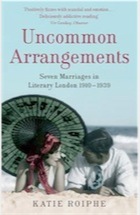
Uncommon Arrangements

You would think that a book about marriages within the Bloomsbury group--the famous "circle of friends who lived in squares and loved in triangles"--would be interesting. Or I would think that anyway. At the very least the gossip should be good. So why was Uncommon Arrangements so boring for me?

I'm not hugely familiar with the work of the Bloomsbury group outside of Virginia Woolf--of whom I'm just not hugely fond--but I did visit Charleston a few years back and found the home, long inhabited by Vanessa Bell and Duncan Grant, beautiful and charming and fascinating. It's why I picked up this book. And my enjoyment of that place is also what made me particularly disappointed by how little I liked the book.

A large part of my issue is that I disliked the structure of the book. Each of the seven couples Roiphe discusses gets a chapter of roughly equal length, and these seven chapters are bookended by an introduction and a postscript. This means that roughly equal time is devoted to each couple even though some are a good bit more interesting than others. It also means that while certain people--Virginia Woolf, for one--flit through a number of the chapters, the central couple in each often feels divorced from their social and artistic milieu (two things that are, after all, not so different with from one another when it comes to the Bloomsbury group).

But more fatal still, for me, is the fact that while you'll finish Uncommon Arrangements with a good idea of how people like H.G. Wells and Vanessa Bell constructed their romantic relationships you won't be much the wiser when it comes to the connections between their work and their views on relationships. Roiphe writes with great insight about the feelings, the ideas, the negotiations, etc. that formed the seven relationships under consideration. But she has less to say about the work that keeps us interested in these people. Well, some of them anyway.

It's not particularly fair to judge a book on what you want it to be rather than what it intends to be. But I don't think fairness has much of anything to do with reading enjoyment. And while Roiphe no doubt succeeded on her own terms--by which I mean she examines the nature of marriage by looking at the unusual arrangements of these famous literary figures--Uncommon Arrangements isn't the book I wanted it to be.

Sunday, November 08, 2009

Endings

I put Pyramus to sleep on Friday, October 30th and today I picked up his ashes. Which seems terribly final. I was there when he died and they wrapped him up in a towel and carried him away and you would think that would be final enough. But I've been walking in the door every night half expecting him to be waiting for me. The cremation company puts the ashes in a little tin then wraps them up like a gift and sticks a brochure in the bag detailing all the fancy urns you can buy. But lest you think that's rather capitalist of them, the brochure also informs you that there's a private funeral room and an on-site grief counselor. Which all seems over-the-top to me because I don't tend to think of animals as little people. But then again I'm the atheist who needed her cat's ashes so she can bury him in her mother's garden so I don't exactly have a monopoly on logic here.

I'll spare you the stories about what a spectacular cat he was--though they would be true, of course--but I do want to write a little about his death. He was small and sick and mine and I spent so much time in the last year focused on his health that to suddenly find myself free of that concern is disconcerting. It's a lonely thing to suddenly have no beloved obligations waiting at home. When I get up in the morning and realize that there are no pills to be cut into fourths, no supplements to be measured out, no food to be portioned, I'm not quite sure what to do with myself.

I came home that night to all the things that needed to be cleaned up: opened cans of cat food with which I was trying to tempt him, chicken breasts in the freezer that I won't eat, open cans of tuna that I drained in order to give him the tuna-flavored water, clothes on the bathroom floor that I didn't pick up because he'd taken to sleeping on them, litter, his bottles of medicine . . . And then there were the things that I needed to just store away: litter boxes, the scratching post, the cat carrier, the water fountain. It was all a little overwhelming.

All that is taken care of now though. The things that needed to be tossed have been tossed. The things that can be saved for a new cat somewhere down the line are stored in closets and cabinets. So it's nice to have the tin with his ashes in it, tucked away next to the plants because he always liked them and that seems like as good a place as any to keep them for the time being. It's still sad, but it was the right thing to do and the right time to do it, and now at least everything seems neatly wrapped up.


Tuesday, October 13, 2009

On the Nobel Prize for Literature

I can't say that I'm ever particularly excited to find out who has won the Nobel Prize for Literature. It just doesn't generally seem like an effective way to discover new authors whose work I'll actually enjoy. There's a nice essay on Literary Kicks though about the predictable dismay--in the English speaking world, that is--that has greeted Herta Müller's win. Dedi Felman writes:
The problem many non-specialists (and here I count a large swath of publishers, press, booksellers, lovers of literature and non-Germanists etc) have with Herta Müller isn’t that she isn’t known. It’s that, at least until they’ve all had a chance to read her and perhaps discover differently, she’s not better loved. She’s critically acclaimed in Germany, but she’s not a bestseller. She’s topical, but it’s unclear whether her writing is all that accessible.
I think it's a good point that gets lost in all the vaguely (or not so vaguely) nationalistic, decidedly provincial hoopla surrounding the award.

Also I totally agree re: the delightfulness of Wislawa Szymborska. Her Nonrequired Reading is just about the most perfect subway commute reading I can imagine. You know, in case anyone was looking for a recommendation.

Monday, October 12, 2009

American Ballet Theatre at Avery Fisher

I found the choice of Avery Fisher Hall as a performance space frustrating. The cheapest unobstructed seats were $40 and while normally I'd just suck it up and deal with the obstructed seats I couldn't do that this time around because I was bringing my elderly grandmother. So that was a blow to the budget. While none of the Lincoln Center buildings I've been in are particularly beautiful, Avery Fisher, with its odd glass enclosure around the auditorium and its mustard-colored seats, is particularly unappelaing. Also, I had an allergy attack while there so that was nice. Still, the hall wasn't entirely without its advantages as we could see well from our seats at the back of the third tier and it was fun to see the dancers warming up during each intermission. Whether they enjoy having an audience for that I don't know—I imagine they're entirely indifferent—but it was an interesting peek behind the scenes for us.

Ratmansky, more than any other choreographer whose work I'm familiar with, is one whose new work I'm always excited to see. Even when he fails ("Pierrot Lunaire," which I found miserable) or gives us a flawed work ("On the Dnieper" which I adore despite its flaws) there's a sense that he's at least trying to do something interesting within the context of the ballet tradition. His dancers seem to relate to one another as people first and dancers second. He puts characters on the stage and then has them interact with one another in ways that seem quite natural. In doing this he clearly gives genuine consideration to who his dancers are and where their strengths and weaknesses lie. They're neither interchangeable nor faceless and so it's easy to care about the people in a Ratmansky ballet. But in presenting these characters he doesn't neglect the need for interesting, varied movement and into his streams of steps he inserts small, happy surprises and motifs to which you're delighted to return. There's a balance to his successful choreography that makes it comfortable to watch without being easy.

"Seven Sonatas" is probably the least ambitious of the Ratmansky ballets that I've seen. He's certainly not reinventing the wheel here. And yet its beautifully crafted. Could it have been a tad shorter--say "Six Sonatas"? I think so. But that could very well be my own personal lack of patience. Although reminiscent of Robbins ballets like the larger "Dances at a Gathering," I think “Seven Sonatas” lacks the (occasionally bitter)sweetness and nostalgia that give that ballet its power. Rather, this ballet feels like it takes place very much in the present with three distinct couples living out their own personal dramas. And yet, because no one exists in isolation in a Ratmansky ballet, these pairs occasionally overlap in the Venn diagrams of community life. Herman Cornejo and Sarah Lane were the flirty fun couple (of course, they're short and in ballet that means they're the fun ones), while Stella Abrera and Gennadi Saveliev seemed weighted down by some undefined sorrow. David Hallberg, meanwhile, was often left searching for an elusive Julie Kent. But over the course of the ballet all three couple step outside themselves to interact as a community. It's an entire small world on stage and you feel richer for having experienced it.

Coming after "Seven Sonatas" Aszure Barton's "One of Three" felt impoverished both in feeling and in movement. It seemed like she didn't quite know what to do with her talented dancers. Why bother using Gillian Murphy if all you're going to have her do is look lovely in a long white dress and lift her leg in the air? Why did all the men seem so interchangeable? Surely it wasn't just the suits. I feel like it's not fair to say only that something isn't interesting, because that's a conversation killer. If you're simply bored by something then what more is there to discuss?But the truth is, I just wasn't interested in this ballet.

The most ambitious ballet of the evening—which followed Clark Tippet's enjoyable, but in my opinion too long, “Some Assembly Required”--was Millipied's “Everything Doesn't Happen at Once.” Although I didn't love it, I also didn't think it was as much of a mess as many of the critics did. Certainly it was the crowd pleaser of the evening and that's not inherently a bad thing. It sent the audience out happy while at least attempting to do something of artistic value and that in itself seems like a plus for an art form that struggles to find an audience and often resorts to impressive levels of tackiness in its attempts to draw people into the theater.

My grandmother and I speculated that maybe the view of this ballet was actually better—clearer, less confused--from our seats than it was from those closer and lower seats that the critics occupy. We thought that from lower down the stage might seem muddled and confused to a greater extent than it did from the third tier. (If this wasn't the case, please don't disillusion me, I'm enjoying that fantasy that I had particularly desirable seats for a change.)

To my untutored eye the ballet had three major problems. The first is that the space was just a bit too small. I don't think that it needs a large stage, but it needs a stage that's a touch larger. The second is that the transitions from section to section seem somewhat slapdash. And the third (which I actually think is the root of the second) is that the central duet is just not strong. All that seems to matter here is the mechanics of the dancing. Marcelo Gomes is a delightfully charismatic dancer with a strong stage presence and yet the only thing the audience gets to see is what he's physically capable of doing. Which is impressive, but he brings so much more to the table. I'm less familiar with Isabella Boylston but she seems like a lovely dancer. Surely she too is capable of projecting more personality if only she's given the material to work with. These problems undermine any coherence and leave the viewer with a ballet that has a lot of excitement but lacks clarity.

That's a shame, because I actually thought there was a lot to enjoy here. Of all the choreographers, Millipied seems to have thought most about how he could use the unusual dance space in an interesting way. I liked that he used white flooring to lend a degree of definition to the performance space and I also liked that he allowed the borders of that space to remain permeable. The regimented way in which he mobilized groups of dancers was intriguing and I loved the way he employed applause-machine Daniil Simkin to add and element of chaos and bringing light to what was otherwise a dark piece.

I thought you could feel Millipied working through problems throughout the ballet. I just wish it were a work in progress as opposed to a finished ballet because I think that what it needs is not a trip to the scrap heap but a little editing and rethinking. Unfortunately, I'm not under the impression that ballet choreographers have much opportunity to revise their work. It's a shame because I think that what we saw should be, "Everything Doesn't Happen at Once: First Draft," and I'd be eager to see the second version.

Monday, September 28, 2009

The National Parks

If you missed the first episode of the new Ken Burns documentary The National Parks--or, like me, don't have a working tv--you can watch it online here.

I've had the good fortune to visit quite a few of the national parks and honestly don't have the adjectives to describe them. They really are spectacular and, at the risk of seeming obnoxiously preachy, something that all Americans should be both proud and grateful to have. So anyway, what I'm saying is that I'm pretty excited to watch the documentary.

Edited to add: Well I certainly hope this improves in later sections because an hour in I am utterly unimpressed. Disappointing.

Going-to-the-Sun Road, Glacier Nat'l Park

Grinnell Glacier Trail, Glacier Nat'l Park

Saturday, September 26, 2009

Miscellany (part whatever)

1. When The Millions began posting their "Best of the Millenium" list last Monday I was excited that it seemed evenly divided between men and women. Equal representation on a best-of list isn't exactly common. And several of the women were people whose work I'm not familiar with as well. But then 9 of the top 10 were men. So, in the end the panel put together a fairly typical list when it comes to gender representation. And the list put together by Millions readers was roughly the same. I'm in no way criticizing the panelists or the readers; a quick glance at my shelves is enough to remind me that a list I put together would be roughly the same in that respect.

I also find it interesting that more than half of the six books by women on the panelists' list are short story collections. Meanwhile all but one of the books written by a man are novels. The readers list--also featuring six female writers--only has two short story collections by women. But none at all by men. I don't really have an explanation for this, but I do wonder if we, collectively, are judging literature by standards that are disadvantageous to women.

2. Alastair Macaulay seems a little baffled by the reception some of the performances are receiving at Fall for Dance. I think there are a few things at work here:
  • The tickets are only $1o so people are generally going to be happy whether they love something or not.
  • The wine is $2 a glass and nearly everyone is louder after a few drinks
  • To a greater extent than at other dance performance you have a mixed crowd that includes not only people who go to watch dance all the time but people like myself who attend performances regularly but not frequently and people who almost never see dance. So if something features terrible cliches or whatever a large portion of the audience isn't going to recognize that those things are so done.
  • It's kind of a loud, relaxed atmosphere.
I haven't actually seen any of the Fall for Dance shows this year, but hey, that's not stopping me from making conjectures.