Monday, August 31, 2009

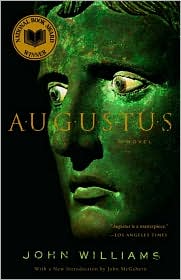
Augustus

My summer has been going pretty much the way every other season has been going for the last year, which is to say that, for the most part, if it can go wrong it will go wrong. That applies to things both petty (all the shoes I wear to work are falling apart) and more serious (my apartment is a disaster story and my cat is broken), but to top it all off, I'm in a total reading rut. To be fair, I've actually been having decent luck on the nonfiction front. It's just that my feelings about the fiction I've been reading lately have ranged from indifference, to irritation, to irrational loathing. I have to admit, I was even more than a little relieved to read that other people are also experiencing the reading doldrums this summer. But unfortunately, as is usually the case with the whole misery-loves-company thing, that hasn't made my own problem (or my desire to whine about it) go away. I thought I'd write then, about the last novel I completely enjoyed.

There's nothing particularly original about what John Williams does in Augustus. That's not a complaint. I'm just saying that the epistolary novel has been around for about as long as the novel itself, at least in Western literature, and to write about Augustus Caesar is to go down a well-travelled path. But that doesn't matter here.

Augustus covers, roughly speaking, three separate subjects in the life of Augustus Caesar: his rise to power, the exile of his daughter, and his death. John Williams tells the story through letters, diaries, and memoirs. In the first two sections of the novel, these are the works of Augustus' contemporaries. Only in the final section does Williams give voice to the emperor himself.

In his author's note Williams wrote,"if there are truths in this work, they are the truths of fiction rather than of history." Augustus isn't meant to be a biography, fictional or otherwise, and Williams isn't interested in presenting facts. He understands the limits of fiction and nonfiction and chooses not to tell us what happened or why but instead concerns himself with an exploration of power and duty and the sacrifices those twin gods demand. He illuminates the interior worlds that history cannot show us with a broad-minded empathy and in doing so tells us something about who we are--our loves, our needs, our friendships, the way we govern ourselves and the way we are governed--without asking the novel to carry a greater burden than it can bear.

There's something restorative about an author for whom writing is a means of communicating and not a chance to show off their talent for linguistic acrobatics. Williams style is modest and draws no attention to itself. His writing is clean and clear, neither spare nor overwrought but perfectly balanced. This quality seems most refined, appropriately enough, toward the end of the novel, when Williams gives us Caesar through his own eyes.

Letter: Octavius Caesar to Nicolaus of Damascus (A.D. 14)
August 9
Though it was nearly sixty years ago, I remember that afternoon on the training field when I got the news of my Uncle Julius's death. Maecenas was there, and Agrippa, and Salvidienus. One of my mother's servants brought me the message, and I remember that I cried out as if in pain after I read it.

But at that first moment, Nicolaus, I felt nothing; it was as if the cry of pain issued from another throat. Then a coldness came over me, and I walked away from my friends so that they could not see what I felt, and what I did not feel. And as I walked on that field alone, trying to rouse in myself the appropriate sense of grief and loss, I was suddenly elated, as one might be when riding a horse he feels the horse tense and bolt beneath him, knowing he has the skill to control the poor spirited beast who in an excess of energy wishes to test his master. When I returned to my friends, I knew that I had changed, that I was someone other than I had been; I knew my destiny, and I could not speak to them of it. And yet they were my friends.

At this point in the book, we have witnessed the scene where Augustus learns of Julius Caesar's death before. Williams has unfurled the story of the emperor's life already. Early on this particular moment was described by Salvidienus Rufus. He describes a cry, "grating and loud and filled with uncomprehending pain, like the bellow of a bullock whose throat has been cut at a sacrifice," and Octavius alone, "a slight, boyish figure walking on the deserted field, moving slowly, this way and that, as if trying to discover a way to go." But now, with Augustus at the end of his life, we reflect back with all the clarity of hindsight. It's an elegant conceit, and effective because it feels utterly natural. This moment, horrible and marvelous and world-changing, deserves to be revisited and enriched. In his old age, Williams's Augustus can see so clearly, he has become a kind of oracle who knows what will come of all he has built, the limit of his power, and accepts it. It's a beautiful thing in its way.

It's surprisingly hard for me to write about Augustus. Here I have this beautiful object in my hands, this work that is complete and whole, and I find that I don't want to pick at it too much. I've been working on this post for much longer than I'd like to admit (because something with this much time devoted to it ought to be less half-assed). So it goes.

Tuesday, August 25, 2009

How I Spent My Weekend . . .


Unfortunately, my camera is broken so this picture was taken with my phone. The tall mountain in the center is, I believe, Marcy (as viewed from Basin). I don't think I've ever been so happy to get out of the city.

Monday, August 17, 2009

Martha Wainwright and Morphoses

I always forget how much I dislike Central Park SummerStage in between visits. The view is bad enough to begin with but once you factor in the number of reserved seats shows like this one have, well, the hoi polloi just isn't going to be able to see that well. And the only time bleachers are remotely comfortable is when you have lots of space around you. Definitely not the case Friday night. Still, it seems churlish to complain about the seating you get at a free show and I am glad I went.

When I first heard about this particular performance I thought it was a fairly odd combination that wouldn't show either party at their finest. Part of the appeal of Wainwright's shows is their slightly ramshackle, undisciplined feel. They tend to be warm and down to earth. And the way she changes up her songs live is another of the delights. For the most part though I think those concerns were misplaced as the show was something of a mash-up of concert and dance performance, with each getting their moment in the sun.

The first half felt mostly like filler on the dance front. There was a nice little solo to "Far Away" and "Whither Must I Wander" was one of those pieces that features the woman being partnered all over the stage and not dancing much on her own to feet, while "Bleeding All Over You" brought us a dance with Teresa Reichlen and four men that showed off her long legs but wasn't particularly interesting choreographically. "Love is a Stranger" was upbeat and fun at least. Wainwright also, to my surprise, played a number of songs without dance accompaniment. I was glad that she replaced "Tower Song" (not one of my favorites of hers) with the more upbeat "When the Day is Short" with her mother Kate McGarrigle playing piano. It's always a family affair one way or another with the Wainwrights.

The second half of the program was more rewarding. It opened with Wheeldon's "Fool's Paradise," which despite its at times excessive partnering is more interesting and innovative than any of the too-brief dances of the first half. It really sort of felt like the dance portion of the program began there. Afterward Wainwright sang a few songs without dancers, including her delightfully over-the top rendition of "Stormy Weather."

And then we got the piece of the evening, the world premiere of "Tears of St. Lawrence," choreographed by Christopher Wheeldon and Edward Liang. Here I thought the musical collaboration worked much better than in the first half of the evening--where it wasn't so much a collaboration as the choreographers setting movement to songs Wainwright has been singing for some time--as the greater length gave Wheeldon and Liang time to develop ideas in their choreography and create an arc. At the same time though, I'm left with the same impression I get from so much of the Wheeldon choreography I've seen: It's perfectly pleasant to watch, I'm interested, and then 48 hours later it has evaporated from my memory. Or at least everything but the ending tableau has (both "Fool's Paradise" and "Tears of St. Lawrence" close with scenes that stick in the mind, though in different ways). While I'd be happy to see the ballet again, I'm more interested in hearing the music again. I couldn't focus on it or get an impression of it as a whole to the extent I might have liked and it seemed on first listen to be lovely and moving.

As a side note, Alistair Macaulay complains about the program notes in his review. He actually lets them off easy; the bios on the back were shoddily written as well. Even if the program creators are operating from the assumption that well-written program copy doesn't matter, you'd think they could bother with a spot of copyediting.

Sunday, August 16, 2009

Lazy Sunday


Not so much for me (I've been cleaning the apartment) but certainly for him.

Friday, August 14, 2009

I managed to come down with a nasty cold at the beginning of August and as soon as I started feeling fully functional my cat managed to hurt the feline equivalent of his wrist. Which sucks for numerous reasons, including the fact that I had to cancel a trip to the Adirondacks with my father to take care of his pathetic, barely-upright self. And as if that weren't enough to deal with, my mother has been in town. Which is fantastic, actually, because I love seeing my mother, but has also contributed to my feeling like I have a lot on my plate. On the bright side though, I'm more caught up at work than I've been in at least a year. Our summer interns? They are fabulous.

So while I haven't been doing much that's interesting to blog about here in the dog days of summer, I have been reading.

The -Ookies are counting down to hockey with fabulous pictures that make me wish that my camera wasn't broken. And that it was better. And that I could take such nice pictures. And that I had jars of chocolate chips.

The Millions tackled Malcolm Gladwell's (shabby) stab at literary criticism. The main problem, as I see it, is that Gladwell doesn't really seem to appreciate the difference between the kind of fun cultural criticism he normally does and writing about literature. He tackles the two things the same way and treats the characters as if they're real historical people, the novel as if it's artless. And his conclusion is particularly egregious: "A book that we thought instructed us about the world tells us, instead, about the limitations of Jim Crow liberalism in Maycomb, Alabama." Even if we accept the idea that To Kill a Mockingbird "instruct[s] us about the world" in a way that's different than the way that all great literature and art does so--a conclusion I'm not particularly inclined to agree with--we're still left with the fact that telling us about the limits of Jim Crow liberalism in a particular place in time is instructing us about the world. Not the way we're instructed by a history class though--the way we're instructed by a novel: through thoughtful reading and fierce attention.

I'm not fussed about Gia Kourlas saying bad things about the program Tulsa Ballet performed at the Joyce. I didn't see it so I'm not in the position to agree or disagree with her, but if she didn't like it she didn't like it and should say so. But I do wish she hadn't started her review with a somewhat condescending paragraph that begins by saying, "State government doesn’t normally shut down for ballet, but you wouldn’t have believed it judging by the dignitaries who spilled into the Joyce Theater on Monday night," and finishes up by claiming, "It was surreal—the whoops that erupted as the curtain was raised were a bit much—but it was also sweet to see such hometown pride." It just feels to me like she's looking down her nose at the Oklahomans. Of course small cities are proud of their cultural institutions. Of course they're going to come and support said institutions when they perform in a cultural capital like New York. It's a big fucking deal when it's something they only do once every few decades instead of all the time. I can't say I'm at all surprised that Oklahoma bigwigs came. And as for the whooping at the curtain raising . . . yeah, that doesn't surprise me either. People tend to be a bit more vocally enthusiastic outside New York. It doesn't mean they need to be portrayed like they just might be overexcited yokels.

I just read most of Love Begins in Winter. Then it became the first book in quite some time that I actively chose not to finish. Van Booy's writing is full of lovely lines and scenes, moments of genuine beauty, but they seem to come without real regard for the stories themselves. This one for example: "In the far distance, Sunday parked over the village like an old mute who hid his face in the hanging thick of clouds." I don't even know what that means. That it was quiet and foggy? That the author is trying rather too hard on the evocative imagery front? That he thought up that line and had to get it in there no matter what? Some combination?

My big issue though, is that there's so much that just doesn't feel true to me. The story that really killed me though is one that contains a scene wherein the protagonist and her boyfriend go on a trip to the Adirondacks. They hike nine miles “up into the white breath of the mountain” go off trail to a river with a large and flat enough rock for them to make love on, which isn’t soaked although it’s just been raining because “it’s amazing how quickly the sun dries the earth after it has been washed.” Now having spent some time in the Adirondacks I find it hard to believe that if it's just been raining you're going to be amazed at how quickly the sun dries things. Or that you'll feel like said rain has cleaned anything. Because you'll be hiking in mud. And if you've been hiking up for nine miles you are a) on a hell of a long day hike and b) probably not near any rivers large enough to contain a rock that sizable and flat. It doesn't seem real; it feels like Van Booy just wanted the scene. Particularly because while they've been busy having sex and taking a nap, their champagne glasses have rolled off into a rock pool where they stand upright. There, we are told, “Each glass held the weight of an entire river without knowing where it came from and how much was left.” Say what? That sounds nice and serious and all but it doesn't mean much of anything, which is pretty much how I felt about so much in this story collection.

Tuesday, July 28, 2009

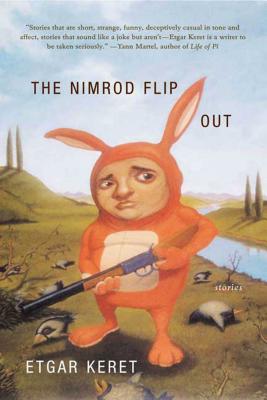
The Nimrod Flipout

We had a briefly impressive storm here in New York on Sunday night. I had to run around closing windows and by the time I got to the balcony door--I leave just the screen door shut pretty much all summer, rain or shine--there was a puddle on my kitchen floor. Yesterday morning there were big branches covering the sidewalk near my apartment. I don't think there've been any storms like that in the time I've lived in New York so it felt a little bit like being back in Buffalo.

I finally read a book that cured my case of the blahs. Unfortunately that's because I really didn't enjoy it. It's an awfully slim book--about 160 pages--and yet it includes thirty separate stories. And they all start to seem awfully similar pretty rapidly. The names are different, and the details of the story are different, but really, underneath the frippery, they're the same: anxiety-ridden, jittery, relentlessly modern. The characters are glib and disconnected, the storytelling truncated. And, with the exception of the sameness, there's not really anything wrong with those things. It's a sort of fiction that's not really to my taste, but I think it's good that someone's writing it and I think it engages with the present day in a different way than a lot of the fiction I like best.

At first I thought maybe it was the length, or lack there of, that was giving me a problem. That the stories didn't have a chance to develop properly. But the longer stories--and "longer" is relative here--get tedious quickly. Maybe it's the prose that throws me. It's not a prose style I'm particularly fond of and that probably contributes to my boredom. I'm reading this in translation and speak no Hebrew whatsoever so it's hard to know where exactly the problem lies for me. But nevertheless, the stories have a very distinctive (and consistent) tone.

One story, "Glittery Eyes," starts:
This is the story of a little girl who loved glittery things more than anything else in the whole world. She had a glittery dress, and glittery socks, and glittery ballet slippers. And a glittery black doll named Christy after their maid. Even her teeth glittered, though her father insisted that they sparkled, which wasn't quite the same.
In the story the little girl wants glittery eyes to go with her glittery dress, and her glittery teeth, etc. But she can't have them. Another story, "A Thought in the Shape of a Story" features a similar theme, and that one begins like so:
This is a story about people who once lived on the moon. Nowadays, there's no one up there, but up until just a few years ago, the place was mobbed. The people on the moon thought they were very special, because they could think their thoughts in any shape they wanted. In the shape of a pot, or a table, or even in the shape of flared pants. [. . .] It was all very impressive, all those shaped thoughts, except that as time passed, all the people on the moon came to a kind of agreement about how every thought should look.
There's a man on the moon and he wants to think his thoughts into different shapes. But he doesn't get what he wants. Both stories are about three pages long. They're not next to each other in the book, and are separated by a good number of stories, but they're close enough that you can easily read them in one sitting and they're not the only two such stories in the book anyway. Individually, I don't dislike the stories. In fact I find the ending of the one about the people on the moon oddly, beautifully sad. they're not really as interesting in combination as they are on their own merits.

I think that's what was particularly frustrating about this book for me. Keret has something to say and the skills to say it. But actually sitting down and reading my way through The Nimrod Flipout made me want to toss it out the window. Perhaps it's a book I would have been better off dipping in and out of rather than reading straight through . . .

Friday, July 17, 2009

Mary Stuart

Sunday was my monthly dinner-and-a-show outing with my grandmother--although this time around we daringly mixed things up and made it lunch and a show. We ate at a Greek restaurant on 42nd that had delicious food. More specifically, good baklava (just so my priorities are clear here).

The acting in Mary Stuart was of that stylish, stylized British variety where the audience gets to sit and watch the actors declaim--beautifully, of course--from the stage. It's a sort of acting that I sometimes like and often dislike, but it works quite well when the focal point of the play is a conflict between two of western history's most famous queens. And it's elegantly written and crafted and feels like it should be so much more powerful than it actually is.

Mary Stuart is about any number of things--power, appearances, penance--but one thing it's not about is history. Which isn't a bad thing or a good thing, per se, but I often feel wary of work that seems intent on using history to speak to the present day. And the modern ambitions of Mary Stuart--or at least this production--seem evident in everything from the set (stark, black brick, wooden benches) to the costumes (the men are dressed in the suits of today, although the women are in Elizabethan-style dresses). Yet for all that the show attempts to drag these characters into the present day, the production isn't doing anything innovative or daring and perhaps as a result it feels stranded between the two eras.

In the end though, I'm not sure if my inability to feel anything more than a kind of detached admiration is based entirely on the play itself of if the book reading ennui I wrote about earlier is in fact a more generalized entertainment ennui. That would be too bad.


Thursday, July 09, 2009

A Woman in Jerusalem

I love my family, but oh do they make me long for quiet (well, the loud side of my family anyway, which is the side I mostly spent this latest holiday with). I got home and it was totally quiet and such a relief. Of course my apartment is a train wreck and my cat is essentially dying of a nice heart disease/kidney failure combo (although hopefully he's dying very slowly--keep your fingers crossed, folks) so you can't have it all.

Between the bus rides to and from Virginia though, and some stolen moments during my stay there, I was able to finish A Woman in Jerusalem by A. B. Yehoshua. It's not that I didn't like it, but I had the same problem with it that I've had with most of the books I've read so far this year: I enjoyed it, but I could put it down; it had as its subject an interesting topic, but it never seemed to go as far as it needed to; I wanted to like it but was, in the end, was left with vague feelings of dissatisfaction.

Jerusalem explores issues of societal responsibility, the kinds of love--most particularly those sudden and inexplicable bursts of fellow feeling, sympathy, and affection that can take us unawares--that tend to get short shrift both in literature and in life, and guilt. By identifying the characters by occupation or position in life--the human resource manager, the emissary, the ex-wife, the consul, etc.--Yehoshua seems to be making a sort of gesture toward universality as well as situating his characters within a larger society. It's not an uninteresting set of preoccupations for a book. The problem is that it's so damn tasteful (even the jacket cover is polite). I feel like it's a book that needs a bit of dirt under its fingernails.

Still, I'm beginning to wonder if the problem is really the books or if it's me. Am I too distracted or preoccupied to appreciate what I'm reading? Have I become a lazy reader who wants to be hand fed? Am I just doing a shitty job of choosing books that will speak to me? Whatever it is, I hope my reading luck turns around soon because I could really use some time with a great book just now.

Thursday, July 02, 2009

Twelfth Night

Prior to last weekend, I'd never been to Shakespeare in the Park in New York City. I went to the one in Buffalo regularly growing up, but that's pretty different. They use the same set every year, the acting is not particularly good, and you certainly don't have to line up. You just show up kind of early with your lawn chair or blanket and some food and sit on this little slope. At intermission the actors come around collecting donations and while I don't know if it's still there, there used to be an ice cream place nearby in the park and we always made an intermission ice cream run. It's fun and summery and totally laid back.

Getting in line at central park at 6:10 in the morning--and being well back from the front of said line--is pretty much the opposite of laid back. And that's not even taking into account the fact that they have a security guy policing the line and explaining the rules. Which isn't to say that it was a drag or anything. We were right across from a big open space, which was nice.

Right across from our spot in line.

Early in the day the park is full of big dogs running around off leash, and my friend and I had fun watching them play. And there are worse ways to spend a beautiful Sunday then hanging out in Central Park snacking, reading, and playing games. Actually, I can't think of many better ways to spend a Sunday in late June.
Bananagrams

We collected our tickets--our seats were near the back but not too far from the center--and walked over to the farmers market behind the Museum of Natural History to buy lunch. A lunch which included some fantastic strawberries. Then right back to the park where we hung out until my friend's parents met us for dinner and the show.

I'd had a nice day anyway, but the fact that this production of Twelfth Night is as good as it is made it pretty perfect. It was funny and full of music and acted with great humor and clarity. I liked the entire cast. Also, this production, which is rather traditional, does a particularly nice job of balancing the comedy with the more serious aspects of the love and loss in the story. And to be honest, I tend to prefer my Shakespeare traditional, particularly when it's being performed in this kind of setting where people just want to enjoy the show after spending a day in line and out in the sun.

I was surprised at how much I enjoyed the whole day, although it can't hurt that it was such a pleasure just to have a beautiful day after the weather that plagued us for pretty much the entire spring. It's something I'll look forward to doing again (next year).

Monday, June 29, 2009

Lewis Forever

The most recent Performance Club outing was to see Lewis Forever at the New Museum. While I'm not sure it really went anywhere it was a fun show to attend. We got to color and put together our own stick puppets, drink, throw things . . . I do like it when performers bring that sense of play into their work. And the audience participation was nice, although somewhat undermined by the fact that our actions didn't really seem to have a reason behind them--or at least not a reason that became clear to me. The performance itself lacked cohesion. Some parts weren't terribly engrossing, perhaps because it seemed unclear how they fit into the whole, others were fun (a bit related to Back to the Future, for example), and even oddly lovely. On the balance though I had such a good time though and you really can't complain about that.

Friday, June 26, 2009

The NHL Draft

So here we are, on a Friday in late June, and I'll be watching the first round of the NHL draft tonight. And the thing about that is that the NHL draft makes for truly tedious television. Last year I paid a little bit of attention beforehand since I was going to be at the draft and all, but this year I haven't bothered. My draft prep has pretty much amounted to reading the Interchangeable Parts ladies' Not On the Road with IPB series. Still, there's a lot you can predict without knowing more than 10 names:
  • About 30 18-year-olds, all excited, most awkward will get up on stage and put on a sweater and a cap to pose for pictures.
  • Gary Bettman will be booed. Loudly.
  • Pierre Maguire will make people all over North America uncomfortable. And he will do so with enthusiasm.
  • When Darcy Regier gets on stage Sabres fans will be crossing their figures and toes, hoping that he drafts someone who could not be described as small, or short, or as another member of the fucking midget brigade.
  • I'll spend most of the show wondering what possessed me to spend my Friday night watching this crap.
This prediction gig is easy. You just have to set the bar low.

Tuesday, June 23, 2009

The Woman in the Dunes

My office has summer Fridays, which means I get out at 1:00 every Friday between Memorial Day and Labor Day. And every Friday this year I've made plans about the things I'm going to do with my free time: I'm going to go see the High Line, I'm going to wash my windows, I'm going to find a father's day gift . . . but every Friday I've gone home and taken a long nap. This week I'm blaming The Woman in the Dunes for that. Seriously, even the cover makes me feel like sleeping.

The story here is that an amateur entomologist spends the day at a beach looking for some kind of beetle, only to have the residents of a nearby village entrap him in a pit. There he is to help a woman shovel away the ever-encroaching sand that threatens to destroy her home. He plots various ways to escape--sometimes rather hysterically--only to pass up an opportunity at the end of the book. This is no surprise to the reader, not only because he seems like a fairly incompetent person but also because we were told at the beginning of the book that he was declared dead after being missing for seven years.

For me, the book was mostly a reminder of just how much I dislike novels where symbolism and allegory take precedence over character (and how little I enjoy existentialism in novels). Here we are, the people in the sand pit, endlessly shoveling away a la Sisyphus. Oh, the meaningless of life. The way the daily grind wears down any desire we have for freedom or joy. Blah fucking blah.

I'm being dismissive though, of a novel that doesn't deserve such treatment. It's not a bad book, just not to my taste. Abe is an evocative and stylish writer and the plot is neatly constructed and spare. The sand, pervasive, unrelenting, corrosive, becomes a character. After his first night in the sand pit that is to be his home, our protagonist wakes coated by sand:
Quickly he jumped up. The sand that had accumulated on his face, head, and chest fell away with a rustling sound. Around his nose and lips sand was encrusted, hardened by perspiration. He scraped it off with the back of his hand and cautiously blinked his eyes. Tears welled up uncontrollably under his gritty, feverish eyelids. But the tears alone were not enough to wash away the sand that had become lodged in the moist corners of his eyes.
[. . .]
The whole surface of [the woman's] body was covered with a coat of fine sand, which hid the details and brought out the feminine lines; she seemed a statue gilded with sand. Suddenly a viscid saliva rose from under his tongue. But he could not possibly swallow it. Were he to swallow the sand that had lodged between his lips and teeth would spread through his mouth. He turned toward the earthen floor and spat. Yet no matter how much he ejected he could not get rid of the gritty taste. No matter how he emptied his mouth the sand was still there. More sand seemed to issue constantly from between his teeth.
The combination of the unpleasant nature of the sand and its inescapability is unpleasantly vivid. After all, most things become nearly unbearable when constantly present but anyone who has ever been to the beach knows how badly you want to wash the sand off after leaving. Reading the book I felt itchy and grit-covered myself. And any desire to go to the beach in the near future? Gone. (Convenient given the shit weather we've been having here in New York of late.) For me though, the quality of the writing wasn't enough to make up for the fact that I just didn't care about the characters or what happened to them.


Saturday, June 20, 2009

Two Ballets

La Sylphide had been on my (unwritten, highly informal) list of ballets I most wanted to see for awhile now. Alexandra Tomalonis wrote about it extensively in her biography of Henning Kronstam and I've wanted to watch it ever since because I have a weakness for magical creatures and Scottish reels and all that sort of thing.

At its heart it's the story of a man who falls in love with a being that is not quite of this world, and of the tragedy that ensues when he follows her instead of staying home where he belongs. In fairy tales--and La Sylphide, which comes complete with a witch stirring a cauldron and mimed triumphal laughter, feels more like a fairy tale than most such ballets--it's never a good idea to go chasing supernatural beings into the forest.

Herman Cornejo is a dancer I've often felt like I admire more than enjoy. It's utterly unfair of me, but I often find myself distracted from just how good he is by just how small he is.  In this case I wasn't bothered by that, and his dancing was fantastic--as it always is, as far as I can tell--but I didn't believe the character. In her book, Tomalonis quote Kronstam talking about the role of James:
James can be a man who is so infatuated with the Sylph that he abandons everything to follow her. Or he can be a Romantic soul who is looking for the beauty of life and he sees that more in the Sylphide than in a household. Or he can be very impulsive [. . .] James has his doubts, and he has his fears of what he is going to do, but he cannot help himself. Or, if you do it differently, its that he wants to get away. It's not that he is unhappy; it's because he wants to get out. 
What's clear is that there's any number of variations when it comes to the characterization of James. But in all those variations his character is such that the events of the ballet become inevitable. This is who he is and so this is how it ends. The problem is, in Cornejo's interpretation the character of James isn't fully embodied; he's merely a sketch and you never quite know who he is. And that lack of clarity undermines the story as a whole.

Natalia Osipova was more convincing as the sylph. She's a less complex character--a creature really.  And because she's a magical being associated with weightlessness and flight, Osipova's particular talents serve her well. She jumps so high: One second she's on the ground and the next second there she is, hanging in the air, without having seemed to put any effort into getting there. And then she comes down quietly and feather light. It's as though being in the air is the easiest, most natural thing in the world for her. 

So there's a lot to enjoy. In the end though, for all the wonderful dancing--there were also lovely performances from Gemma Bond as James's fiancee, jilted at the altar, and Jared Matthews as Gurn, who loves her (and seems rather more deserving of her love than James--the ballet didn't entirely hold together as theater on Wednesday night. 

The evening had opened with Paul Taylor's Airs which I enjoyed in the sort of abstracted way that I've enjoyed the few other Taylor dances I've seen. His dances have such a sense of fun and play, which I love because being able to depict such things without seeming saccharine is a particular strength of dance as an art form. It also seemed to be a good pairing with La Sylphide in terms of tone. I do prefer the weightier quality his own dancers give his choreography though.

Thursday, June 18, 2009

Weird Bugs

I went backpacking in New York and Connecticut last week with my sister, who is currently hiking the Appalachian Trail. I'll write more about it later, but in the meantime, here's a video of some weird bugs (which google tells me are wood wasps). Now if only my point and shoot camera took better videos while zoomed in I'm sure the Discovery Channel would be calling any day now. After all we clearly have the gravitas and calm typical of nature documentarians.


Sunday, June 14, 2009

Things That Make a Girl Peevish...

My apartment building has been having water problems pretty much all year and I can deal with that. I can even deal with the brown water and sediment spitting out of the pipes. I felt a little like the Laura Ingalls Wilder of the East Village last weekend when my water was out all day and I was heating water in the kettle in order to bathe and I wasn't totally aggravated although I wouldn't say I was thrilled. But when I got home from vacation today to find my toilet not working, I was not at all happy. I just spent time backpacking, people . . . all I want this afternoon is a toilet that actually flushes without my dumping 5 gallons of water into the tank. 

Tuesday, June 02, 2009

On the Dnieper, etc.

I was at BEA Saturday and am very grateful that my job doesn't actually require me to spend time there, because I find it pretty overwhelming. Also, someone tried to hard-sell me these weird insoles for my shoes. What's with that? Are people at BEA really all about the gel-filled insoles? Somehow I doubt it. Then on Sunday I got all hardcore with my backpacking training and walked about 8 miles. Shock of shocks, I gave myself blisters. So by the time I found myself at the Metropolitan Opera house on Monday night I was very ready to spend an evening off my feet in a darkened theater.

The real draw of the evening was the premier of Alexei Ratmansky's first ballet for ABT, On the Dnieper, which was also the last ballet. I so enjoyed this ballet and, while it wasn't perfect, thought it was very good. The plot is neither awful nor inspiring: A soldier (Marcelo Gomes) returns home from World War I and finds that he no longer loves his fiancee (Veronika Part), but instead wants another girl (Paloma Herrera) who is herself engaged to someone else (David Hallberg). Tragic and not terribly subtle, it's exactly the sort of material from which you expect ballets to be made. But what Ratmansky does with it is often fantastic.

Apollinaire Scherr has a review up on her blog, and I basically agree with her criticisms--the score was too short for the female characters and situations to be fully developed. At times the plot itself seems to rush forward, which goes hand with the previous. "Wait," I wanted to say, "how can they be in love already? They should fall in love longer. This tension should build more." 

But the score is what it is, and the work has so much to recommend it that I can easily overlook those flaws. Both major male characters are fully developed and both have wonderful solos. Alice Munro writes short stories in which she creates an entire world and characters that feel so real you think they must exist, just as they are in the story, somewhere in the world, in just a few pages. They're small miracles of writing; it seems like it should be impossible to get things so exactly right, and yet there the story is in front of you. The solo for Gomes that opens the ballet, and the solo for Hallberg in the second part of the ballet are like that. These characters are real individuals and watching them dance you feel that you understand them; you know who they are. And the community of which they are a part feels genuine in the same way. Ratmansky's characters don't exist in a void: they're interconnected parts of a community.

The great gift of the ballet though is the fact that unlike so many things that ABT dances, particularly the new ballets that are made for them, in On the Dnieper Ratmansky gives the dancers choreography that genuinely utilizes their prodigious abilities. Gomes and Hallberg, who are so frequently fantastic, were as wonderful in this as I've ever seen them (Gomes throughout, Hallberg in that great solo). Ratmansky told Robert Hilferty of Bloomberg that Gomes was, "very inspiring," and it's not hard to understand why. And although their characters were less clearly sketched Herrera was lovely and Part does despair as beautifully as anyone. 

I also thought that, though the lighting could stand to be brighter, the sets were beautiful. I like the cherry trees and loved the fences that were moved around to redefine the space. 

In addition to Apollinaire Scherr's review, Alastair Macaulay reviewed it for the New York Times, Tonya Plank has a post up, and Robert Johnson reviewed it for the Newark Star-Ledger (and hated it to a degree I find utterly baffling, but he also thinks that Ratmansky isn't a "genuine choreographic talent" so we're clearly on very different wavelengths).

And one more note before I move on: I don't know who writes the synopses for ABT's program, but "the villagers enjoy lively dancing and boisterous cheer"? Really? I have every confidence that it's possible to do better.

The evening had started with Balanchine's Prodigal Son, which I was excited to see but found that I didn't love. In retrospect it's not so surprising. When it comes to art movements, I've really never liked Primitivism and I can't say Constructivism drives me wild either and there's an abundance of both in the ballet. And then there was the fact that I forgot my opera glasses and we were sitting so far away (Family Circle). Being closer and able to see more detail would surely have helped, particularly for a ballet like this. 

Michelle Wiles--who I really wish I enjoyed more than I do--just didn't work for me in this role. She's certainly commanding. Particularly so when towering over Herman Cornejo (the size difference there is something else). But I felt like she should also seem alluring and predatory and that really didn't come across. The connection between Wiles and Cornejo seemed awkward but I imagine that will get better in subsequent performances. Cornejo was dancing in place of an injured Ethan Stiefel, and I expect that he and Wiles will polish their performance as the week goes on.

One thing that did help me to appreciate the ballet more than I otherwise would have, was Nancy Goldner's essay on Prodigal in her Balanchine Variations. She writes:
The desire to bring industry and art, the functional and the decorative, under one tent extended to making an amalgam of beautiful and ugly movement, and high and low art--that is, dance and circus.
Thinking about the pas de deux between the Siren and the Son as a circus-like performance, and the drinking companions as grotesques helps me to understand this decidedly unclassical ballet.

About the second ballet of the evening I really have very little to say. Desir was one of those ballets where you can see why it was made but it's awfully hard to figure out why it's being revived or picked up by other companies than the one it was made for. The costumes are pretty, the music is pretty, a good bit of the dancing is pretty (and also pretty repetitive). And that's just about all there is to it. It's theoretically about relationships and desire, but it doesn't feel particularly human or individual. Ultimately it was kind of inoffensively boring. 

The photo for On the Dnieper was stolen from this Wall Street Journal article and the the photo from Prodigal Son from the New York Times review.

Friday, May 29, 2009

Blather and a Poem

This backpacking training is exhausting, folks . . . I did so many flights of stairs yesterday and I've been running which is something I  haven't done since high school gym class. Between the exercise and my allergies (or rather the Benadryl I took for my allergies) and worrying about Pyramus' latest health issues (a urinary tract infection [probably], a worsening heart problem, and unexplained weight loss), I am one tired person. I'm also well on my way to being one broke person seeing as my cat is pretty much a pharmacy with fur. 

Which is all to say that I'm feeling a bit worn out. So in lieu of a coherent post please take this poem by Louise Glück:

Parable of the Hostages

The Greeks are sitting on the beach
wondering what to do when the war ends. No one
wants to go home, back
to that bony island; everyone wants a little more
of what there is in Troy, more
life on the edge, that sense of every day as being
packed with surprises. But how to explain this
to the ones at home to whom
fighting a war is a plausible
excuse for absence, whereas
exploring one’s capacity for diversion
is not. Well, this can be faced
later; these
are men of action, ready to leave
insight to the women and children.
Thinking things over in the hot sun, pleased
by a new strength in their forearms, which seem
more golden than they did at home, some
begin to miss their families a little,
to miss their wives, to want to see
if the war has aged them. And a few grow
slightly uneasy: what if war
is just a male version of dressing up,
a game devised to avoid
profound spiritual questions? Ah,
but it wasn’t only the war. The world had begun
calling them, an opera beginning with the war’s
loud chords and ending with the floating aria of the sirens.
There on the beach, discussing the various
timetables for getting home, no one believed
it could take ten years to get back to Ithaca;
no one foresaw that decade of insoluble dilemmas—oh unanswerable
affliction of the human heart: how to divide
the world’s beauty into acceptable
and unacceptable loves! On the shores of Troy,
how could the Greeks know
they were hostages already: who once
delays the journey is
already enthralled; how could they know
that of their small number
some would be held forever by the dreams of pleasure,
some by sleep, some by music?

Wednesday, May 27, 2009

Balanchine-Tchaikovsky Spectacular

I meant to write about this last week but I was wrapped up in packing for a camping/hiking trip and then I was actually on the trip and time just got away from me. Of course now I'm trying to get in shape for four days of backpacking with my sister the hiking machine next month. I actually went for a run today, which I can tell you is nowhere near a regular occurrence. But anyway, on to talking about people who are far more fit than I'll ever be . . .

This seemed to me like a program put together with marketing in mind as opposed to audience enjoyment. Which isn't to say that each of the ballets isn't a pleasure in and of themselves, but that there was a certain sameness to them and I was longing for a bit more variety. There were two ballets I'd seen before ("Tchaikovsky Pas de Deux" and "Theme and Variations") and two I hadn't ("Allegro Brillante" and "Mozartiana") and perhaps my preference for the two I'd seen previously had something to do with a greater level of familiarity. But I think it also had to do with the performances. 

I normally like Gillian Murphy a great deal but in "Allegro Brillante" she and Ethan Stiefel left me a bit cold. It's so fast and the architecture of the dance is interesting, but it didn't seem like much fun somehow. There they were, doing the steps with their usual proficiency and looking a little bit like they were ticking off boxes on a form. It was refreshing then, to see Paloma Herrera and Marcelo Gomes look like they were genuinely enjoying themselves. They brought a spontaneity and sense of fun to "Tchaikovsky Pas de Deux" that fit well with its flash and showoff-y quality. Also the first time I saw this ballet I whined about the costume for the man, so I guess I should say that I dislike ABT's costume far less. (Granted, they make up for  that with "Theme and Variations," but more on that later.)

I'm conflicted about "Mozartiana" though. I think Veronika Part is an absolutely gorgeous dancer: She has beautiful lines and is so musical. And it's nice to see such a womanly looking ballerina. But I think I need to see the ballet again because the first time around it didn't make much of an impression but at the same time I think it's a ballet I could work my way into as a viewer. 

My favorite ballet of the night though, was "Theme and Variations." I'd never particularly enjoyed Michelle Wiles's dancing, so I'm very glad that I did this time around (although I do feel like she'd benefit from dancing with someone who doesn't look like he could be her twin--a little contrast would be nice). And David Hallberg was wonderful, but that won't be news to anyone who has seen him dance. This looked so much nicer and more expansive and impressive on the big Met stage than it did at City Center.

What I don't understand though is why the ballet world feels the need to dress men up so they look like like, for example, a watermelon that's been attacked by a bedazzler. As in the pictures below.
David Hallberg, etc. from this New York Times slideshow
Daniil Simkin and Sarah Lane from this New York Times slideshow

Now, I'm not saying there's something wrong with a man being dressed up in a tacky, glittery outfit per se. But when the role is that of a noble cavalier I don't think it particularly works; at the very least it isn't in keeping with modern sensibilities. And as such it only serves to emphasize the museum piece quality that so much ballet has. Isn't this a problem? Is it really so hard to manage costumes that aren't silly?

Oh well. The next ABT performance I'm going to is the All-Prokofiev evening, which I'm very much looking forward to. 

Thursday, May 21, 2009

3 Dancers, 4 Chairs, 26 Words

I attended this on Saturday with performance club and very much enjoyed it. It felt like such a fragile thing . . . so contained and particular and carefully crafted. The performance club post and discussion is here. 

Tuesday, May 19, 2009

Desire Under the Elms

My grandmother and I went to our monthly dinner and a show on Thursday. We ate at the sort-of expensive restaurant we sometimes go to when my grandmother can get double air miles by eating there. The food is good enough, but I'm really in it for the apple crisp with cinnamon ice cream. Priorities, right? I mean, that was totally the highlight of the night. And while, admittedly, food is often a highlight for me, the problem here was that I really didn't like the play.

Anyway, it's not that I didn't know that Desire Under the Elms is a depressing play. I knew that. But it's so goddamn stagey. The dialogue, the plot, the way the actors--Carla Gugino excepted--speak . . . it all rings so false and strips the play of whatever power it might have. And the staging and set seem calculated to make the play feel less dated, but it doesn't really work. Mostly the set looks expensive and attention grabbing. Granted, it helps create a feeling of claustrophobia and heaviness, but I'm not sure it's necessary to have a giant house hovering above the stage to create that feeling. I don't know, the play as a whole wound up feeling kind of bland and tiring to me. Tedious, even.

It was one of those nights where you sit in the theater thinking what am I doing here and why are they reviving this instead of doing something new. And that's never a good feeling. Sure, Gugino is fantastic. But I would have preferred to see her be fantastic in something else.